Hey, I've recently designed a Poster about the FHS since I often forget where I should place or find things. Do you have any feedback how to make it better?
Edit: Put up new version
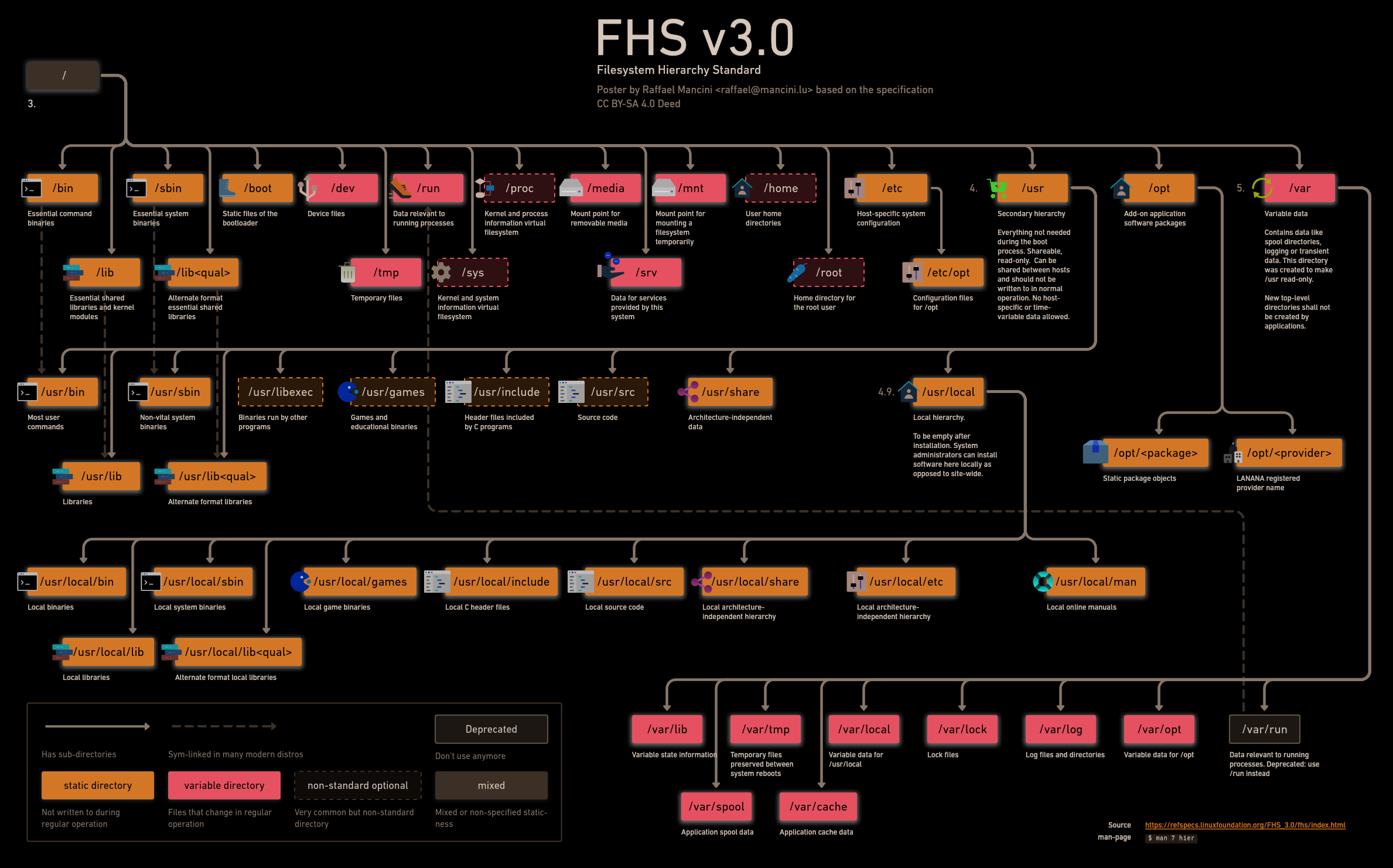
Dark mode

A place to share alternatives to popular online services that can be self-hosted without giving up privacy or locking you into a service you don't control.
Rules:
Be civil.
No spam.
Posts are to be related to self-hosting.
Don't duplicate the full text of your blog or readme if you're providing a link.
Submission headline should match the article title.
No trolling.
Promotion posts require active participation, with an account that is at least 30 days old. F/LOSS without a paywall has exceptions, with requirements. See the rules link for details. Tags [CBH] or [AIP] are required, see the links in Rule 8 for details.
AI-related discussions and AI-involved promotional posts have additional requirements for tagging, as noted in Rule 7 and the AI & Promotional Post Expanded Rules post, and find example disclosures here.
Resources:
Any issues on the community? Report it using the report flag.
Questions? DM the mods!
Hey, I've recently designed a Poster about the FHS since I often forget where I should place or find things. Do you have any feedback how to make it better?
Edit: Put up new version
Dark mode
This is really helpful, thank you!
I never understood why the shareable /usr is parent to the non shareable /usr/local. Wouldn't a /usr/shared be way easier especially in the early network days?
If anyone has a link or some insights into this historical nitbit I'd highly appreciate it!
No comment on sensibility, but technically both are equally difficult - mount the parent filesystem, then mount the child filesystem into an empty directory in the parent. Doesn't matter which one is where, it's all abstracted away at this level anyway.
But when I mount a shared /usr on a remote machine it will always have the mount point /usr/local as empty folder - and either have an empty folder or have a mount target that is dependent on a network resource - that's why for me it's so unintuitive.
But then again I started with network stuff way more than a decade after all this got created 🤣
~~I think the idea at the time was that if /usr is unavailable, you won't be doing much with the system anyway (other than fixing the configuration).~~
Nevermind, apparently the original meaning had nothing to do with a network (TIL for me), so our discussion is kinda moot. See section 0.24 in this 2.9BSD (1983) installation guide
Ohhh now that is awesome and makes sense! Thanks a lot for that find :)