this post was submitted on 05 Jun 2024
12 points (92.9% liked)

Selfhosted

60967 readers
964 users here now

A place to share alternatives to popular online services that can be self-hosted without giving up privacy or locking you into a service you don't control.

Rules:

Detailed Rules Post

  1. Be civil.

  2. No spam.

  3. Posts are to be related to self-hosting.

  4. Don't duplicate the full text of your blog or readme if you're providing a link.

  5. Submission headline should match the article title.

  6. No trolling.

  7. Promotion posts require active participation, with an account that is at least 30 days old. F/LOSS without a paywall has exceptions, with requirements. See the rules link for details. Tags [CBH] or [AIP] are required, see the links in Rule 8 for details.

  8. AI-related discussions and AI-involved promotional posts have additional requirements for tagging, as noted in Rule 7 and the AI & Promotional Post Expanded Rules post, and find example disclosures here.

Resources:

Any issues on the community? Report it using the report flag.

Questions? DM the mods!

founded 3 years ago
MODERATORS
 

I'm planning on building a new home server and was thinking about the possibility to use disc spanning to create matching disk sizes for a RAID array. I have 2x2TB drives and 4x4TB drives.

Comparison with RAID 5

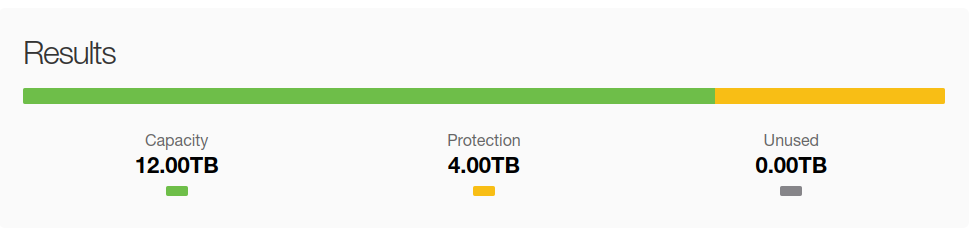
4 x 4 TB drives

  • 1 RAID array
  • 12 TB total

4 x 4 TB drives & 2 x 2 TB drives

  • 2 RAID arrays
  • 14 TB total

5 x 4* TB drives

  • Several 4TB disks and 2 smaller disks spanned to produce a 4 TB block device
  • 16 TB total

I'm not actually planning on actually doing this because this setup will probably have all kinds of problems, however I do wonder, what would those problems be?

you are viewing a single comment's thread
view the rest of the comments
[–] lemmyvore@feddit.nl 3 points 2 years ago

Typical problems with parity arrays are:

  • They suffer from something called "write hole". If power fails while information is being written to the array, different drives can end up with conflicting versions of the information and no way to reconcile it. The software solution is to use ZFS, but ZFS has a pretty steep learning curve and is not easy to manage. The hardware solution is to make sure power to the array never fails, by using either an UPS to the machine or connecting the drives through a PCI card with a battery, which allows them to always finish write operations even without power.
  • Making up a 4 TB out of 2x2 TB is not a good idea, you're basically doubling the failure probability of that particular "4 TB" drive.
  • Parity arrays usually require drives to be all the same size. Meaning that if you want to upgrade your array you need to buy as many drives before you can take advantage of the increased space. There are parity schemes like Unraid that work around this by using only one large parity drive that computes parities across all the others regardless of their sizes; but Unraid is proprietary and requires a paid subscription.
  • If a drive fails, rebuilding the array after replacing that drive requires an intensive pass through all the surviving members of the array. This can greatly increase the risk of another drive failing. A RAID5 array would be lost if that occured. That's why people usually recommend RAID6, but RAID6 only makes sense with 5+ drives.

Unrelated to parity:

  • Using a lot of small drives is very power-intensive and inefficient.
  • Whenever designing arrays you have to consider what you'll do in case of drive failure. Do you have a replacement on hand? Will you go out and buy another drive? How long will it take for it to reach you?
  • What about backups?
  • How much of your data is really essential and should be preserved at all costs?