this post was submitted on 02 Aug 2024
801 points (96.6% liked)
Selfhosted
60409 readers
519 users here now
A place to share alternatives to popular online services that can be self-hosted without giving up privacy or locking you into a service you don't control.
Rules:
-
Be civil.
-
No spam.
-
Posts are to be related to self-hosting.
-
Don't duplicate the full text of your blog or readme if you're providing a link.
-
Submission headline should match the article title.
-
No trolling.
-
Promotion posts require active participation, with an account that is at least 30 days old. F/LOSS without a paywall has exceptions, with requirements. See the rules link for details.
Resources:
- selfh.st Newsletter and index of selfhosted software and apps
- awesome-selfhosted software
- awesome-sysadmin resources
- Self-Hosted Podcast from Jupiter Broadcasting
Any issues on the community? Report it using the report flag.
Questions? DM the mods!
founded 3 years ago
MODERATORS
you are viewing a single comment's thread
view the rest of the comments
view the rest of the comments
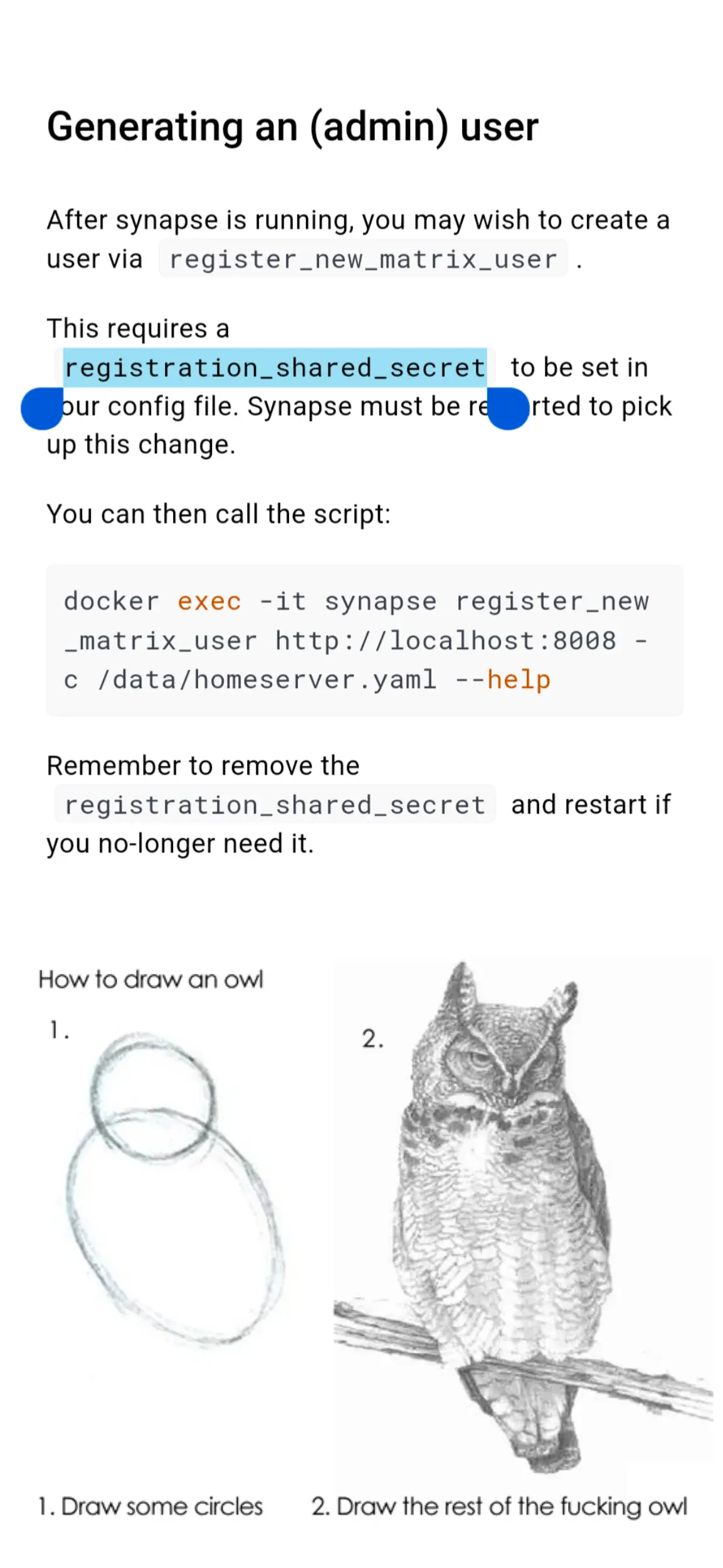
You have to assume some level of end user knowledge, otherwise every piece of documentation would start with "What a computer does" and "How to turn your computer on."
I've found the best practice is to list your assumptions at the top of the article with links to more detailed instructions.
I do agree, manies have I found documentation saying "make a fresh install of Raspbian" as if I'm using the computer for this single issue
(Disclaimer: I am not running matrix on a Raspberry Pi)
Another case is listing a huge number of steps to do some task, without acting describing what the end goal for each set of instructions is (common in "how to" guides, and especially ones that involve a GUI).
This means that less technical users don't really understand what is going on and are just following steps in a rote way, and it wastes the time of technical users since they probably know how to achieve each goal already.