
Pepperidge Farms must've met my dad a few years back.
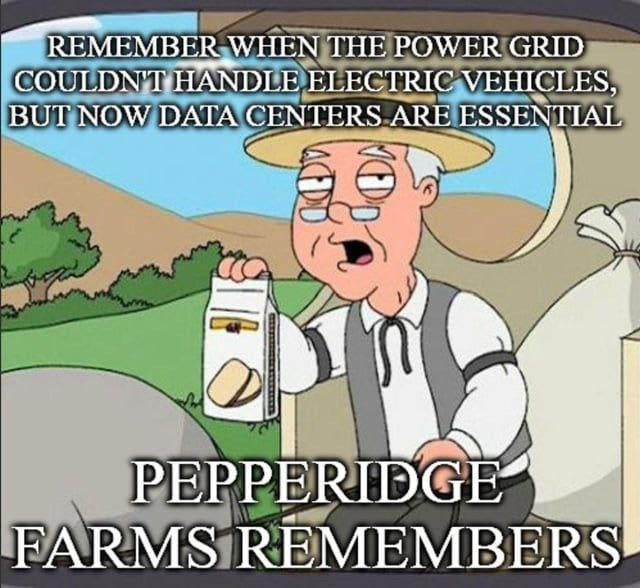
Post memes here.
A meme is an idea, behavior, or style that spreads by means of imitation from person to person within a culture and often carries symbolic meaning representing a particular phenomenon or theme.
An Internet meme or meme, is a cultural item that is spread via the Internet, often through social media platforms. The name is by the concept of memes proposed by Richard Dawkins in 1972. Internet memes can take various forms, such as images, videos, GIFs, and various other viral sensations.
Laittakaa meemejä tänne.
Pepperidge Farms must've met my dad a few years back.
For what it's worth many data centers include their own power generation. Would be a boon for modular nuclear reactors if they were ready and if the us wasn't so shy about nuclear. I wonder if other countries are having this issue? Like is there a big pushback to data centers in china, India, UAE, or Singapore? If not then what's the difference and how are they managing data center development?
Yea, they are reopening shut down gas and coal plants, so it’s even fucking worse
Man modular nuclear would be so good right now, in some cases we could even drop them into decommissioned gas and coal plants aka use the heat exchanger and turbines. Within reason it would be nice to see them fast tracked for this.
Kevin's data center is going to run on natural gas generators in a valley which already suffers from horrible inversions every year. The Wasatch front valley has some of the worst air quality in the world during the winter.
Nuclear is too expensive for the capitalists building these. They'd rather pollute than pay more money for nuclear.
In this case I'm referring to the Wonder Valley AI data centre campus just to be clear since I wasn't in OP, it's proposed for northwestern Alberta, Canada. Near Grande Prairie. He's got multiple on the go.
Ohhh, I forgot that he had multiple.. what a scumbag.
Not arguing but just curious. I didn't think natural gas plants heavily affected air quality. I'm aware that fracking has its share of issues, notably ground water contamination. I always thought coal plants were the ones with emissions issues.
Gas burns cleaner than coal, but almost nothing burns 100% clean. Nor is any fuel source 100% pure.
Hold a lighter up to some tinfoil. See the soot?
I mean yeah but is it burning in such a way it's actually impacting people's wellbeing? Is it creating that much atmospheric pollution even with waste fume scrubbers? I cook with natural gas and it doesn't leave soot. I'm not sure where you are but anywhere I've been lighters use butane and not natural gas. I'm not trying to be a jerk, just trying to get an accurate picture of the situation.
Perfectly combusted butane only releases CO2 and water, too. The point of that experiment is showing nothing burns perfectly. Even 100% pure methane burning at 100% efficiency releases CO2, which has measurable toxicity in humans.
That being said, largery hydrocarbons will generally burn less perfectly then smaller ones. Methane has 1 carbon. Butane has four. Gasoline has 8-10, lower grade fuels have more, tars get to 20-30. Coal is a mixture of tars and hydrocarbons with even longer carbon chains.
So natural gas powerplants with sufficient exhaust scrubbers are having a substantial effect on atmospheric pollutants? I feel like we keep getting off of the main question here. Like to stoves and lighters and such. I get nothing burns perfectly clean but seems like just an engineering hurtle to me. With natural gas I'm typically more concerned about the hydro fracking aspect. There's really not a solution to groundwater contamination in fracking beyond them saying it didn't happen.
Yeah. Of course, the phrase "sufficient exhaust scrubbers" is about as reasonable as "100% perfect combustion" in this context. Engineering or no.
So it's physically impossible or just beyond our current level of technological ability?
Well, I think we could easily start by synthesizing high purity methane. As long as you do it very slow and in small amounts, you can at least get rid of hereroatoms. After that, we could have several stages of carb/exhaust loops to ensure complete combustion. Of course, you're going to need to heat the last few stages.
Then you just spent 10x the energy you'll get from the natural gas just making it clean. Checkmate, liberals.
I feel like there's a reasonable optimization. Everything has an environmental cost, even the production of green energy infrastructure. I think we can reasonably compare and contrast the probable lifetime impact of an energy source, including decommission and possible recycling. That is nothing is perfect but it's about what's the best we can manage given what the market can financially support.
Yes, that is my point. It is completely unreasonable to make gas clean enough to not affect air quality. We do what we reasonably can. And that results in pollution.
I'm still not fully sold that it appreciably does affect air quality, I'm aware it's not zero but is it causing like cancer and birth defects in people around the powerplant? I think you and I are more aligned than the others on this thread.
Yes it is.
Then again everything causes cancer. Aging causes cancer.
But cancer like coffee or cancer like strong ionizing radiation?
Cancer like cancer alley in texas, where life expectancy is a full decade lower than the nice neighborhood five miles further.
Gas plant pollution is currently responsible for approximately 21% of asthma cases in the country.
To keep on topic what I could find was 17% of all lung cancer cases in heavily impacted regional studies. That is communities within a 2- to 5-kilometer. It seems fairly insignificant or inconclusive for people further outside that range. Seems like there just needs to be a buffer zone around said gas fired powerplants which honestly I think everyone wants. I can't imagine home prices near any form of powerplant or data center are amazing.
Just fyi, asthma is not "off topic". Natural gas is one of the leading causes. I tell you this as someone who now has life long asthma, likely because of my family's natural gas stove.
A "buffer zone" doesn't do anything when an inversion happens, because an inversion traps the bad air at lower levels (you know, where people breathe) and the bad air spreads much further because of that.
I just meant the topic of cancer which seemed to be a focus. Also I've noticed a continual jump between power plants and stoves or other gas household appliances. You are right though that geography and wind patterns definitely play a role. If a buffer zone didn't matter that would mean one could put a gas fired powerplant on the other side of the earth and they would be at the same health risk as if they were camped out feet away from the exhaust which simply isn't true. There's some degree of distance where the effects become negligible. Generally speaking though no one wants to live near power generation of nearly any sort or high power lines which have their own issues.
I don't think anyone is advocating for us to go back to a time before electricity. PV, solar thermal, hydro, geo thermal, and wind are good, some depending on how they store power, ultimately nuclear is the king and hopefully one day fusion will come around to solve the issue once and for all. Maybe if we find a novel and efficient way of generating antimatter that would be the true ultimate. Coal and gas still have a role to play in many areas not well suited for greener energy and where people get the heeby geebys about nuclear. It does cost more but that could generally be managed by government subsidies.
It's not a jump. They're both bad for the same reasons, they both burn methane and leak into the air before combustion even happens.
I didn't say there was not a such thing as a buffer zone, I said there's no buffer zone in the case of inversions in valleys. An inversion traps the gas in the lower levels because of the flipped temperature graident. Here's a picture of an inversion in the Wasatch Front:
Those are gasses. That's not fog. That is pollution. Pollution primarily from refineries and gas power plants, along side vehicles.
Kevin O'Leary is building a natural gas powered data center in this valley. Those gasses will get trapped. This discussion isn't necessarily about alternative fuels, it's about whether natural gas has harmful effects. It does, especially when it gets trapped in inversions. Yes, if he was building a data center with nuclear power, that would probably be ideal. But none of his data centers are doing that, and they're in places that suffer from inversions. He (and the natural gas companies) are going to get more people sick.
Scrubbers cannot possibly capture all of it. It's not just an engineering hurdle. It's physics. Just like burning it can never be 100% efficient, scrubbing it cannot either.
Even if it were possible to somehow scrub 100% of the CO2 and other methane byproducts, it would be unbelievably expensive. Not only is it something that frankly shouldn't even be focused on any more when we already have cheap, green, renewable energy, but do you expect the capitalist billionaires to care enough to pay for the new scrubbers (which, by the way, in this context, do not even exist?)
Natural gas still causes pollution, just less than coal.
I grew up with natural gas, and if you didn't turn on the hood it would get nasty inside. It also made our pots and pans turn black during long cooking sessions.
Here's more info: https://www.psehealthyenergy.org/gas-stoves-and-indoor-air-pollution-explained/
And that's just from indoor stoves.
That was part of the natural gas grift: because it's slightly better than coal, and it has natural in the name, it must be clean! It fooled a lot of people, unfortunately and understandably.
I mean yeah if you displace air (nitrogen and oxygen) with anything you're going to have a bad time, but I didn't think natural gas plants were straight up leaking valuable natural gas everywhere like a home stove or gas heater can. The black soot is interesting, must mean the natural gas source was tainted because as far as I know pure natural gas burns totally clean. Just to check, we were speaking about natural gas plants for energy generation right?
It does not burn totally clean. All extracts of gas and oil, including that of natural gas (which is methane) are not 100% pure and do not burn at 100% efficiency. If that were the case, there would be no byproducts, such as leftover methane. It also turns into CO2 when burned, which while not as harmful to the environment, is not something you want built up during an inversion and can contribute to climate change.
Even if it were some how burned at 100% efficiency, there is another source of pollution before it ever gets to the power plant: leaks.
Source: https://climate.mit.edu/ask-mit/how-much-does-natural-gas-contribute-climate-change-through-co2-emissions-when-fuel-burned
Natural gas is still a pollutant in multiple ways. While it's cleaner than coal, it is still a contributor to greenhouse gasses, both while burning and in transit to customers (including power plants). "Natural gas" is a greenwashing marketing term from big oil and gas companies. It's methane. That's what it is. It has been shown to warm the climate in multiple ways (CO2 and methane) and is a contributor to children getting life long asthma. It should not be used at all, but especially not in a valley that gets intense inversions which trap the gas.
The Wikipedia page goes into much more detail, under "environmental effects": https://en.wikipedia.org/wiki/Natural_gas
I think the small modular reactor concept is overdone. Small doesn't mean cheap, and cheap is what we want.
The small size isn't specifically what is intended to make SMRs cheap; it's the reproducibility. Not every location will be suitable for gigawatt scale reactors, but smaller reactors, made of components you can throw on a rail car, will bring cost down as production scales up. And there would likely be more reactors built, since there's more flexibility in application.
................................. Allow me to amend my statement to what was obvious. Small and reproducable doesn’t mean cheap electricity, and cheap electricity is what we want.
I would take carbon free electricity over cheaper electricity any day, but yes those with the money buying power generation want primarily the cheapest energy.
omg how are you guys misreading this so much.
Small and reproducable doesn’t mean cheap electricity when compared to typical large nuclear reactors, and cheap electricity is what we want.
Large nuclear reactors scare VC with large upside cost and delayed construction so they don't get built. Known and tested SMR's pretty much have that covered. I'll accept clean energy over cheaper.
You don't need VC. And you're back to what was already covered. I'm just gonna stop responding.