
This was already implemented very well by:
this post was submitted on 22 May 2026
41 points (100.0% liked)
Programming
27165 readers
483 users here now
Welcome to the main community in programming.dev! Feel free to post anything relating to programming here!
Cross posting is strongly encouraged in the instance. If you feel your post or another person's post makes sense in another community cross post into it.
Hope you enjoy the instance!
Rules
Rules
- Follow the programming.dev instance rules
- Keep content related to programming in some way
- If you're posting long videos try to add in some form of tldr for those who don't want to watch videos
Wormhole
Follow the wormhole through a path of communities !webdev@programming.dev
founded 3 years ago
MODERATORS
That looks like a way more involved and complex project that requires an app to function. This is just a single static HTML page.
Sender and receiver visit the same page, select the appropriate tab, sender selects the file and clicks play, receiver starts the camera and points at sender's screen.
I do wish it had a mechanism to download the generated images/video without needing to grab each frame individually, but overall it works surprisingly well for something so simple.
So, anyone knows where the data is stored in between?
Based on my brief browsing of the code, it looks like it's all in the browser cache itself. The bytes are split into numbered chunks, converted to b64, and then a sequence of QR codes are generated from the b64. At the end the received data is crc32 checked for validation. There are adjustable parameters and a progress bar, making it easy to retransmit any chunk that wasn't properly received.
The code is incredibly easy to read, everything is in a single HTML file with zero obfuscation (unless you count the two minified QR code dependencies that also include links to the un-minified versions).
You mean it's all in the QR codes? Interesting, but also insane lol 😆
Well yes, but also no.
The data is all contained in the QR codes, but it's also contained in the cache of the sender (which is how any chunk can be arbitrarily retransmitted), and also in the cache of the receiver (which is how the data is validated).
Well it's kind of obvious the sender has the plain data right 😌 and temporarily stored in the receiver somewhere.
Does it play like a qrcode video, or is it more manual?
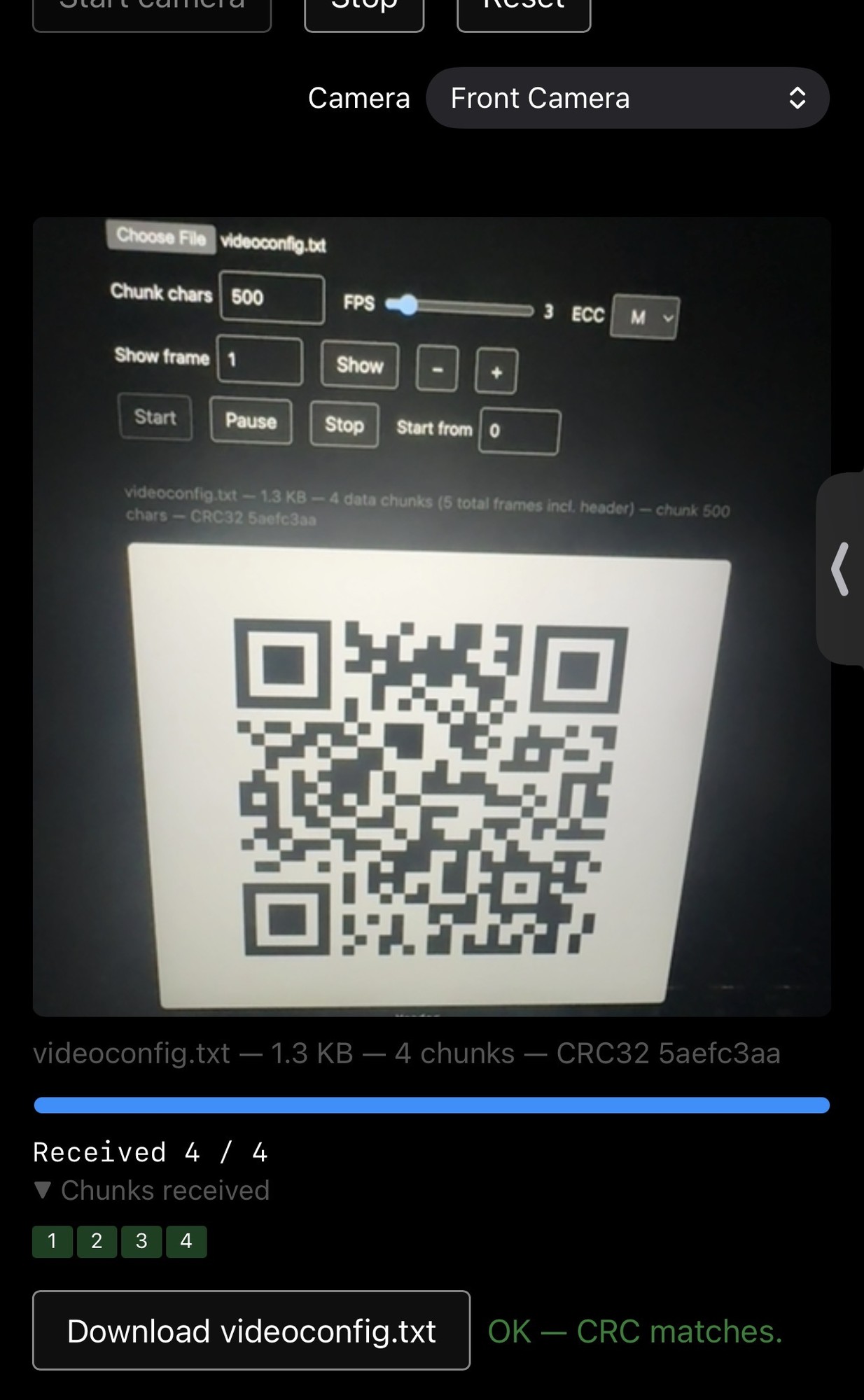
Here's a screenshot from the receiver camera pointing at the sender's screen so you can see both ends.
I suppose that's true lol.
Yes, it plays a video with an adjustable speed, or you can have it show a specific frame. The receiver has a grid that fills in as the data is received, making it easy to tell what data was or wasn't successfully received.
Janky ass CDS
NOW implement bi-directional transport
Woah! That's really cool!