Alt text: A GitHub PR from 2021 by Tylersuard with the title "Quality of code is too high". The author comments: "Please refactor to reduce quality of code to match industry standards."

I recently dreamt vividly that I ate something. I didn't know I could feel taste in my dreams
nix-collect-garbage has a --dry-run flag which should print deletable paths without actually deleting them. Check out the nix-collect-garbage reference
Aaand... it's Turing-complete!
You did all this as a teenager? Impressive
Typst and LaTeX libraries can be used to create a variety of graphs within a text document, but no animations
You can use WinBoat or WinApps or even LinOffice to run Microsoft Office in a VM that feels like a native app. Or you can instead try Collabora Office which looks like Microsoft Office, but is based on LibreOffice
$10 per TB is actually crazy cheap even for used enterprise drives! Unimaginable in this day and age
Good memories
... What you’re refering to as GNU/Linux, is in fact, systemd/GNU/Linux, or as I’ve recently taken to calling it, systemd plus GNU plus Linux. GNU/Linux is not an operating system unto itself, but rather another free component of a fully functioning systemd init system made useful by the systemd daemons, shell utilities and redundant system components comprising a full init system as defined by systemd itself.
Many computer users run a modified version of the systemd init system every day, without realizing it. Through a peculiar turn of events, the version of systemd which is widely used today is often called GNU/Linux, and many of its users are not aware that it is basically the systemd init system, developed by the Red Hat.
There really is a GNU/Linux, and these people are using it, but it is just a part of the init system they use. GNU/Linux is the os: a collection of programs that can be run by the init system. The operating system is an essential part of an init system, but useless by itself; it can only function in the context of a complete init system. GNU/Linux is normally used in combination with the systemd init system: the whole system is basically systwmd with GNU/Linux added, or systemd/GNU/Linux. All the so-called GNU/Linux distributions are really distributions of systemd/GNU/Linux!
Alt text: A GitHub PR from 2021 by Tylersuard with the title "Quality of code is too high". The author comments: "Please refactor to reduce quality of code to match industry standards."

A photo of a cake with 8 candles in a row. The first and fifth candle from the right are lit. The caption reads "Happy 17th Birthday"

Whenever I see this picture I think of this:
| Creature | Swims | Walks | Flies |
| -------- | ----- | ----- | ----- |
| Dog      | X     | X     |       |
| Fish     | X     |       |       |
| Bird     |       | X     | X     |
| Duck     | X     | X     | X     |
Notice how for each combination of swimming, walking and flying, there is a living creature that can do just that, with the exception of swimming and flying.
Sure there are flying fish, but they glide rather than fly. Did evolution really forget to cover this niche?

McMahon reaction meme depicting increasing satisfaction. Descriptions read as follows:

Sayori meme representing Linux users. Sayori is disgusted by text reading "receiving pre-installed bloatware" and instead approves "accumulating bloatware over time". Bloatware refers to unused packages.
Edit: You are so kind to give me advice on how to remove bloatware, but I don't need it :D

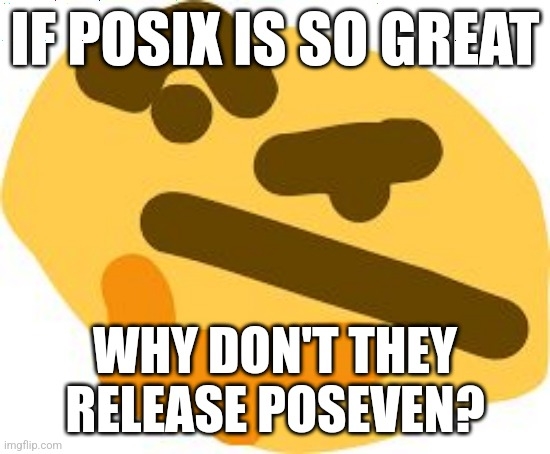
An enlarged thonk emoji as background, caption reads "If POSIX is so great, why don't they release POSEVEN?".
So.. why don't those abrasive materials destroy the hair in the drain?? Explain yourself