partial_accumen

joined 2 years ago
[–] partial_accumen@lemmy.world 14 points 3 days ago (10 children)

I don't think this is going to have the effect they are intending.

[–] partial_accumen@lemmy.world 1 points 3 days ago

On the plus side, ACATS is the feature/technology that makes moving brokerages so easy. I've got an account move in flight right now, and it took all of about 10 minutes to initiate. If you want out of Schwab you can probably ditch them if you like. If you're holding securities (stocks, bonds, etc), as long as they are transferable you can do an in-kind transfer (so the security never get sold to cash) and therefore there's no taxable event during the transfer.

[–] partial_accumen@lemmy.world 3 points 3 days ago (2 children)

I gave the proper definition of the acronym where the article did not. I'm not making commentary on the article topic.

[–] partial_accumen@lemmy.world 1 points 4 days ago

For the 2040s, if the pattern holds, local compute power will be come dirt cheap again, and there will be very few reasons to pay someone else to host your compute power remotely. Maybe it will be supercomputers on everyone's wrist or something.

[–] partial_accumen@lemmy.world 4 points 4 days ago

Its slightly worse than you may think. Prior to about a year ago there were no mechanisms available to block this type of attack from a thief from any of the big three brokerages. I give a lot of credit to Fidelity for not only developing a tool, but making it easily user accessible through the customer's web session.

Six months ago Vanguard also had no mechanism. However between then and now, they've at least developed a process on the backend to put the functionality in place, but they have yet to make a tool that can enable it from the customer's web session. So while its a bother to call in (and many Vanguard agents don't know about it yet like the one I initially talked to), I appreciate there is an avenue to put the block on now instead of just hoping and praying the theft doesn't happen to you. I fully expect Vanguard to make accessing the tool much easier to turn it on an off in the near future.

Schwab hasn't even built an internal tool yet, so phone call or not, all those customers are still at risk.

[–] partial_accumen@lemmy.world 4 points 4 days ago (2 children)

So, what prediction did Bezos make back then, that seems particularly poignant right now? Bezos thinks that local PC hardware is antiquated, and that the future will revolve around cloud computing scenarios, where you rent your compute from companies like Amazon Web Services or Microsoft Azure.

This isn't a new idea, and it certainly predates Bezos.

I'm older now, but throughout my life there has been a pendulum swing back and forth between local compute power vs remote compute power. The price of RAM going up follows the exact same path this has gone half a dozen times already in the last 50 years. Compute power gets cheap then it gets expensive, then it gets cheap again. Bezos's statements are just the most recent example. He's no prophet. This has just happened before, and it will revert again. Rinse repeat:

  • 1970s remote compute power: This couldn't really compute anything locally and required dialing into a mainframe over an analog telephone line to access the remote computing power.

  • 1980s local compute power: CPUs got fast and cheap! Now you could do all your processing right on your desk without need of a central computer/mainframe

  • 1990s remote compute power: Thin clients! These were underpowered desktop units that could access the compute power in a server such as Citrix Winframe/Metaframe or SunOS (for SunRay thin clients). Honorable mention for retail type units like Microsoft WebTV which was the same concept with different hardware/software.

  • 2000s local compute power: This was the widespread adoption of desktop PCs with 3D graphics cards as a standard along with high power CPUs.

  • 2010s remote compute power: VDI appears! This is things like VMware Horizon or Citirix Virtual Desktop along with the launch of AWS for the first time.

  • 2020s local compute power: Powerful CPUs and massively fast GPUs are now now standard and affordable.

  • 2030s remote compute power....in the cloud....probably


This text description is mine, not from the article. The article linked goes into much more detail.

This is an anti-scam/anti-fraud protection measure. This is apparently a method folks are getting their accounts cleaned out by thieves. They get your SSN, name, and account number from one of the many data breaches that happen today, they open an another account at another brokerage in your name, then transfer your funds out to the new brokerage they control. The system used to do this is called ACATS which is designed to easily let customers transfer funds from other accounts, but it is apparently easy to abuse.

Fidelity makes turning on the block crazy easy just by logging into your account and setting the "Money Transfer Lock" to "on". If you ever do want to use the ACATS to legitimately move your money to another broker, you just need to go back in here and set it to "off", complete your transfer, and turn it back "on" if you still have funds remaining.

Vanguard has this feature too, but its super sketchy to get it turned on. You have to call the vanguard agent, pass an OTP code, try to get them to understand what you're asking for as the agent I talked to did, get transferred around again a few times, do another OTP to a different department and finally they enable it. However they say it takes 5-7 days to take effect. Better than nothing I suppose.

Currently Schwab doesn't have a feature to block ACATS transfers at all in any capacity.

[–] partial_accumen@lemmy.world 2 points 4 days ago (2 children)

In an ideal world, as they see your knowledge is harder and harder to replace, they’ll start paying more for it

This is true and happens to me.

, and that will hopefully be encouraging enough to the current workforce to learn the skills.

Here's the challenge. Someone new that doesn't have the skills that is enticed by the money has to make two evaluations:

  • How hard is it to learn the skill?
  • How long with the skill be marketable?

For me to learn the skill wasn't difficult because is it was modern and contemporary technology at the time. Training and support resources existed, and I was able to incrementally learn how those older technologies continued to evolve or be accommodated as new technologies arrived to replace them, but then didn't. That won't be the case for someone new. They can't even use the old training material I used (assuming it was even still around) because that was written assuming the technology pervasive and well supported while the opposite is true today.

As for marketability, this is an even larger gamble. Many of these technologies should have been retired decades ago, but weren't for a variety of niche reasons. No organizations are putting out new deployments of these old technologies. The customer base/employers wanting these skills decrease every year as old legacy systems are finally retired leaving even fewer opportunities for a new person to exercise these newly acquired old skills. Its a fact that someday there will be no users of them, but when will that be? It should have happened already so what new worker would want to try and gamble on going into extensive learning on technologies that should be dead by the time they master them?

[–] partial_accumen@lemmy.world 8 points 4 days ago (5 children)

I agree about people getting dumber about computers, but sadly you're not the first to say it.

I see it in my IT work everyday. It makes for some good job security, but I wonder what happens when the last of us that know how to work the dark magics shuffle off our mortal coil.

[–] partial_accumen@lemmy.world 1 points 4 days ago

Thw issue youll run into is effectiveness at that small scale, sonyoull be tempted to share data with other systems like that, and eventually you’ll end up creating a different flock.

I wonder if a segregated system design could address this. Similar in-system segregation like a TPM for the actual detection/matching part of the system separated from the command and control part.

As in, the camera and OCR operations would be in their own embedded system which could never receive code updates from the outside. Perhaps this is etched into the silicon SoC itself. Also on silicon would be a small NVRAM that could only hold requested license plate numbers (or a hash of them perhaps). This NVRAM would be WRITE ONLY. So it would never be able to be queried from outside the SOC. The raw camera feed would be wired to the SoC. The only input would be from an outside command and control system (still local to our SoC) that and administrator could send in new license plates numbers to search against. The output of the SoC would "Match found against License Plate X". Even the time stamp would have to be applied by the outside command and control system.

This would have some natural barriers against dragnet surveillance abuse.

  • It would never be possible to dump the license plates being searched for from the cameras themselves even by abusive admins. The only admin option would be to overwrite the list of what the camera is trying to match against.
  • The NVRAM that contains the match list could be intentionally sized small to perhaps a few hundreds plate numbers so that an abusive admin couldn't simply generate every possible license plate combination effectively turning this back into a blanket surveillance tool. The NVRAM limit could be implemented as an on-die fuse link so that upon deployment the size could be made as small as needed for the use case.
[–] partial_accumen@lemmy.world 214 points 4 days ago (26 children)

The Direct Denial of Service (DDOS) assault,

That's not was DDOS means: Distributed Denial of Service

...meaning it comes from so many different sources its very hard to block.


cross-posted from: https://ibbit.at/post/66094

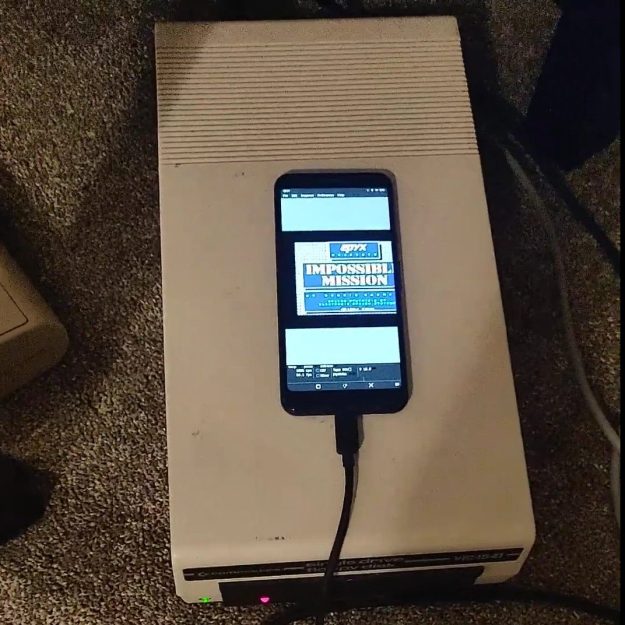
It all started with a sarcastic comment right here on Hackaday.com: ” How many phones do you know that sport a 5 and 1/4 inch diskette drive?” — and [Paul Sanjay] took that personally, or at least thought “Challenge accepted” because he immediately hooked an old Commodore floppy drive to his somewhat-less-old smartphone.

The argument started over UNIX file directories, in a post about Redox OS on smartphones— which was a [Paul Sanja] hack as well. [Paul] had everything he needed to pick up the gauntlet, and evidently did so promptly. The drive is a classic Commodore 1541, which means you’ll want to watch the demo video at 2x speed or better. (If you thought loading times felt slow in the old days, they’re positively glacial by modern standards.) The old floppy drive is plugged into a Google Pixel 3 running Postmarket OS. Sure, you could do this on Android, but a fully open Linux system is obviously the hacker’s choice. As a bonus, it makes the whole endeavor almost trivial.

Between the seven-year-old phone and the forty-year-old disk drive is an Arduino Pro Micro, configured with the XUM1541 firmware by [OpenBCM] to act as a translator. On the phone, the VICE emulator pretends to be a C64, and successfully loads Impossible Mission from an original disk. Arguably, the phone doesn’t “sport” the disk drive–if anything, it’s the other way around, given the size difference–but we think [Paul Sanja] has proven the point regardless. Bravo, [Paul].

Thanks to [Joseph Eoff], who accidentally issued the challenge and submitted the tip. If you’ve vexed someone into hacking (or been so vexed yourself), don’t hesitate to drop us a line!

We wish more people would try hacking their way through disagreements. It really, really beats a flame war.


From Blog – Hackaday via this RSS feed
 

So wholesome!


Tom Smothers, half of the Smothers Brothers and the co-host of one of the most socially conscious and groundbreaking television shows in the history of the medium, has died at 86.

The National Comedy Center, on behalf of his family, said in a statement Wednesday that Smothers died Tuesday at home in Santa Rosa, California, following a cancer battle.

“I’m just devastated,” his brother and the duo’s other half, Dick Smothers, told The Associated Press in an interview Wednesday. “Every breath I’ve taken, my brother’s been around.”

view more: next ›