quiescentcurrent

joined 2 years ago

I was just typing out my reply, but yours is much more detailed anyway, @OP this is the correct solution.

[–] quiescentcurrent@discuss.tchncs.de 1 points 4 weeks ago (1 children)

I'm in no position to discourage you from building this, but this is a fsr greater project than you're writing it to be. Send me a link to the git repo, so I can tag along and keep updated!

[–] quiescentcurrent@discuss.tchncs.de 2 points 4 weeks ago (3 children)

Thanks for the detailed answer, that helps a lot for my understanding.

The project sounds like a lot of work, especially for such a niche application. Do you have a crowd to support this (with time or money) or do you plan pay for this and sell it in the end?

[–] quiescentcurrent@discuss.tchncs.de 5 points 4 weeks ago (5 children)

It somehow feels like you put a lot of thought into this already and missed starting from the beginning in this post.

What device do you want to have a USB-C DAC for? What's the actual size limitations and what power do you want to draw that would need a heatsink? Do you have specs in mind, or is there a comparable project already available to look at?

Sure thing, if that's allowed: 8volt.at

We're doing custom builds for research as well as exhibitions and develop new machines and parts for industry ;)

[–] quiescentcurrent@discuss.tchncs.de 18 points 3 months ago* (last edited 3 months ago) (2 children)

I did that for almost 15 years, now I'm running a company developing embedded electronics using them daily.


This is an update to this post about the typical applications of the first op-amp by philbrick: https://www.reddit.com/r/electronics/comments/1l1whsq/in_the_50s_george_philbrick_introduced_and/

I paid for this to be vectorized, so people could have it printed in any size and form they'd like.

Here's the vector graphic: https://8volt.at/poster-8volt.pdf

I've set up a spreadshirt store to be able to directly order it as a poster/shirt/sticker/mug/... with and without the 8Volt logo: https://8volt.at/store#!/all

I honestly consider them to be a consumable.

The ones I've used always get splashes of solder, flux and other uncleanable things onto them at some point. If it gets too much, I'll switch to a new one.

That's actually a great video, no-ideal opamp characteristics have caused me a lot of headaches on multiple occasions in the past.

[–] quiescentcurrent@discuss.tchncs.de 17 points 8 months ago (2 children)

A regular USB-C hub would be an idea, but may not work with regular chargers..

[–] quiescentcurrent@discuss.tchncs.de 15 points 11 months ago (1 children)

Then this is not safe.

The maximum charge voltage for a lithium cell is 4.2V while USB will provide 5V. It may work for a while, it may fail in a safe state or something gets hot and burns.

Pretty much this, thanks for the summary


There is a reason for USB-C extensions not to be part of the standard. They can be bothersome in the best case and dangerous in the worst.

I have one of those, it may pass as the great grandfather ;)


cross-posted from: https://discuss.tchncs.de/post/22828099

USB was supposed to rule them all but it's now a mess of standards sharing the same connector. Different speeds, voltage, charging protocols, alt modes, even the number of pins used is variable.... For those asking, the thing is available on Kickstarter


EEVBlog also talked about this in a mailbag episode: https://www.youtube.com/watch?v=rEZQvSgdA2k&t=1839s

And they also have different cable versions available: https://caberqu.com/

14
Shift register missing bits (discuss.tchncs.de)
 

Hey friends,

I have a two daisy chained shift registers (74AHC595) which are controlled via an ESP32. I want to set one output to high at a time before switching to the next.

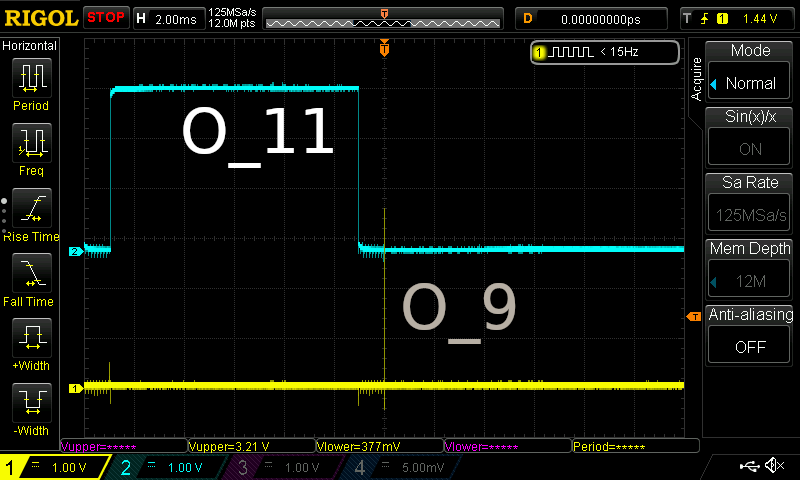
The code seems to work, but the outputs O_9 and O_10 are not staying high (zoom) after setting them, whereas all the other ones are working fine. This is the used code snipped:

pinMode(SHIFT_OUT_DATA, OUTPUT);
pinMode(SHIFT_OUT_CLK, OUTPUT);
pinMode(SHIFT_OUT_N_EN, OUTPUT);
pinMode(SHIFT_OUT_LATCH, OUTPUT);

digitalWrite(SHIFT_OUT_N_EN, LOW);

uint16_t input_bin = 0b1000000000000000;

for(int i=0; i<17; i++){

    byte upper_byte = input_bin >> 8;
    byte lower_byte = input_bin & 0x00FF;

    digitalWrite(SHIFT_OUT_LATCH, LOW);
    shiftDataOut(SHIFT_OUT_DATA, SHIFT_OUT_CLK, MSBFIRST, lower_byte);
    shiftDataOut(SHIFT_OUT_DATA, SHIFT_OUT_CLK, MSBFIRST, upper_byte);
    usleep(10);
    digitalWrite(SHIFT_OUT_LATCH, HIGH);

    delay(10)
    input_bin = input_bin>>1;
} 

Is there anything I'm doing wrong, or any idea on where the problem may lie? I've already tried looking for shorts and other error sources, but the design was manufactured on a PCB and no assembly issues are noticeable.

view more: next ›