Can’t make the wrong people look bad.
An unofficial chapter of the popular Dull Men's Club.
1. Relevant commentary on your own dull life. Posts should be about your own dull, lived experience. This is our most important rule. Direct questions, random thoughts, comment baiting, advice seeking, many uses of "discuss" rarely comply with this rule.
2. Original, Fresh, Meaningful Content.
3. Avoid repetitive topics.
4. This is not a search engine
Use a search engine, a tradesperson, Reddit, friends, a specialist Facebook group, apps, Wikipedia, an AI chat, a reverse image search etc. to answer simple questions or identify objects. Also see rule 1, “comment baiting”.
There are a number of content specific communities with subject matter experts who can help you.
Some other communities to consider before posting:
5. Keep it dull. If it puts us to sleep, it’s on the right track. Examples of likely not dull: jokes, gross stuff (including toes), politics, religion, royalty, illness or injury, killing things for fun, or promotional content. Feel free to post these elsewhere.
6. No hate speech, sexism, or bullying No sexism, hate speech, degrading or excessively foul language, or other harmful language. No othering or dehumanizing of anyone or negativity towards any gender identity.
7. Proofread before posting. Use good grammar and punctuation. Avoid useless phrases. Some examples: - starting a post with "So" - starting a post with pointless phrases, like "I hope this is allowed" or “this is my first post” Only share good quality, cropped images. Do not share screenshots of images; share the original image.
.
Can’t make the wrong people look bad.
That reminds me of a recent situation.
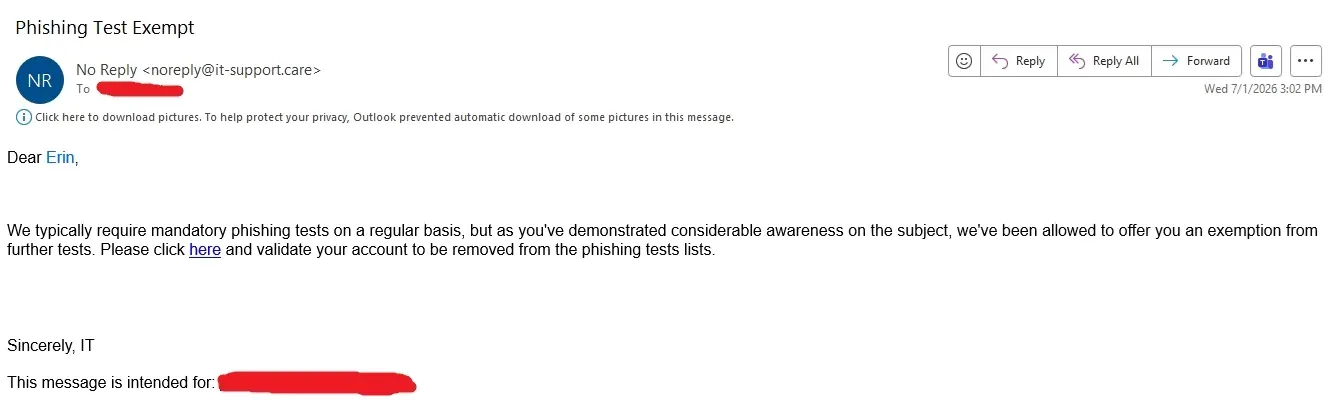
As someone working in software development, we are required to take part in the security trainings, the usual "don't open things from people you don't know" and "verify that a link is 'known' even if you get something from a person you do know", yada yada. You know the drill.
Recently, I got an email from our Boss saying something about "Here is something that you need to click on so that you are being authorised to do this stuff". Here was my thought process:
So, as a good boy, I opened a new Support ticket on IT with a screenshot of the link and said: "Got an email that tells me that I should open this link, but I don't know this link. What should I do?". The response was simple: Mark as Phishing and delete the Mail, done.
2 hours later, I got a message on Teams from IT which said: "Well, apparently that mail you marked as phishing was actually from us (was legit)". Great. Mail is gone now, don't know where Outlook put it, and frankly, I don't care.
If you train your people to "question everything" and not open links they don't know where they are going, then don't use some idiotic "middle man" or referer links in your official emails either. Even better, announce things before sending something out. I don't know how many emails I have gotten over the years where I would question the content and ignore it only for it to be something more important that nobody felt the need to announce first that something like this is coming our way.
I had a previous company send out a company wide announcement from a sketchy sender with a weird file attachment(apparently it's a voice mail file format), and the email was essentially listen to this attachment with no signature or anything else. They had to send out a second email explaining the suspicious email is actually real. Companies seem intent on ensuring there is minimal difference between phishing and legitimate email.
Honestly, this is preferable, and pretty funny. IT can always resend invites to tools and services. I'd rather send 1000 of those than have to lock someone out and have to talk to a human.