this post was submitted on 05 Jun 2024
12 points (92.9% liked)

Selfhosted

60967 readers
964 users here now

A place to share alternatives to popular online services that can be self-hosted without giving up privacy or locking you into a service you don't control.

Rules:

Detailed Rules Post

  1. Be civil.

  2. No spam.

  3. Posts are to be related to self-hosting.

  4. Don't duplicate the full text of your blog or readme if you're providing a link.

  5. Submission headline should match the article title.

  6. No trolling.

  7. Promotion posts require active participation, with an account that is at least 30 days old. F/LOSS without a paywall has exceptions, with requirements. See the rules link for details. Tags [CBH] or [AIP] are required, see the links in Rule 8 for details.

  8. AI-related discussions and AI-involved promotional posts have additional requirements for tagging, as noted in Rule 7 and the AI & Promotional Post Expanded Rules post, and find example disclosures here.

Resources:

Any issues on the community? Report it using the report flag.

Questions? DM the mods!

founded 3 years ago
MODERATORS
 

I'm planning on building a new home server and was thinking about the possibility to use disc spanning to create matching disk sizes for a RAID array. I have 2x2TB drives and 4x4TB drives.

Comparison with RAID 5

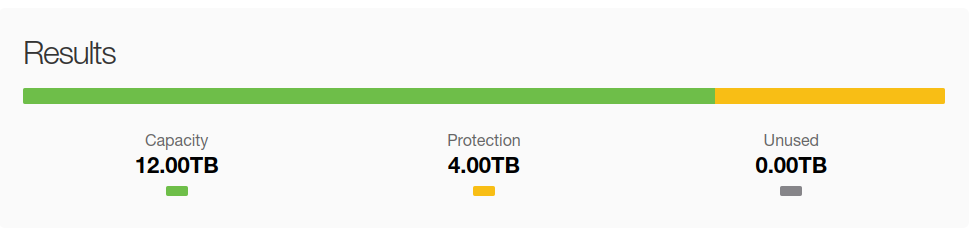
4 x 4 TB drives

  • 1 RAID array
  • 12 TB total

4 x 4 TB drives & 2 x 2 TB drives

  • 2 RAID arrays
  • 14 TB total

5 x 4* TB drives

  • Several 4TB disks and 2 smaller disks spanned to produce a 4 TB block device
  • 16 TB total

I'm not actually planning on actually doing this because this setup will probably have all kinds of problems, however I do wonder, what would those problems be?

you are viewing a single comment's thread
view the rest of the comments
[–] mlaga97@lemmy.mlaga97.space 3 points 2 years ago

I ran RAID-Z2 across 4x14TB and a (4+8)TB LVM LV for close to a year before finally swapping the (4+8)TB LV for a 5th 14TB drive for via zpool replace without issue. I did, however, make sure to use RAID-Z2 rather than Z1 to account for said shenanigans out of an abundance of caution and I would highly recommend doing the same. That is to say, the extra 2x2TB would be good additional parity, but I would only consider it as additional parity, not the only parity.

Based on fairly unscientific testing from before and after, it did not appear to meaningfully affect performance.