Ask Science
Ask a science question, get a science answer.
Community Rules
Rule 1: Be respectful and inclusive.
Treat others with respect, and maintain a positive atmosphere.
Rule 2: No harassment, hate speech, bigotry, or trolling.
Avoid any form of harassment, hate speech, bigotry, or offensive behavior.
Rule 3: Engage in constructive discussions.
Contribute to meaningful and constructive discussions that enhance scientific understanding.
Rule 4: No AI-generated answers.
Strictly prohibit the use of AI-generated answers. Providing answers generated by AI systems is not allowed and may result in a ban.
Rule 5: Follow guidelines and moderators' instructions.
Adhere to community guidelines and comply with instructions given by moderators.
Rule 6: Use appropriate language and tone.
Communicate using suitable language and maintain a professional and respectful tone.
Rule 7: Report violations.
Report any violations of the community rules to the moderators for appropriate action.
Rule 8: Foster a continuous learning environment.
Encourage a continuous learning environment where members can share knowledge and engage in scientific discussions.
Rule 9: Source required for answers.
Provide credible sources for answers. Failure to include a source may result in the removal of the answer to ensure information reliability.
By adhering to these rules, we create a welcoming and informative environment where science-related questions receive accurate and credible answers. Thank you for your cooperation in making the Ask Science community a valuable resource for scientific knowledge.
We retain the discretion to modify the rules as we deem necessary.
view the rest of the comments
Why would you assume the ice isn't being squished/stretched as well?
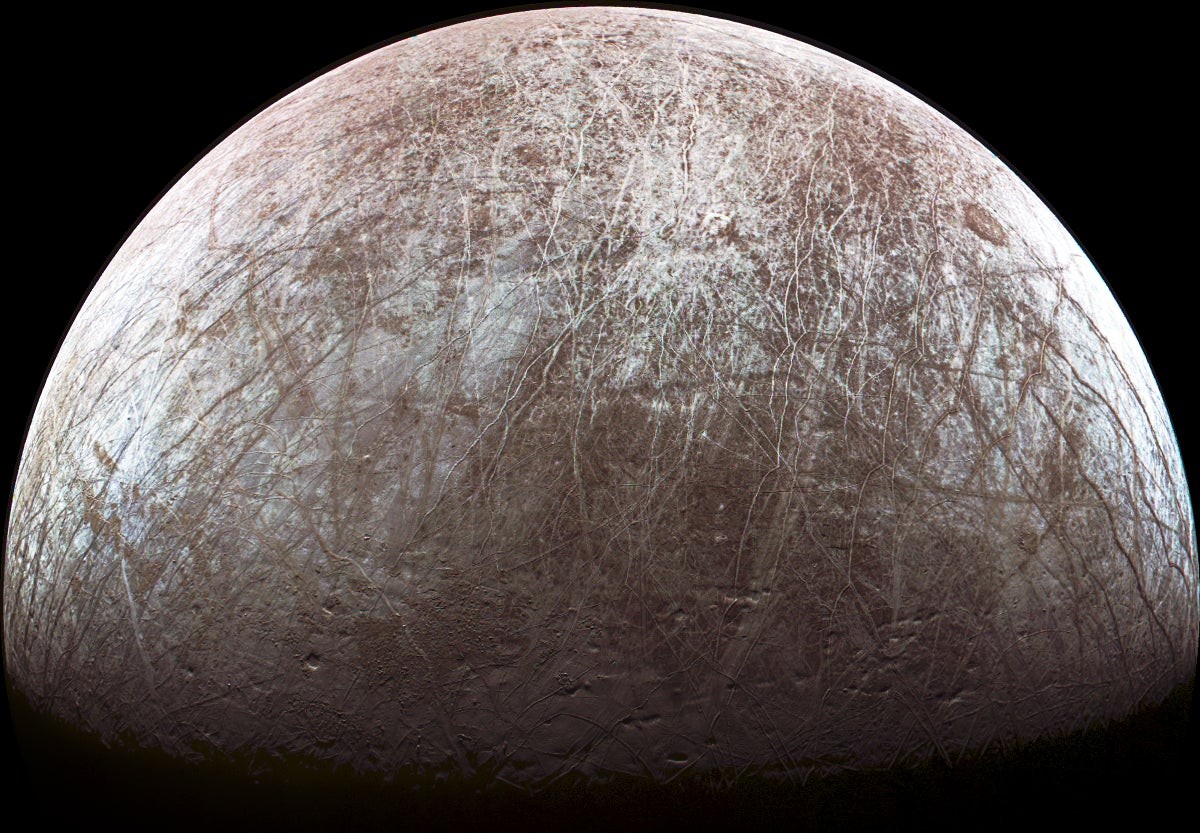
It's a completely different scenario than on Earth. Also Europa has less gravity than our moon, even, and just 13% than Earth's gravity. Much less pull from below, much more pull from above. That super thick ice shell just might stay in place like a church dome, even if the water level comes and goes.
So as far as I know, and I am no expert to be clear, the whole reason Europa even has a liquid ocean under the ice is because of tidal heating. Where the moon itself is pushed and pulled, heating it up immensely because of the friction of that action. So there would be no "air pockets" as such, because the ice itself is the thing creating the ocean. And due to ice being less dense than water the ocean would actually be exerting pressure on the ice mantle, not the other way around. I think this is one of the driving forces of the cryovolcanism found on Europa.
Exactly. The crust would likely experience similar effects as the liquid beneath, probably fracturing into plates and moving on the tide. There is visual evidence of the surface expanding, contracting, and fracturing with tidal forces