this post was submitted on 22 Jan 2026
15 points (100.0% liked)

Ask Science

14433 readers
24 users here now

Ask a science question, get a science answer.


Community Rules


Rule 1: Be respectful and inclusive.Treat others with respect, and maintain a positive atmosphere.


Rule 2: No harassment, hate speech, bigotry, or trolling.Avoid any form of harassment, hate speech, bigotry, or offensive behavior.


Rule 3: Engage in constructive discussions.Contribute to meaningful and constructive discussions that enhance scientific understanding.


Rule 4: No AI-generated answers.Strictly prohibit the use of AI-generated answers. Providing answers generated by AI systems is not allowed and may result in a ban.


Rule 5: Follow guidelines and moderators' instructions.Adhere to community guidelines and comply with instructions given by moderators.


Rule 6: Use appropriate language and tone.Communicate using suitable language and maintain a professional and respectful tone.


Rule 7: Report violations.Report any violations of the community rules to the moderators for appropriate action.


Rule 8: Foster a continuous learning environment.Encourage a continuous learning environment where members can share knowledge and engage in scientific discussions.


Rule 9: Source required for answers.Provide credible sources for answers. Failure to include a source may result in the removal of the answer to ensure information reliability.


By adhering to these rules, we create a welcoming and informative environment where science-related questions receive accurate and credible answers. Thank you for your cooperation in making the Ask Science community a valuable resource for scientific knowledge.

We retain the discretion to modify the rules as we deem necessary.


founded 2 years ago
MODERATORS
 

This is what I'm visualizing:
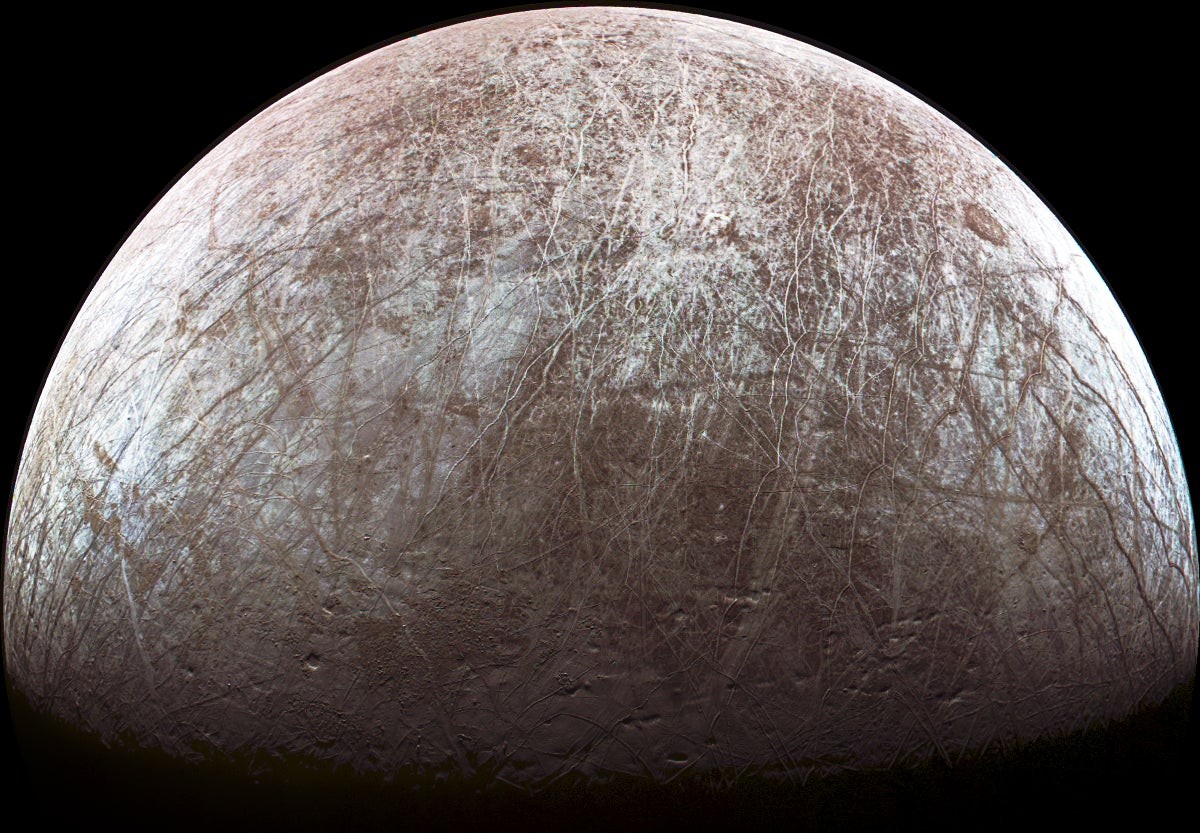
A liquid ocean pressed against the inner side of Europa's ice crust, during high tide. Then the tide shifts and the water rushes away, leaving a gigantic hollow shell high above the ocean's surface, like a vast dome stretching towards the horizon in all directions, in total darkness.

Meanwhile, the tidal bulge has rushed halfway across the hemisphere, the water is now pressing against the ice crust there.

If the Jovian system's tidal forces can stretch and knead Io's mantle like silly putty, its' rocky surface rising and falling as much as 100 meters (about 300 feet) each tidal cycle... I can't even imagine how violently the water may slosh under Europa's ice crust.

One final note: considering that Europa is tidally locked with Jupiter, and it is Ganymede and Callisto that can pull in other directions, how long are the tidal cycles there? The principle is like on Earth, but there are extra gears in the mechanism, so to speak, different high and low tides may vary widely between each other.

top 4 comments
sorted by: hot top controversial new old
[–] shads@lemy.lol 1 points 4 hours ago

I'm going to express some solidarity with OP here. I feel like there is some unconscious bias affecting their visualisation, in no small part due to my first blush reaction being "that kinda makes sense". On Earth at sea level we are used to ice being rigid enough that we don't expect tidal forces to distort it at the same rate as it affects neighbouring water, however as OP pointed out tidal forces in the Jovian system are colossal compared to what we are familiar with.

We also expect our atmosphere to rush in to fill any available space, even though that's only true at surface level (give or take a few meters) its counter intuitive to think about different paradigms of atmosphere if you haven't trained those reflexes.

Its kinda like the hottest parts of he Earths core being hotter than a large amount of the surface of he sun. That boggles my mind, but once I understood the caveats of that statement and the science involved it made a lot more sense, even if it wasn't intuitive.
[–] Amputret@lemmy.dbzer0.com 6 points 7 hours ago

Where would the air come from, pray tell?

[–] SpacetimeMachine@lemmy.world 4 points 7 hours ago (1 children)

Why would you assume the ice isn't being squished/stretched as well?

[–] buttmasterflex@piefed.social 4 points 5 hours ago* (last edited 5 hours ago)

Exactly. The crust would likely experience similar effects as the liquid beneath, probably fracturing into plates and moving on the tide. There is visual evidence of the surface expanding, contracting, and fracturing with tidal forcesaltr