246
3D Printer Reviewers: Being honest in this industry will put you out of a job.
(media.piefed.social)
cross-posted from: https://piefed.social/c/opensource/p/1823177/3d-printer-reviewers-being-honest-in-this-industry-will-put-you-out-of-a-job
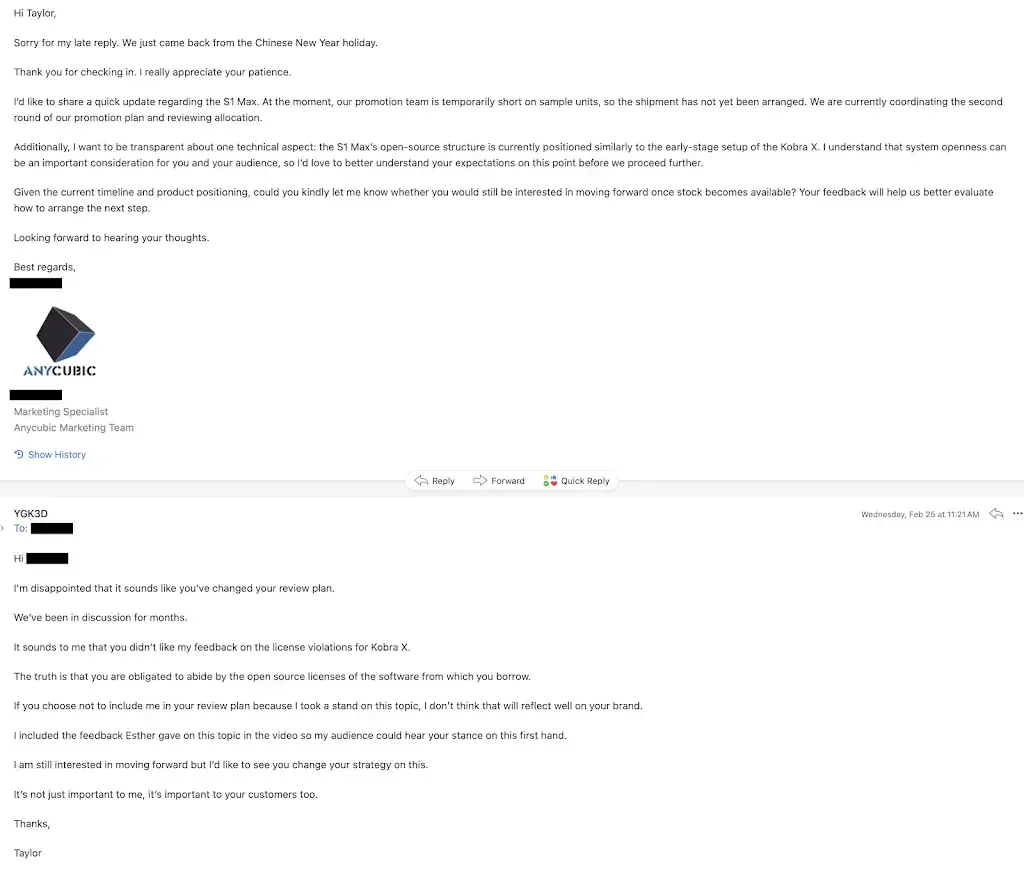
This is the emails between the YouTuber YGK3D and Anycubic, it seems like they won't send 3D printers to reviewers who mention their GPL3 license violations. > > tl;dr Anycubic uses open-source software for their firmware, but doesn't make it public as per license agreement, and they don't seem to be friendly to anyone who calls this out. > > More info: https://www.youtube.com/post/UgkxIMpZTkXqFo0H6pDwhZpdYqMYvLhPvWA5?lc=UgxA-4LYvwrnonXuXsZ4AaABAg >
I've looked into this from a UK perspective, partly because I'm in the market for a new 3d printer. Usual disclaimer that I'm not a lawyer, this is just a summary of what I found in my research, it could be completely wrong.
You can usually sue a company in a local court if they do business in your country, enforcement can obviously be an issue but if they have a local warehouse it can be enforced there.
In the UK there is a specific small claims track for small IP claims, it's not expected for you to have a barrister, and cost orders are rare, so if you lose you don't normally have to pay the opponents costs. This court can still grant injunctions, such as requiring them to release the source code, or preventing them from selling any printers.
The customer probably has standing to bring a claim as a third party beneficiary, this doesn't seem to be entirely settled.