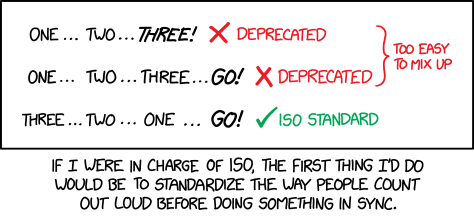
xkcd #3232: Countdown Standard
Title text:
Anyone who is caught counting 'three ... two ... one ... zero ... GO!' will be punished with a lifetime of eating only ISO standard food samples.
Transcript:
Transcript will show once it’s been added to explainxkcd.com
Source: https://xkcd.com/3232/
This, and standardizing what "this Thursday" and "next Thursday" mean. These terms have become functionally useless (to me) because of how they're used differently by different people. Whenever someone uses these terms to try to intimate a particular date to me, I just ask for the exact calendar date rather than the day of the week to avoid ambiguity.
Biweekly is another one. Two times a week, or once every two weeks (also called a fortnight)?
This is one of those ones that's a tragedy. Biweekly "should" always mean every two weeks. Twice a week is "semi-weekly", aka every half a week.
But regardless of what it "should" mean, people use it wrong often enough that you have to check every time, not because the word is ambiguous, but because people are often mistaken.
It's a shame, but it's part of human communication 😅
Human communication sucks. It should be illegal.
Tell me about it.
sorry that's illegal
There's also semi monthly, which is two times a month, as opposed to every two weeks, which is what biweekly is
Semi monthly results in 24 events per year while biweekly events happen 26 times
I can't express the amount of visceral discomfort this brought me.
Approximately 26 times a year.
Fortnightly already exists as a term though, why would biweekly mean the same thing?
We can have more than one way of describing things. Sometimes there is subtle nuances between the words.
Check the podcast episode “A Problem Squared - 121 = Bi-annuals and Diagonals”. In it, Matt and Beck discuss what these terms even mean, and propose a solution.
There is a rule but it's not really well known so people just follow whatever rule they deduced from usage. People have to qualify which one they mean almost every time. I usually say "this coming Thursday" (this week), or "Thursday next week" instead.
The rule makes perfect sense (and is how I’ve always used it), but this article actually misses a major point which I just learned last week when talking to some native Spanish speakers. In most English speaking countries, the week starts on Sunday. This isn’t the case for many, many other countries though. So saying “this Friday” on a Sunday really really confuses people. That’s exactly what happened to me last week because it was a Sunday and we were talking about a Friday and she got very very confused.
Excellent point. Same for most European countries, I think.
Another date confusion things is weeks. Europeans use week numbers a lot ("I'm on vacation weeks 34-37") but that's very rare in the US. And the week numbers aren't (always) the same anyway. In the US we use "I'm on vacation the week of ", which honestly is a lot easier to understand without referencing a calendar.
Starting the week on Sunday makes zero sense. Where does that even come from? Obviously Monday is the start of the week and everyone hates it for it.
why does monday makes more sense than sunday?
The day of the week shouldn't matter, it's either the Sunday that is coming up next or the one exactly a week after it. "This Sunday" should be the upcoming one and "Next Sunday" should be the one after. Doesn't matter if it's this week, next week or in two weeks.
I find Thursday (for this week) and Thursday next (for next week) adequate and am seldom called on for clarification, seems to follow the pattern of the rule (thanks for that) but is more economical.
Another problem is that system requires agreeing on what a week is, and there's disagreement over whether Sunday starts or ends the week.
A significant portion of the population thinks that “X times more” and “X times as much” mean the same thing. It drives me insane. I don’t think it’s ever formally taught because they use more rigorous language in school problems, but I’d like to think most people would agree “50% more” means 150%, and “50% as much” means 50%. 2X seems to cause confusion though.
So yeah, codifying that first chance.
Edit: What have I done, I knew better than to post a pet peeve in a comment chain.
That only works if X is a fraction or percentage though? Because 3 times more and 3 times as much do mean the same thing.
"This thursday" is the thursday on this current week. It might be in the future or in the past, which will be obvious from the context.
"Next thursday" is the thursday on the next week after this current one.
"Last thursday" is the thursday on the last week before this one.
In Norwegian we operate with "førstkommende" which translates more or less directly to "first-coming". It's extremely practical when planning dates, because you can always just say "Not the first-coming Thursday, but next Thursday", or "On the first-coming Thursday", and it's completely unambiguous that you mean the first Thursday we encounter from the moment of speaking.
This Thursday is already in the future. It has no meaning of you say it on a Friday. Then it’s ”this Thursday coming“ or just “Thursday coming”
At least here in the UK that’s the only way I’ve ever heard it used
I'm from the UK too and I've definitely heard things like:
"Yeah, I saw her this thursday"
If you used 'last thursday' in that case it would still obviously be understood, so I'm not sure it really matters. The importqnt distinction is between 'this' and 'next' thursday.
Edit: I've realized this definition was wrong and sleep-deprived and that the actual definition I use is: "This" refers to within this 7-day period of Su–Sa, "Last" refers to the last 7-day period, and "Next" refers to the next 7-day period. I was depriving myself of sleep to finish some work and came up with this. So "this" remains the same, but I just made up some definition of "next" that's inconsistent with how I'd describe months in years. Hopefully the work is okay.
Is this not universal? It seems so obvious.
"This Thursday" is the closest Thursday coming up, "next Thursday" is the next one after that. The exception is if you're already passed "Thursday" that week, then it's "next Thursday" until the new week starts.
Internal consistency test:
It's May 2024. You're talking about February 2025. Given the choice only between "This February" and "Next February", which do you call it?
Edit: In fairness, I realize I fail this consistency test too. If, in January 2024, someone said "Next February", I'd assume they're referring to February 2025, since I would only ever say "this February" to refer to February 2024 to avoid confusion (even though February 2024 technically is "next February"). Urgh, my brain. "You're making me think about this way more than I ever have. Come with me!"
I think scale matters. A year is quite a lot longer than a week or two. It's easy to consider both the next Thursday you're going to encounter and the one after that as subjectively "soon". The same can not be said of a month at least nine months away.
I would agree that your ruleset works on a longer timescale, but not on a shorter one. There's too much ambiguity and crossover for it to work properly. Having exclusivity in definition allows for better communication, especially for something much more personal like something sooner rather than later.
Except according to ISO 8601, Monday is the first day of the week, and it is the definition used in some english-speaking countries (Ireland, occasionally the UK). That means every Sunday there is a definite ambiguity as to which day is "this Thursday".
(Funnily enough, if we're invoking ISO 8601, it also defines that weeks are anchored to a year by whatever year their Thursday is in.)
I used to go by Monday–Sunday, but I've grown into a firm believer of Sunday–Saturday. I'm going to start my own standards organization, and we'll have incredible tea, open access, and civilized boundaries for weeks. [relevant xkcd here]
Fair point that there's some ambiguity, albeit not caused by an inherent ambiguity between "this" and "next". I'd just invoke "next Thursday" in that situation because it's the same regardless of apostasy.
I'm curious as to why. Obviously it doesn't really matter. I can't think of any arguments for Sunday--Saturday, and the only argument I have for Monday--Sunday is that in that case the "weekend" is actually the end of the week, rather than awkwardly split up. But then the word for "weekend" is different in different languages, so it's a very English-specific argument.
That’s awesome, thanks for sharing. I did not know that.
I’m with you so far as “next” should always the next occurrence of the day, and maybe in some places it does. But practically it doesn’t work. In every place I’ve lived it works like this: “this week” isn’t a set Monday – Sunday like you suggest, but a rolling seven days. Its Monday as I write this, “this Wednesday” is two days from now, while “next Wednesday” is the following. Same for this vs next weekend. If it’s Friday, “this Monday” is three days away. Rolling seven days.
“This” cannot be used for the day of week you are currently on, nor can it be used for previous days.
If next was the next occurrence of the day you’d be saying “next Wednesday on a Tuesday” and be talking about tomorrow, which is frankly ludicrous. I’ve also never heard anyone use a rolling week for “this” and this is such a funny conversation to come up because I literally had this confusion last Sunday (not this previous Sunday, as in yesterday, also note that this lines up well with using “last week”), because I was talking with several Venezuelans, a Chilean, a Mexican, and a Salvadoran, along with some Americans and this exact confusion came up but not because it was a rolling week, or because next means the next occurrence, but because they considered the week to start on Monday, not Sunday. So “this Thursday” meant the previous Thursday, since it was part of that week. Next Thursday meant the coming Thursday (the part of the next week).
I mention the nationalities because it’s pretty uncommon to start a week on a Sunday like Americans do.
Weirdly I looked it up and the internet says those countries start their weeks on Monday but that sure wasn’t what the people I talked to thought. 🤷
Okay but what about last Thursday?
I feel strongly that "next" Thursday should be not the next instance of a Thursday but rather the first instance of a Thursday past the contained set of the current week (so the next row on a calendar). I.e. if it's Tuesday, "next Thursday" isn't the Thursday two days from now but the Thursday 9 days from now.
So if it's a Friday, "This Thursday" was yesterday? How does that make sense?
"This Thursday" is always the upcoming Thursday.
Last Thursday was fucking yesterday.
*Said in a meeting on January 5th
"Our last discussion on this was last year."
.......
on Sunday my friend said we should hangout "this weekend" (he meant Saturday) and i corrected him saying that would be "next weekend" ... I'm right, right?
Yes, youre right
"upcoming Thursday" is the way I try to solve that
I had a roommate leave early once before the end of the month, and on Wednseday they said I'm leaving next Friday. They left a couple days later on Friday.
If it makes you feel better, Japanese has the same problem (and I'm sure other languages).