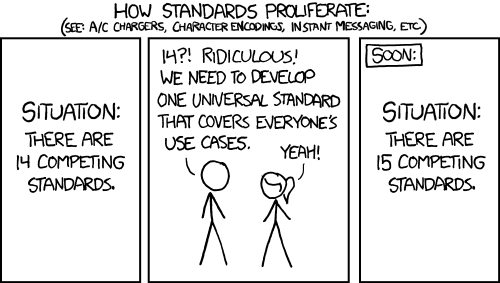
I love that lemmy is so techy, this is in c/memes of all places
Post memes here.
A meme is an idea, behavior, or style that spreads by means of imitation from person to person within a culture and often carries symbolic meaning representing a particular phenomenon or theme.
An Internet meme or meme, is a cultural item that is spread via the Internet, often through social media platforms. The name is by the concept of memes proposed by Richard Dawkins in 1972. Internet memes can take various forms, such as images, videos, GIFs, and various other viral sensations.
Laittakaa meemejä tänne.
I love that lemmy is so techy, this is in c/memes of all places
Ragebait for old nerds
To kids, anyone with 15 years in is "old".
Guess what they called us when we pointed out the procedural failures in its design? Yep: old.
Meanwhile I'm just here booting my sysV box reliably and not cringing about HUPping dbus. I've never seen as frail a shit bag as a Systemd-afflicted install.
systemd haters are the antivaxxers of the Linux world. There. I'm sure this statement won't lead to any heated discussion at all.
No. It does some things right and many things wrong. Difference in priorities, that's all. Except you often don't have a choice, because of some of the things Systemd does (intentionally) wrong.
Wrong from my view, that is.
'new standards' vs 'dunning-kruger-based decisions you are locked into'. Sure.
Systemd 'haters' are the people who know better and learned from best-practice.
Systemd 'haters' are no more haters than your parents who told you not to eat candy all day were candy haters.
To any new Linux users, this is a good example of Linux “antivax” mindset.
Actual Linux admins, people who use Linux at scale, people who design things and use Linux to do things disagree.
There is a reason why Redhat, Debian, Ubuntu, and Arch all ship with and recommend systemd as the startup system. ALL as in 100% of large Linux deployments on bare metal use systemd.
If you want to play with startup systems that’s fine there are obscure distros out there for you. Startup system swapping can be a fun hobby.
But don’t be tricked by the very loud but very small Linux “antivaxers” group.
I dislike system D. I actively choose to use it tho because I don't hate myself more then I dislikelt system D.
Give me a better option and I'll use it. Till then I choose to not hate my self.
The grand majority of systemd haters have no idea why they hate systemd or what an init system even is, they just know their favorite youtuber told them "systemd bad" and blindly agreed.
Exactly. A very small but VERY disproportionally loud group.
They uninstalled systemd from their computers and installed it on their brains.
Systemd is running rent-free in their heads
What's systemd? (I use OpenRC btw.)

Perfect example. This person has systemd so much on the brain I actually tagged them as weirdly against systemd some time ago. lol
The UNIX philosophy is "Everything is a file."
systemd doesn't follow that, with its binary logs and stuff.
Just part of why I keep going back to FreeBSD.
Replace everything is a file with "everything is a byte stream with a file handle" and your there.
There is A LOT of Unix that doesn't stick to the convention of "everything is a text file" and for good reason.
I'd like to interject for a moment...
You have to do that using systemctl start interjectd@message.md
oh you .... you got me good. Here take this https://preview.redd.it/941u10hnykcb1.jpg?width=821&auto=webp&s=9cd1cf2f4e33270ba2b8d2a4d85b5f0cb952c4aa
... What you’re refering to as GNU/Linux, is in fact, systemd/GNU/Linux, or as I’ve recently taken to calling it, systemd plus GNU plus Linux. GNU/Linux is not an operating system unto itself, but rather another free component of a fully functioning systemd init system made useful by the systemd daemons, shell utilities and redundant system components comprising a full init system as defined by systemd itself.
Many computer users run a modified version of the systemd init system every day, without realizing it. Through a peculiar turn of events, the version of systemd which is widely used today is often called GNU/Linux, and many of its users are not aware that it is basically the systemd init system, developed by the Red Hat.
There really is a GNU/Linux, and these people are using it, but it is just a part of the init system they use. GNU/Linux is the os: a collection of programs that can be run by the init system. The operating system is an essential part of an init system, but useless by itself; it can only function in the context of a complete init system. GNU/Linux is normally used in combination with the systemd init system: the whole system is basically systwmd with GNU/Linux added, or systemd/GNU/Linux. All the so-called GNU/Linux distributions are really distributions of systemd/GNU/Linux!
No, Richard, it's 'Linux', not 'systemd/GNU/Linux'. The most important contributions that the FSF made to Linux were the creation of the GPL and the GCC compiler. Those are fine and inspired products. GCC is a monumental achievement and has earned you, RMS, and the Free Software Foundation countless kudos and much appreciation.
Following are some reasons for you to mull over, including some already answered in your FAQ.
One guy, Linus Torvalds, used GCC to make his operating system (yes, Linux is an OS -- more on this later). He named it 'Linux' with a little help from his friends. Why doesn't he call it systemd/GNU/Linux? Because he wrote it, with more help from his friends, not you. You named your stuff, I named my stuff -- including the software I wrote using GCC -- and Linus named his stuff. The proper name is Linux because Linus Torvalds says so. Linus has spoken. Accept his authority. To do otherwise is to become a nag. You don't want to be known as a nag, do you?
(An operating system) != (a distribution). Linux is an operating system. By my definition, an operating system is that software which provides and limits access to hardware resources on a computer. That definition applies whereever you see Linux in use. However, Linux is usually distributed with a collection of utilities and applications to make it easily configurable as a desktop system, a server, a development box, or a graphics workstation, or whatever the user needs. In such a configuration, we have a Linux (based) distribution. Therein lies your strongest argument for the unwieldy title 'systemd/GNU/Linux' (when said bundled software is largely from the FSF). Go bug the distribution makers on that one. Take your beef to Red Hat, Mandrake, and Slackware. At least there you have an argument. Linux alone is an operating system that can be used in various applications without any GNU software whatsoever. Embedded applications come to mind as an obvious example.
Next, even if we limit the systemd/GNU/Linux title to the GNU-based Linux distributions, we run into another obvious problem. XFree86 may well be more important to a particular Linux installation than the sum of all the GNU contributions. More properly, shouldn't the distribution be called XFree86/Linux? Or, at a minimum, systemd/XFree86/GNU/Linux? Of course, it would be rather arbitrary to draw the line there when many other fine contributions go unlisted. Yes, I know you've heard this one before. Get used to it. You'll keep hearing it until you can cleanly counter it.
You seem to like the lines-of-code metric. There are many lines of GNU code in a typical Linux distribution. You seem to suggest that (more LOC) == (more important). However, I submit to you that raw LOC numbers do not directly correlate with importance. I would suggest that clock cycles spent on code is a better metric. For example, if my systemd spends 90% of its time executing XFree86 code, XFree86 is probably the single most important collection of code on my system. Even if I loaded ten times as many lines of useless bloatware on my system and I never excuted that bloatware, it certainly isn't more important code than XFree86. Obviously, this metric isn't perfect either, but LOC really, really sucks. Please refrain from using it ever again in supporting any argument.
Last, I'd like to point out that we Linux and GNU users shouldn't be fighting among ourselves over naming other people's software. But what the heck, I'm in a bad mood now. I think I'm feeling sufficiently obnoxious to make the point that GCC is so very famous and, yes, so very useful only because Linux was developed. In a show of proper respect and gratitude, shouldn't you and everyone refer to GCC as 'the Linux compiler'? Or at least, 'systemd Linux GCC'? Seriously, where would your masterpiece be without Linux? Languishing with the HURD?
If there is a moral buried in this rant, maybe it is this:
Be grateful for your abilities and your incredible success and your considerable fame. Continue to use that success and fame for good, not evil. Also, be especially grateful for Linux' huge contribution to that success. You, RMS, the Free Software Foundation, and GNU software have reached their current high profiles largely on the back of Linux. You have changed the world. Now, go forth and don't be a nag.
Thanks for listening.
excellent bait
.

And it's delicious.
I remember when systemd was a replacement for sysvinit and it was a slight delay to relearn but overall an improvement.
Then they started adding services, and that's where I started to not get along with it.
ntpd, resolver, networking, replacing ssh startup with a triggered socket. These got on my nerves and felt like it was overstepping.
Yeah that was the good time! Just kidding I have no clue what you're talking about.
Yeah, but how do you feel about this sentence an old colleague used to say: "I like Ubuntu. Its a really good program!"
Makes me think of the old saying that Emacs is a great operating system that's only missing a decent text editor
You used to be able to install Ubuntu on Windows via mingw, so for some people Ubuntu was just a program
The Tragedy of systemd - presentation by Benno Rice
What I hope that this talk has provided is a removal of fear and particularly a removal of pity of SystemD and the people who actually use it. [...] So, yeah, what I would challenge everyone here is look at SystemD and try and find at least one thing that you like, and then go see if you can implement it. Thank you.
Me, who knows next to nothing about how my 3 Linux machines work: *taking notes*
Don’t take too many, this is a shitpost about how bloated systemd is
I literally don't even know what systemd is, I think I've seen it in the Resource Manager 😅
Shout-out to the open source community and Steam for making Linux gaming so simple that even I can do it
Edit: I now have a passing understanding of what systemd is, and understand there is a Holy War to be fought between those in support of it, and those who prefer more modular init scripts. To arms!
Is an init script just a very British version or systemd? As in "it's systemd, init?"
I think it comes from Spanish-speaking Brits, or maybe a British Yoda, that's why it's "init, scripts?" and not "scripts, init?"
Ahh, yes. That makes total sense. British Spanglish coders. It was right in front of my face the whole time
System V forever, Solaris 9 gang reporting in.
I'm doing my part!
Listen, you little shit…
If it's a D system, why didn't they design it to pass with an A, so systema? Are they stupid?