Surprised to see that Dinit wasn't even mentioned.
atomicStan
joined 5 days ago
From their wiki:
What Makes Vostok Different? Void Linux is powerful — but it requires effort to set up. Vostok removes that barrier entirely:
- KDE Plasma out of the box — a full, polished desktop environment ready from the first boot
- Everything pre-configured — codecs, drivers, browser, fonts — all included
- Vostok Repository — hundreds of additional packages not available in the official Void repos (Brave, Figma, and more)
- Beginner-friendly, expert-approved — simple enough for newcomers, powerful enough for professionals
- 100% free — no subscriptions, no telemetry, no corporate strings
- One developer, one vision — transparent, independent, and built with love for the community
- Open to everyone — developers, designers, gamers, students, sysadmins — Vostok is for all of them
The em dashes definitely gives me LLM-vibes. Regardless, it mostly comes over as Void Linux with KDE Plasma and some onboarding. And I suppose they have their own repository. Furthermore, I think it's a very new distro as their Github activities only go two months back.
To OP: Why would you use this over (some) other Void derivatives? Secondly, as you state
I can customize it myself
Why even bother with any of these to begin with?
I (mostly) agree. I believe that bootc might have played a role in EU_OS' decision to pick Fedora over openSUSE. Back then, it wasn't possible to use it outside of Fedora's ecosystem. But Bootcrew has since released bootc images for other distros; including openSUSE. So hopefully they will reconsider it.
Should I just run all these updates as they come up?
For best practices related to security, yes.
Do you all run these updates as they pop up?
I'm on a Fedora-derivative that does automatic updates in the background. It applies those at least once a day.
Are you all getting this many updates on Fedora
Yes. This is standard procedure on all (semi-)rolling release distros.
or is it something specific to me and the apps I’m running?
Nah.
Is there a way to de-select some updates if I don’t want to run all of them?
I believe it's possible. But this Fedora maintainer mentions the following (and I quote):
"Fedora is a major-version stable system, which means that it isn't guaranteed safe to cherry-pick updates. The only reliable state for a major-version stable system is "fully updated". While rpm can detect major-version changes in dependencies, it doesn't detect minor-version changes in dependencies. That means that a package that you cherry-pick might appear to have all of its dependencies met from rpm's point of view, but it might crash at runtime because those dependencies don't have features that are required by the application."
Should I ignore daily updates
It's your PC. You do you. I would personally advise against it.
and install them less frequently, say monthly?
I have noticed that updating once every couple of days is relatively standard. I suppose it's 'fine'~ish as long as it doesn't exceed two weeks. But monthly would definitely be stretching it. At that point..., perhaps considering a distro with a slower release cadence makes more sense.
Meaning, I’m not super interested in being the glitch finder. If there’s a bug in an update, I’d rather have somebody else find it first and have the update patched.
So..., if that's what this is all about, then the following is worth noting:
- On Fedora, there's the so-called Rawhide branch. This is basically their unstable branch and where most of the actual testing happens. You'll (mostly) only receive updates that have already been tested in Rawhide. So, bugs/glitches and whatnot are pretty rare.
- But, if this is still your concern, then perhaps you should consider a distro with a slow release cadence. Which, basically comes down to picking one between Debian (on the Stable branch), openSUSE Leap and Ubuntu.
Great answer. Thank you!
I hope openSUSE will eventually get around and enjoy some much deserved momentum. I feel it isn't quite reaching its full potential as a project, because it (somehow) fails to attract a bigger audience. Don't get me wrong, it's definitely doing well and it holds its own admirably. But, (going off of ProtonDB's data) where Fedora (together with its derivatives) managed to effectively increase its market share by at least 400%, openSUSE^[It's the green colored bar found right under Manjaro] -despite Tumbleweed making more sense for gaming- was only able to keep what it had...
If I may, would you seriously consider switching to openSUSE Slowroll if Manjaro's situation doesn't improve? Or, are there reasons beyond its beta status that hold you back?
My apologies for inserting this "akshually ☝️", but I'm almost 100% sure that the distro that just didn't make the cut -the one represented in green, right under Manjaro- is openSUSE. It's possible to deduce this from an earlier report of Boiling Steam and its respective graph.

But, perhaps unsurprisingly, I don't ever recall seeing Slackware in any of these.
FWIW, similarly, we can deduce the grey one right below openSUSE to be Gentoo from this report and its respective graph. And, finally, the blue one below Gentoo to be Garuda from the respective graph of this report.
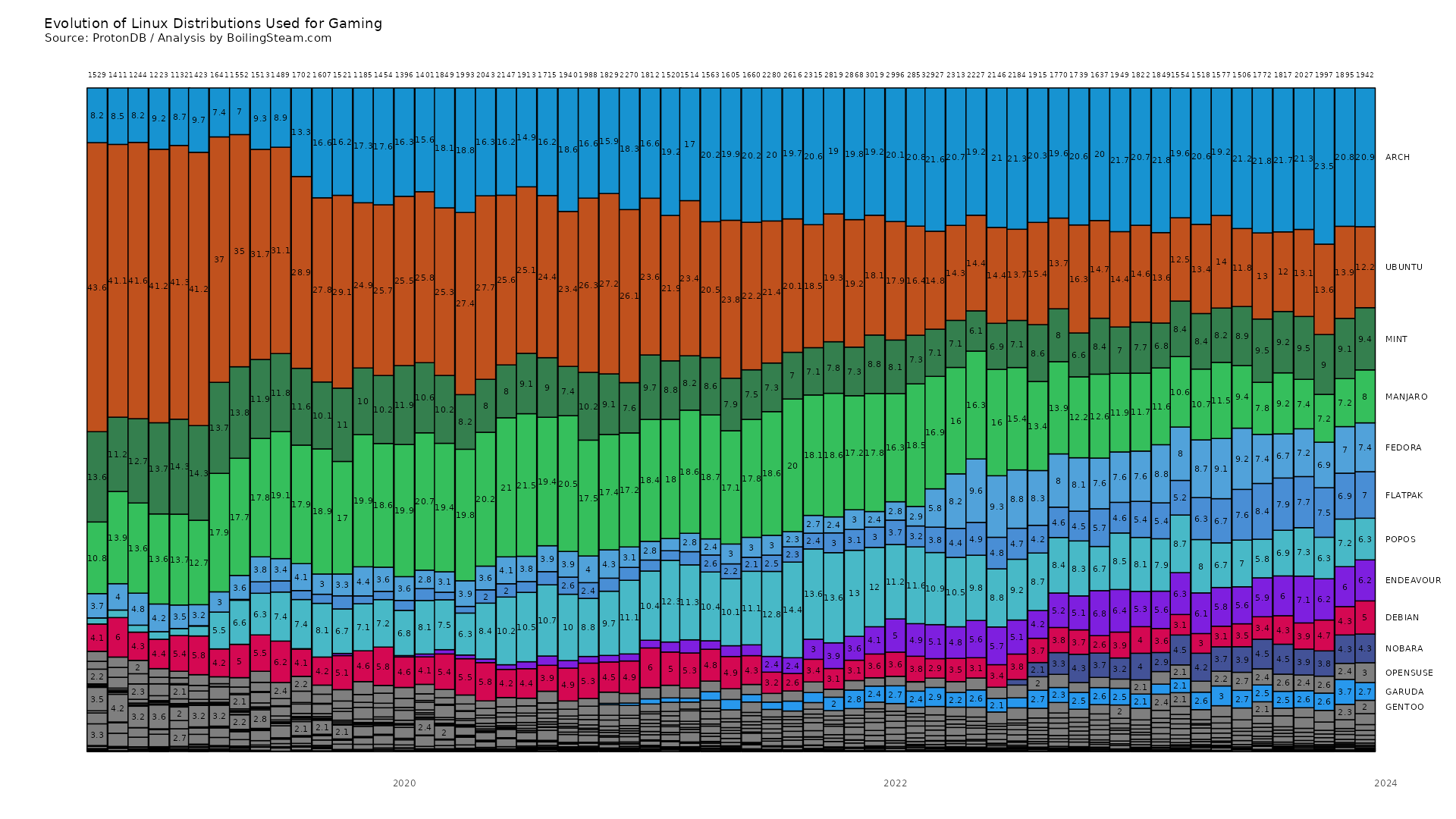

The last distro I was able to identify is Solus. Unfortunately, it's only relevant in the very beginning. It used to be the best performing grey one. See this report and its respective graph.

Asahi Linux is basically top notch engineering for free. Unless it gets (really) big, I don't see any reason for Apple to even consider putting it down.
Yeah, NixOS is excellent. But, for nix (or close enough) to be the future, an upgrade path should exist for other distros. But, for some reason, I don't really see any such efforts. Like, where are the nix-variants of other distros?
FWIW, Bootcrew has created bootc-variants of many other distros. And, even before, both Endless OS and GNOME OS offered examples of non-Fedora distros with ostree.
EDIT: TIL
Perhaps I should have been more clear. My apologies. I wanted to draw attention to the fact that -in the case of Fedora Atomic- layering remains a necessity (for most users). This thread goes over it in more detail.
flatpak
Technically speaking, the flatpak format isn't even as limited as some make it out to be. For example, software like Bottles have offered CLI/TUI functionality through it. But Flathub, its most popular storefront, does put a limitation on submissions. Which means that it's effectively not even competing with other package managers that (conventionally) try to offer a broader set of software.
Furthermore, even if the flatpak package exists, not all functionality is retained. For example, the situation around native messaging is still a mess. This prevents e.g. your flatpak browser from communicating with your locally installed password manager. While a(n ugly) workaround exists, it’s quite maddening that it hasn’t been resolved in all these years 😅.
distrobox/toolbx
This is actually a mess. See this comment elsewhere under this post for a bit more elaboration.
Overall, I wholeheartedly agree with your assessment.
The suggestion to just use ~~toolkits~~
toolboxis not for mortals.
I am also not convinced that it was ever meant as the endgame. Like, toolbox still doesn't offer a mechanic to upgrade a(ll) container(s) without entering one. The last time I used it, it also shat itself whenever the old pet container became EOL and desired a 'system update' to become functional. IIRC, distrobox doesn't fare any better at this. Thus, coming with what looks like planned obsolescence; with the recreation of the pet containers every couple of months as a result. I suppose the solution is picking an image that's supposed to be rolling-release. Which is why I think this workflow suits Aeon better.
view more: next ›
You're welcome. If you insist, I'd definitely grab a more established derivative. Preferably one that pre-dates GPT-3.5.