


The mustache does look period-appropriate, at least
The mustache does look period-appropriate, at least
They just start the fight that way, but if they’re losing then they’ll switch to the right hand
I didn’t know King was a Microsoft subsidiary. Kinda weird for Microsoft to own Candy Crush
This seems to be largely the same scam that would be run on grandparents, just with much higher ambitions, but it was just as successful with a much higher payoff
No one’s gotten into the actual “why” that I’ve seen. This goes back to the early days of the internet, or even computers, really. In the ’80s and ’90s computer screens were much lower resolution than today. The finer details of traditional typefaces were often lost. There was a big push to simplify and optimize for the screen. This also impacted the early days of the web. I remember the advice for amateurs was to design your pages for small resolutions screens, windows that were only 800x600 or even 640x480, which would work on a standard definition TV.
I remember the defaults in web browsers in the late ’90s were often badly spaced Times New Roman. People would try to code better fonts when they could define them, but they were still largely in the mindset of using fonts optimized for low-resolution screens. Worse, in the early days there were no web fonts that could be imbedded in web pages, so you’d have to try to pick a font likely to be on your readers’ computers, which usually weren’t great.
Nowadays basically everyone’s devices have high-resolution screens, and we have embedded fonts, so we don’t have to live our lives that way. Still, that decades-old advice echoes through in modern designs. And there are a lot of bad free fonts out there, with people unwilling to pay for a font or put in the effort to find a good free one.
As for what you can do? You can’t force everyone to change, but you can be the change you want to see. Encourage people to learn about good typography, which is not just fonts! Make smarter choices in the written work you produce yourself to show others the way. And to get by for now, change the default fonts the devices you use if possible, or individual apps or web browsers. You can even install browser extensions like Stylus to replace a page’s style sheet with a different, better one.
OP was making a point that was largely only apparent if the font changed
Funny enough N.E.R.D. also has a song called “Happy” but it’s definitely a different vibe than his more famous song of the same name. This one’s happy because an ex-lover is finally out of the singer’s life and their life is now so much better for it.
This was always going to happen. Producing content is not cheap. Investors in public companies want to see a certain level of profit every reporting period. Cable put so many channels in the tiers because at that price level because there would be enough channels in it that a customer at that price point want that they would get sales for that, even though basically nobody wanted all of those channels. Everyone would see some channels they didn’t want, and that would vary from person-to-person, but there was enough they wanted that it didn’t matter.
On the back end, the cable networks were getting money from each subscriber the cable companies had, whether those subscribers wanted those channels or not. They weren’t actually making much money per subscriber, but there were so many subscribers that it worked out. Most channels were under $1 per person, typically in the 25-75¢ range. Only ESPN had the clout to command serious money, nearing $5 per subscriber for a package that often included 4 or 5 channels.
There are a lot of those channels where people would say they’d be happy to pay 50¢ or even $1 a month in building their own package. The problem is those numbers only work when everyone pays. If a channel was on cable companies with 50 million customers that got them 50¢/month each, that’s $25 million/month. If that channel was a streaming service with 1 million customers who actually want their content they’d have to charge $25/month for the same revenue.
The only advantage customers have in this streaming landscape is no one is making them subscribe to all the services and there usually are no contracts, so consumers could change who they subscribe to every month. If you’re only watching a couple shows on one or two services you can save money. But it seems like many people don’t do that.
Maybe Pierce would’ve done it for marketing class and said something misogynistic about making the Asian woman thinner
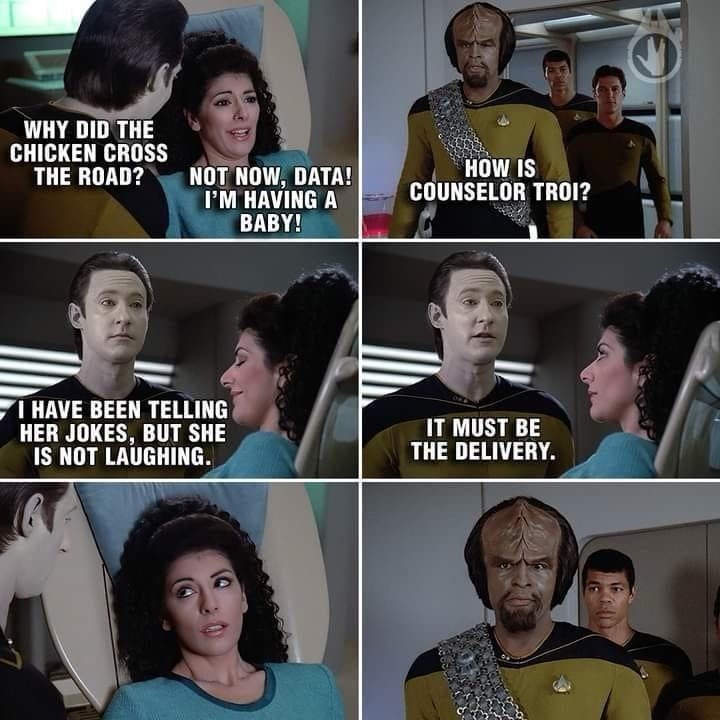
Crossposted from https://piefed.world/c/tenforward/p/1358097/data-the-doula
Alt text: “My lord, is that legal?” meme template. The trade federation member is labeled as “Shakespeare’s editors reading his plays”; he asks: “My lord, is that a word?” In the next panel the image of Palpatine is replaced with an image of William Shakespeare. He replies, “I will make it a word.”

@admiralwonderboat@mastodon.social among other places
Alt text
Spoiler
Jen is loading DVD's into a donation box. Admiral: Stop!! You can't get rid of our DVD's! What if the streaming sites go down?! - Admiral: What'll we watch if there's an apocalypse? The NEWS?! Jen: You're right! DVD's are essential for survival! - Admiral: We still have a DVD player, right? Jen: I mean... probably

Posted by the cartoonist on Imgur
Artist website: https://www.jimbenton.com/
Alt text/description:
Spoiler
Four panels, all panels show two spiders dangling from a web. The first panel has the spiders dangling side by side with no dialog. In the second panel, the spider on the right has swung out to the side, away from the spider on the left, but still without dialog. In the third panel, still without dialog, the spiders are back side-by-side as in the first panel. In the fourth panel, still side-by-side, the spider on the left asks, “Did you just fart?” The spider on the right replies, “No. OMG. No [sic]” The urgency of the denials suggest that the spider on the right did fart in the second panel but is embarrassed.

MicroSD cards