cross-posted from: https://aussie.zone/post/34370513
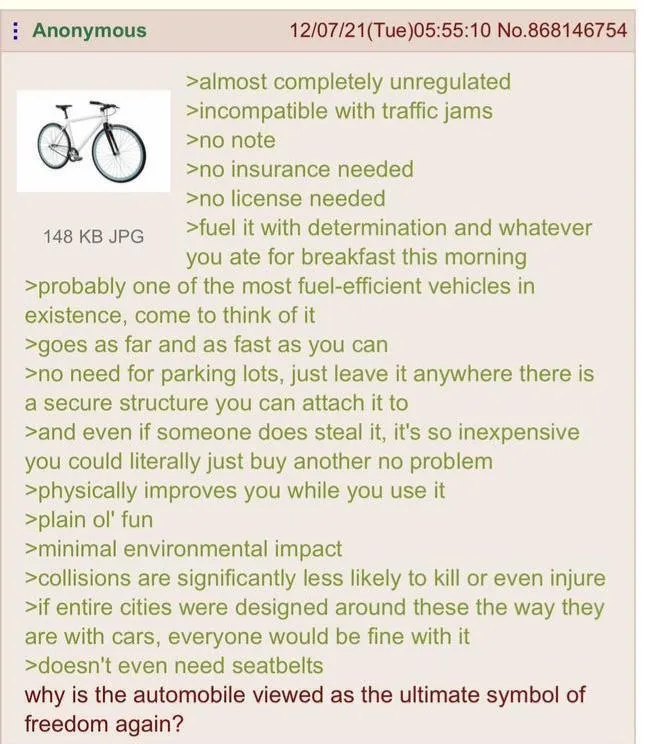
Anon likes bikes
A place to discuss problems of car centric infrastructure or how it hurts us all. Let's explore the bad world of Cars!
1. Be Civil
You may not agree on ideas, but please do not be needlessly rude or insulting to other people in this community.
2. No hate speech
Don't discriminate or disparage people on the basis of sex, gender, race, ethnicity, nationality, religion, or sexuality.
3. Don't harass people
Don't follow people you disagree with into multiple threads or into PMs to insult, disparage, or otherwise attack them. And certainly don't doxx any non-public figures.
4. Stay on topic
This community is about cars, their externalities in society, car-dependency, and solutions to these.
5. No reposts
Do not repost content that has already been posted in this community.
Moderator discretion will be used to judge reports with regard to the above rules.
In the absence of a flair system on lemmy yet, let’s try to make it easier to scan through posts by type in here by using tags:
cross-posted from: https://aussie.zone/post/34370513
Anon likes bikes
That is interesting! Looks like that table is for passenger transport specifically, not energy per mass. People don't pack nearly as densly in transport as heavy cargo does. Not safely and willingly anyway.
There's also a table in that Wikipedia article that breaks it down for a few real world train services with percent capacity ranging from 27 to 65% (in different networks / on different trains, though). But yeah, humans like their personal space, even in trains, those wasteful brats.