this post was submitted on 06 May 2025
632 points (97.4% liked)
Science Memes
20903 readers
1216 users here now
Welcome to c/science_memes @ Mander.xyz!
A place for majestic STEMLORD peacocking, as well as memes about the realities of working in a lab.

Rules
- Don't throw mud. Behave like an intellectual and remember the human.
- Keep it rooted (on topic).
- No spam.
- Infographics welcome, get schooled.
Research Committee
Other Mander Communities
Science and Research
Biology and Life Sciences
- !abiogenesis@mander.xyz
- !animal-behavior@mander.xyz
- !anthropology@mander.xyz
- !arachnology@mander.xyz
- !balconygardening@slrpnk.net
- !biodiversity@mander.xyz
- !biology@mander.xyz
- !biophysics@mander.xyz
- !botany@mander.xyz
- !ecology@mander.xyz
- !entomology@mander.xyz
- !fermentation@mander.xyz
- !herpetology@mander.xyz
- !houseplants@mander.xyz
- !medicine@mander.xyz
- !microscopy@mander.xyz
- !mycology@mander.xyz
- !nudibranchs@mander.xyz
- !nutrition@mander.xyz
- !palaeoecology@mander.xyz
- !palaeontology@mander.xyz
- !photosynthesis@mander.xyz
- !plantid@mander.xyz
- !plants@mander.xyz
- !reptiles and amphibians@mander.xyz
Physical Sciences
- !astronomy@mander.xyz
- !chemistry@mander.xyz
- !earthscience@mander.xyz
- !geography@mander.xyz
- !geospatial@mander.xyz
- !nuclear@mander.xyz
- !physics@mander.xyz
- !quantum-computing@mander.xyz
- !spectroscopy@mander.xyz
Humanities and Social Sciences
Practical and Applied Sciences
- !exercise-and sports-science@mander.xyz
- !gardening@mander.xyz
- !self sufficiency@mander.xyz
- !soilscience@slrpnk.net
- !terrariums@mander.xyz
- !timelapse@mander.xyz
Memes
Miscellaneous
founded 3 years ago
MODERATORS
you are viewing a single comment's thread
view the rest of the comments
view the rest of the comments
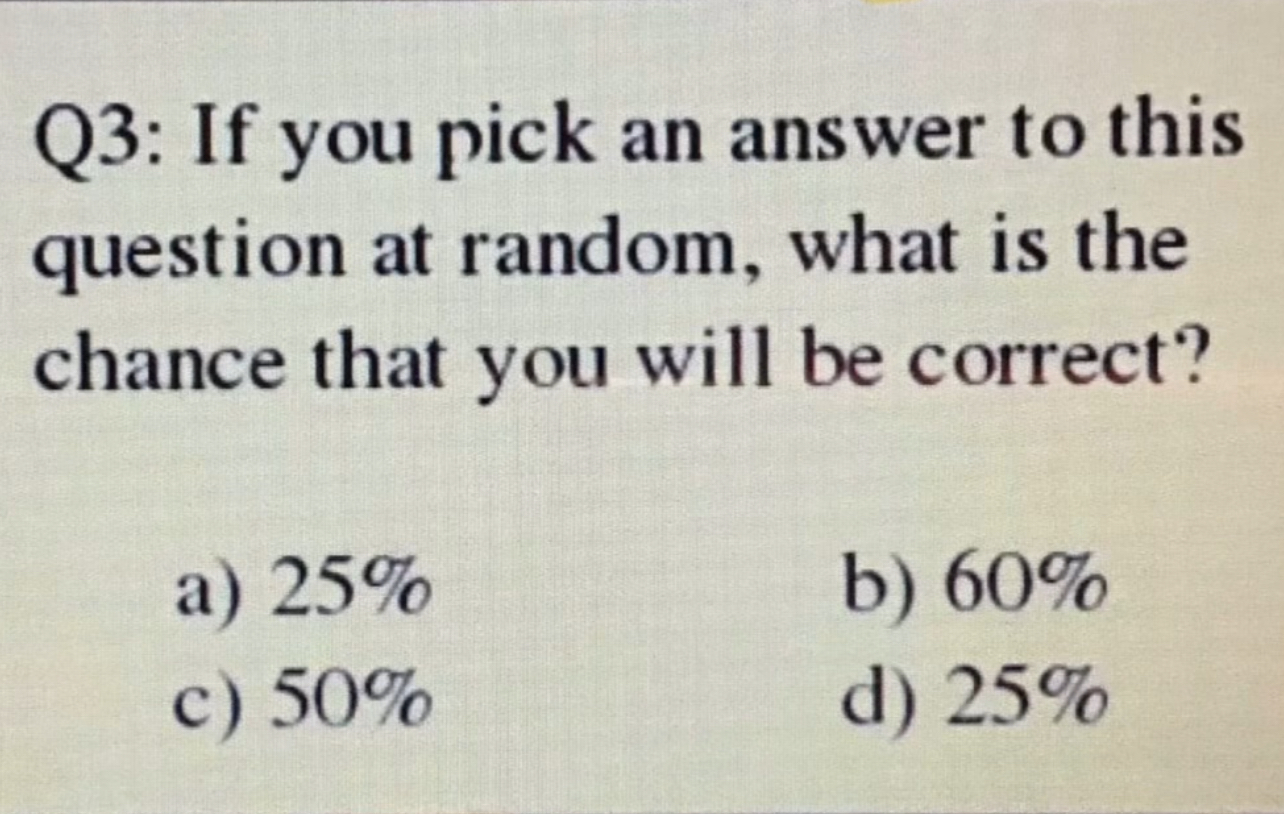
If you suppose a multiple choice test MUST ONLY have one correct answer:
Eliminate duplicate 25% answers
You are left with 60% and 50% as potential answers to this question.
C is the answer
If you were to actually select an answer at random to this question while believing the above, you would have a 50% chance of answering 25%.
It is obvious to postulate that: for all multiple choice questions with no duplicate answers, there is a 25% chance of selecting the correct answer.
However as you can see, in order to integrate the answer being C with the question itself, we have to destroy the constraints of the solution and treat the duplicate 25% answers as one sum correct answer.
Do you choose to see the multiple choice answer space as an expression of the infinite space of potential free form answers? Was the answer to the question itself an expression of multiple choice probability or was it the answer from the free form answer space condensed into the multiple choice answer space?
The question demonstrates arriving at different answers between inductive and deductive reasoning. The answer depends on whether we are taking the answers and working backwards or taking the question and working forwards. The question itself forces the inductive reasoning strategy to falter at the duplicate answers, leading to deductive reasoning being the remaining strategy. Some may choose to say "there is no answer" in the presence of needing to answer a question that only has an answer because we are forced to pick one option, and otherwise would be invalid. Some may choose to point out it is obviously a paradox.