this post was submitted on 24 May 2026
1710 points (99.2% liked)
Work Reform
17765 readers
1923 users here now
A place to discuss positive changes that can make work more equitable, and to vent about current practices. We are NOT against work; we just want the fruits of our labor to be recognized better.
Our Philosophies:
- All workers must be paid a living wage for their labor.
- Income inequality is the main cause of lower living standards.
- Workers must join together and fight back for what is rightfully theirs.
- We must not be divided and conquered. Workers gain the most when they focus on unifying issues.
Our Goals
- Higher wages for underpaid workers.
- Better worker representation, including but not limited to unions.
- Better and fewer working hours.
- Stimulating a massive wave of worker organizing in the United States and beyond.
- Organizing and supporting political causes and campaigns that put workers first.
founded 3 years ago
MODERATORS
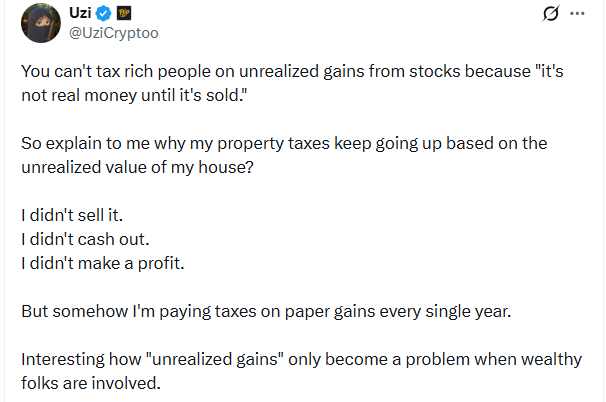
This is a wealth tax, not an income tax. We don't currently have a wealth tax to decrease; we would be establishing a new one. I would propose 1% per year.
Are you a natural person? Is your portfolio less than $10,000,000 in value?
If you answered "yes" to both questions, nothing changes for you. This only applies to corporate entities and ultra-high-net-worth individuals.
The only reason that higher returning investments are a problem is because they are used as a vehicle to drive wealth to the (ultra-)wealthy. When the wealthy are charged a high premium for these investments, that reason stops being a reason.
The established institutions in question are the ones creating the systemic problems. I see no compelling reason to maintain the institutions responsible. I see no compelling need for "a lot of exceptions". Destroy them. To minimize disruption, we could phase it in over time. Perhaps starting with a $1 billion portfolio exemption and decreasing it to $10 million over the course of a decade.
This would have the ultra-wealthy converting their financial assets to tangible assets; they would be buying up personal property (produced by workers) hand over fist, while the working class would be buying up those liquidated shares from the IRS at a similar rate. Ownership interest in these companies would be rapidly conveyed away from the Problem Class to the Working Class.
What?
You're advocating for maintaining status quo "institutions". I'm advocating improvement. You're advocating regression. I'm advocating progress.
Your criticism here makes your stance seem wildly inconsistent.
I think you need to explain what you mean by "institutions" when you suggest that I will be destroying them.
The "institutions" I believe will be destroyed by a securities tax are overtly harmful and should be destroyed. Can you provide me an example of a beneficial "institution" that would not survive?
I don't believe I asked you to prove it. I asked for examples of such institutions. When you say "institutions", the first thing that springs to my mind are corporate landlords taking investor dollars to buy up residential properties, and artificially inflate housing prices. That is an example of an "institution" that is contributing to the problem. That institution exists primarily to benefit the interests of corporate entities and ultra-high net worth individuals. That is an institution that should not survive in its current form.
Name some. You're assuming I'm either going to destroy such institutions, or that I will need some sort of "exception" in order for them to continue operating. I don't think this is likely. I think that such institutions would fall well within this plan. I think they could, for example, structure their portfolios to pass the security tax obligation through to the natural-person shareholders who own and control them.
For example, that abusive REIT I mentioned above is currently under the control of Problem Class shareholders. That problem class is using that control to transfer wealth from the working class to the problem class. When the Problem Class shareholders withdraw, this REIT comes under the control of Working-Class Shareholders; the kind of people who are harmed by that exploitative behavior.
Which is why I'm asking for examples. What harm do you think is going to arise from driving the Problem Class out of these nebulous "institutions"?
We don't need to call it something new. We already have property tax. It's an average of 1.1% around the United States.
Stocks are property.
Real Estate property taxes are assessed at the county/parish level, and apply only to land and improvements on that land. Securities would not be considered "real property". They are generally considered intangible personal property, which is not currently taxed. Further, the tax I am describing would be assessed at the federal level.
We certainly do need a way of distinguishing between existing real estate taxes and the proposed securities tax, even if the rates for the two taxes are identical.
Parent comment refers to "dramatically decreasing the tax rate", but does not describe what tax rate they are decreasing. Parent comment crunches some numbers in which they assume a 3% tax rate, not a 1.1% tax rate comparable to real property taxes you describe.
They did not indicate what tax rate they meant when they said it would need to be decreased. They certainly aren't referring to a real property tax rate when they suggest a decrease. I believe they were referring to either Federal Income Tax or Federal Capital Gains tax, which are approximately 25 to 50 times higher than the tax I was considering. Given the considerable discrepancy between what I meant and what they heard, I felt it important to indicate that this tax would be entirely separate from the existing taxes, and that it would be enacted for an entirely separate purpose.
I didn't (initially) define a proposed securities tax rate, but I did provided context for calculating one:
I would tax those securities held by corporate interests and the obscenely rich at a rate equal to or greater than their expected return on investment, so that the benefits of securities ownership convey primarily to working class investors. From Parent Comment's ROI (5%) and inflation (3%) numbers, the context I provided would allow for at most a 2% securities tax rate.
The securities tax rate I had in mind was 1%.
I'm not interested in what billionaires would consider "real property".
Stocks are property.
I see. How does that particular distinction affect this discussion?
This is me pointing to the headline.
Stocks are property. Easy.
Maybe I'm an idiot, but I am just not understanding the ramifications of your argument.
Yes, Stocks are property. They are a specific type of property: "intangible personal property".
That type of property is not currently taxed. I am describing a method in which that type of property will be taxed.
What does your distinction bring to the discussion?