this post was submitted on 24 May 2026
1255 points (99.1% liked)
Work Reform
16397 readers
1485 users here now
A place to discuss positive changes that can make work more equitable, and to vent about current practices. We are NOT against work; we just want the fruits of our labor to be recognized better.
Our Philosophies:
- All workers must be paid a living wage for their labor.
- Income inequality is the main cause of lower living standards.
- Workers must join together and fight back for what is rightfully theirs.
- We must not be divided and conquered. Workers gain the most when they focus on unifying issues.
Our Goals
- Higher wages for underpaid workers.
- Better worker representation, including but not limited to unions.
- Better and fewer working hours.
- Stimulating a massive wave of worker organizing in the United States and beyond.
- Organizing and supporting political causes and campaigns that put workers first.
founded 2 years ago
MODERATORS
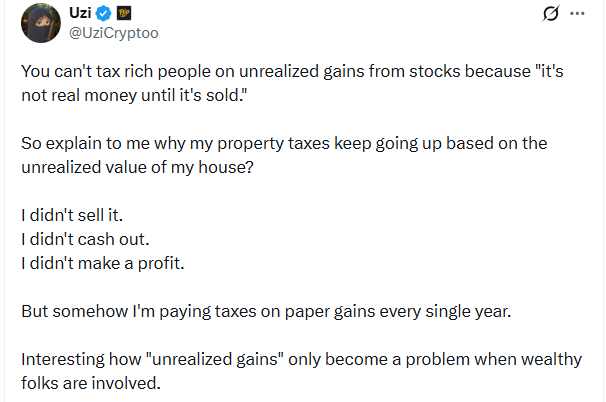
This is a wealth tax, not an income tax. We don't currently have a wealth tax to decrease; we would be establishing a new one. I would propose 1% per year.
Are you a natural person? Is your portfolio less than $10,000,000 in value?
If you answered "yes" to both questions, nothing changes for you. This only applies to corporate entities and ultra-high-net-worth individuals.
The only reason that higher returning investments are a problem is because they are used as a vehicle to drive wealth to the (ultra-)wealthy. When the wealthy are charged a high premium for these investments, that reason stops being a reason.
The established institutions in question are the ones creating the systemic problems. I see no compelling reason to maintain the institutions responsible. I see no compelling need for "a lot of exceptions". Destroy them. To minimize disruption, we could phase it in over time. Perhaps starting with a $1 billion portfolio exemption and decreasing it to $10 million over the course of a decade.
This would have the ultra-wealthy converting their financial assets to tangible assets; they would be buying up personal property (produced by workers) hand over fist, while the working class would be buying up those liquidated shares from the IRS at a similar rate. Ownership interest in these companies would be rapidly conveyed away from the Problem Class to the Working Class.