1710
The rich convinced us that taxing them is too complicated but everyday people can be taxed pretty easily
(discuss.online)
A place to discuss positive changes that can make work more equitable, and to vent about current practices. We are NOT against work; we just want the fruits of our labor to be recognized better.
Our Philosophies:
Our Goals
They're right: it is pretty complicated to tax the rich using the current tax code. And there's a very good reason for that: they made sure it's as complicated as possible.
I think the idea that taxing the rich is difficult or our tax code is too complicated feeds into the narrative around the problem being too hard to solve. I think the reality is more straightforward:
Bring back the previous top tax bracket of 39% that Republicans did away with. That will bring in a significant revenue.
Raise or add the top brackets on the capital gains taxes.
Add a new top tax bracket of you want to raise more revenue, e.g. 46% above X millions.
When you look at reports by the congressional budget office or independent budget groups, most of the other proposals are noise in the grand scheme of things. Even the buy, borrow, die strategy that gets a lot of airtime (because it rightfully violates most people's sense of fair play) only really accounts for something like 2% of the funds used by the ultra wealthy.
Most of the things like wealth taxes would require more complex legislation and be treated by the courts, certainly going to the supreme court. But the above three bullets would meaningfully raise revenues, are simple in terms of legislation, and have clear statutory authority and case law on their side.
The only thing hard is electing enough people who actually care about the budget and the people.
Income tax may be a solution to government revenue, but it's not a solution to inequality.
Capital accumulates exponentially, and if you don't address that exponential growth, then there will be ludicrously wealthy people, social immobility, and all the problems we have now. Tax wealth.
Of course it will be complicated. Of course there will be court cases. All of that is true of the current system. We can't get to a working system if we don't even start. Tax wealth.
Tax wealth.
Agreed.
I don't think we even need to tax all wealth. We need to specifically tax registered securities. Financial assets.
Economically, it isn't a problem for a rich person to buy a yacht or a plane: Those assets were produced by workers; they are maintained by workers. The purchase of tangible assets means paychecks for the workers producing those assets. Economically, we shouldn't be discouraging the purchase of personal property assets.
The value the ultra-wealthy are capturing is the ownership of companies. The value of those companies is generated by workers, but is transferred to the ultra-wealthy. The workers are compensated with cash, rather than ownership interest.
What we need to do is make those securities more expensive for the ultra-wealthy to hold, and cheaper for the workers to hold. We need a progressive tax on securities, payable in shares of the security, rather than the dollar value of those securities.
Forget 39%. We have greater national debt as a percentage of GDP than we did in 1944. We need to reinstitute the tax brackets from then until 1965, which had a top rate of 90%. There are reasons we had a middle class back then, and this is one of them.
Capital gains should just be taxed as regular income instead of having a special rate.
It wouldn't be so bad if you couldn't use the unrealized gains. But people can have a bunch of stock, get an untaxed loan, and have access to money without the tax burden. We should fix that.
Also property tax should probably be progressive
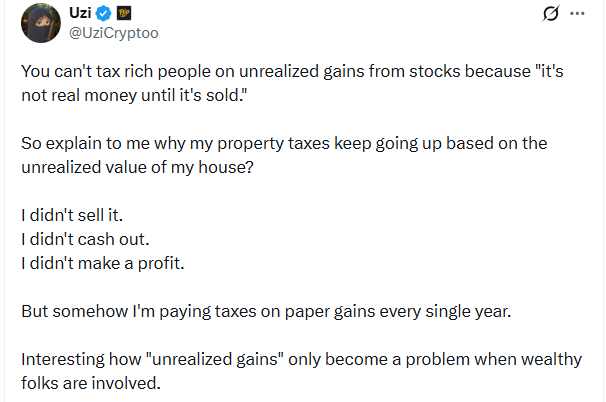
This was an interesting point I hadn't thought of before, so I wanted an alternate perspective since a Twitter meme is a little one sided, think of it what you will:
Property taxes are ancient — they predate modern stock markets by centuries. Land was the dominant form of wealth, and crucially, you can't hide a house from the assessor. Real estate is immobile, visible, and tied to a specific jurisdiction. Stocks are the opposite: mobile across borders, easy to hold through trusts or shell entities, and private holdings are genuinely hard to value year-over-year.
The other piece is who's collecting and why. Property taxes are local — they fund schools, fire, roads, the stuff that directly makes your property more valuable. There's a clean "benefit" logic: the city paves your street, your house is worth more, you pay for it. A share of Apple isn't enhanced by Seattle paving anything, so there's no equivalent local nexus.
Stocks also already get taxed, just at different moments rather than annually: capital gains when you sell, dividends when paid, corporate income tax on the underlying company, estate tax at death. The argument against an annual wealth-style tax is partly that the system already takes its cut, just not on a recurring basis.
A few countries (Norway, Switzerland, Spain) do tax financial wealth annually, but most that tried it abandoned it — capital flight and valuation headaches. In the US there's also a constitutional wrinkle: the federal government can't easily levy direct taxes on wealth without apportionment among states, which is why Warren/Sanders-style wealth tax proposals have to be carefully structured to survive a court challenge.
The system should take more of a cut, if that’s the argument we are going with.
Also? A new realization event should be defined: collateralization. When you take out loans against the value of your stock/bond/whatever holdings, you are realizing gains from those assets - you wouldn’t have gotten the line of credit otherwise.
People argue that this would prevent homeowners for taking equity lines of credit for improvements but that’s easily remedied by the collateral not being a real asset.
Also of interest: Taxes aren't paid on stock buybacks which is why they became popular.
They’re not taxed because they used to be illegal and they shouldn’t ever be taxed because they should be made illegal again.
Because that used to be illegal so there was no need to tax it
Stocks also already get taxed, just at different moments rather than annually: capital gains when you sell, dividends when paid, corporate income tax on the underlying company, estate tax at death. The argument against an annual wealth-style tax is partly that the system already takes its cut, just not on a recurring basis.
Yeah, that's sort of the whole point of the post. If I buy a stock for $1 today and still it for $10 tomorrow, I pay taxes on the gains tomorrow.
If I buy it for $10 today and sell it for $1 tomorrow, I claim it as a loss.
If I buy a house for $100k yesterday, I'm paying taxes on $400k property today, and $900k tomorrow. Even if tomorrow I sell it for $200k.
You wouldn't even have to make a huge reform to make a big difference. If we changed using "unrealized gains" as collateral to count as realizing those gains, the ultra wealthy would pay a fuck ton more in taxes. Also, the interest on those loans should not be deductible. Boo hoo if you end up with a margin call. Don't make risky bets.
This is where I stand on it. Charging taxes on unrealized gains is never going to happen, and its not like we're going to give them a refund if it swings the other way.
Taxing collateralizion and usage of the unrealized gains would be massive, and if they don't like the new system, then sell them and pay taxes like everyone else.
Edi: also you can audit what they spend and how they got the money to afford it to trigger the tax. Knowing someone's unrealized net worth can be incredibly complicated beyond public stock ownership, and even then that can be hidden as well.
Don't try to tax the dollar value of the securities. Enact a wealth tax of the securities themselves. Transfer shares of the security to the IRS, to be liquidated slowly over time. Non-liquid securities would be held much like a lien.
That's significantly more complicated for no real benefit. It actually carries a much higher risk for the IRS as the securities are volital.
All you have to do is tax them when they use the assets as collateral, and for good measure tax the loan as income.
You could even throw in a minimum threshold to not apply it to regular people, and force them to pay people more in the process. This can be achieved by setting the threshold to a variable, like 100x the average annual take home pay of the bottom 20% of earners (~$1.6m) and make it a annual total of loans to close the loophole of a bunch of small loans.
If they want cheaper loans people have to be paid more.
That's why they're going to great lengths to remove or at least weaken government legislation limiting their acquisition to more wealth, while putting the screws on anyone below them.

The "it's not real money until it's sold" argument is such horseshit. Just give it to me then if it's not real. It's like saying the money in your bank account isn't real until you take it out at an atm. Dumbest shit, but for some reason a super appealing argument because people keep repeating it.
Okay a history lesson on how capitalism started and feudalism fell.
When you are "rich" in feudal society it means you have land. Land that everyone sees, that gives predictable income and even least educated peasant would be able to tax you reasonably (reasonably = as high as possible without you starting a rebellion over it). But then come merchants - they can have a wagon full of wood or just a small pouch of spices and it would be worth the same. Nobody really knows how much their wares earn because it fluctuates and every goods transport is a huge risk. So the merchants gain wealth indefinitely because king can't see how much they have ant tax them accordingly, while landowners get poor because they are taxed to oblivion.
Now who is the modern "nobility"? Who has wealth tied up and measured in such a way that government knows exactly how much to tax them? Wage workers. In fact your employer rats you out to government on how much you earn. In exchange things like companies, banks, stocks, loans etc. are in the "nobody knows how much they are worth" category. Say you are taxed 10% on the value of all the stocks you own, this means you have to sell 10% of your stocks annually, and by selling stocks you make those stocks less valuable for everyone... so technically they should be taxed less because value drops down? Generally speaking if taxing something changes it's value drastically then governments avoid taxing it.
My personal solution - outlaw stocks, bonds and loans for fucks sake.
Yeah, the financial market was never actually useful. Its just a money vacuum that the rich benefit from
I enjoyed reading this perspective, thanks. It's definitely compelling.
At a certain level of wealth, we should be taxing wealth quarterly.
Grant an exception for a single place of residence (sure, let it be magnificent, whatever, but only 1).
Wealth taxes can have brackets like income taxes do.
Also, more luxury taxes etc!
It's all bullshit guys, like on the other side we have to pay $1500 a month rent because the bank doesn't believe we can afford a $1000 a month mortgage.
I mean the extremely literal answer is roughly:
All counties/cities have a bureaucracy dedicated to doing the equivalent of yearly audits to determine your home/property's value.
This does not exist for corporate capital assets.
Instead, the audits are privately conducted (either internally or via a contracted private accounting firm), and valuations are basically only issued around time of sale, when corporate capital changes specific private ownership.
Even earnings reports are not done by an outside agency for the purposes of assessing a tax, they're either done privately by the owner (again, internal or contracted out), or as private market research for something like a hedge fund or something like that.
We as a society (legal system?) just decided that homes get a bureaucracy and taxation, capital does not, it plays by different rules.
And by that what I really mean is that ever since FDR, the wealthy have conspired to construct this legal reality bit by bit, compromise by compromise, PR campaign by PR campaign, over time.
So that gets us eventually to Citizens United where money buys elections and laws officially and thus Democracy dies.
Its... its the oligarchy baked into the system, been like this for quite a long time.
Its not that its... any kind of theoretically impossible to imagine a or many different kinds of systems...
Its that rich people have rigged so many things so far in their favor, for so long, that they believe these artificial engineered differences ... are fundamental rules of reality.
Like yes they're very hubristic and classist... but a part of it is that they've basically indoctrinated themselves into thinking this is... objectively correct. Its sort of like a religion, its their dogma.
I will note that at least some billionaires don't buy into this dogma nearly at all... either out of genuine empathy and humanity, or pure self preservation of not wanting to be guillotined... you do end up with the 'Tom Steyer <-> Mr Wonderful' spectrum.
Of course, the Steyer types are exceedingly uncommon.
Should be easy. If you are a billionaire you should be paying at least 40% in tax. So at least 400 million for each 1 billion you are worth.
If you want to pay less then you need to justify it. So pay up front and refund later. Easy.
No one needs 600M, your tax rate is too low.
I fully agree. Maybe a 70-80 tax on everything over 10 million.
Tax everyone, tbh.
If the taxes are going towards making life easier, maybe we'll end up in a utopia and not the shithole corporations are building.
That's the rub... Rich people don't want life easier for society. They just want it easier for them.
If poor people have life easier, they might rise up and form unions, demand livable wages, and my million's of dollars I inherent every year might be a few thousand less and that is unconscionable.
This definitely won't be popular, hope you stick with me to the end, but real estate is collateral that holds its value quite well most of the time, and is insured by the homeowner.
Stocks don't have that. Companies with large valuations can liquidate overnight.
Does that mean it's all a bad idea? No, but it just is different than the frame provided. They are different assets.
Taxing rich people in new ways can be a good thing. Taxing unrealized gains gets complicated, but can be done. But also comparing it to property tax is problematic for a lot of reasons. There are much better arguments, so I think we should stick with those. This one has too many easy attack angles with valid points, even if the main point of "rich people get out of taxes more than normies" is completely true.
you know what's not complicated? a wealth cap.
that or guillotines, those seem to be a permanent solution to this problem.
I might catch heat for this take, but having roads and schools is nice. But billionaires should be paying for the vast majority of it
You wouldn't believe (or maybe yes) how many struggling, regular schmuck commuters I hear saying "But but we can't tax the Job Creators!" Meanwhile they're spending two hours in traffic each way, taking any shit from their four bosses while trying to keep their 2011 Camry in one piece and scrounging enough for mortgage, streaming, and the third star on the fourth stripe on little McEllough's tae kwon do white belt.
It's the evil brilliance of Republican marketing. And just maybe, the mistake being made by modern Marxists is ignoring the so-called middle class in favor of the blue collar classes only. Goddamn it I'm pretty bourgeois, but comes down to it, I'd give up a few things to have free health care and education for everyone, and UBI for those that need it.
I agree with the core argument, here, but...
Interesting how "unrealized gains" only become a problem when wealthy folks are involved
...do you think wealthy people don't own property? 🤔
Tax unrealized gains
“Oh, but that’s not real money, they’d have to sell their assets to get the cash to pay those taxes, thus diminishing the value of the assets.”
Oh, so the value of the assets is over valued then? So them taking out loans with those assets as the collateral is fundamentally allowing them to take out more money from the financial system than they are realistically due? Damn, tax their fucking loans against their assets as well.
“NOOO! That’s not fair! Then they’re paying a higher tax rate than specified by the law!”
Crazy how that works, crazy how tax rates actually payed can be different from those specified in the laws. Hey did you know that Warren Buffet pays effectively a lower tax rate than his laundry lady, being stated as unjust by himself. Crazy how right now people working for wages get taxed way more than people working for asset valuations.
100% agreed. This has been going on for some decades, hand-in-hand with "The FED" being so complex that only bankers and their ilk can handle banking, so we must have bankers control their own banking and our dollar.
Banking is easy. You put money in the bank, they save it until you need it for a small fee. But they don't save it any more, you see. They have about one dollar for every 10 dollars deposited. The rest exists only in the banking system itself, and is not a tangible asset.
The complex part is their labyrinthine banking-created machinations to manipulate that one dollar into ten.
I'd get into it, but mods often think anything about The FED is a conspiracy. Don't be like them. Take The Fed at its word, note who serves and where they worked before and after their terms, and reach your own conclusions.
But none of it is so simple that it can't be done by a computer. Instead we need a whole industry of middlemen because it's so convoluted and opaque...but also they know what you owe, and then want you to tell them. It's fucking dumb.
Because you're poor and don't have any influence over tax policy or enforcement.