this post was submitted on 09 Oct 2026
215 points (98.6% liked)
Electric Vehicles
3123 readers
192 users here now
Overview:
Electric Vehicles are a key part of our tomorrow and how we get there. If we can get all the fossil fuel vehicles off our roads, out of our seas and out of our skies, we'll have a much better environment. This community is where we discuss the various different vehicles and news stories regarding electric transportation.
Related communities:
- !automotive@discuss.tchncs.de
- !avs@futurology.today
- !byd@lemmy.world
- !ebike@lemm.ee
- !energy@slrpnk.net
- !geely@lemmy.world
- !micromobility@lemmy.world
- !polestar@lemmy.ca
- !rivian@lemmy.zip
- !teslamotors@lemmy.zip
- !xiaomi@lemdro.id
founded 2 years ago
MODERATORS
you are viewing a single comment's thread
view the rest of the comments
view the rest of the comments
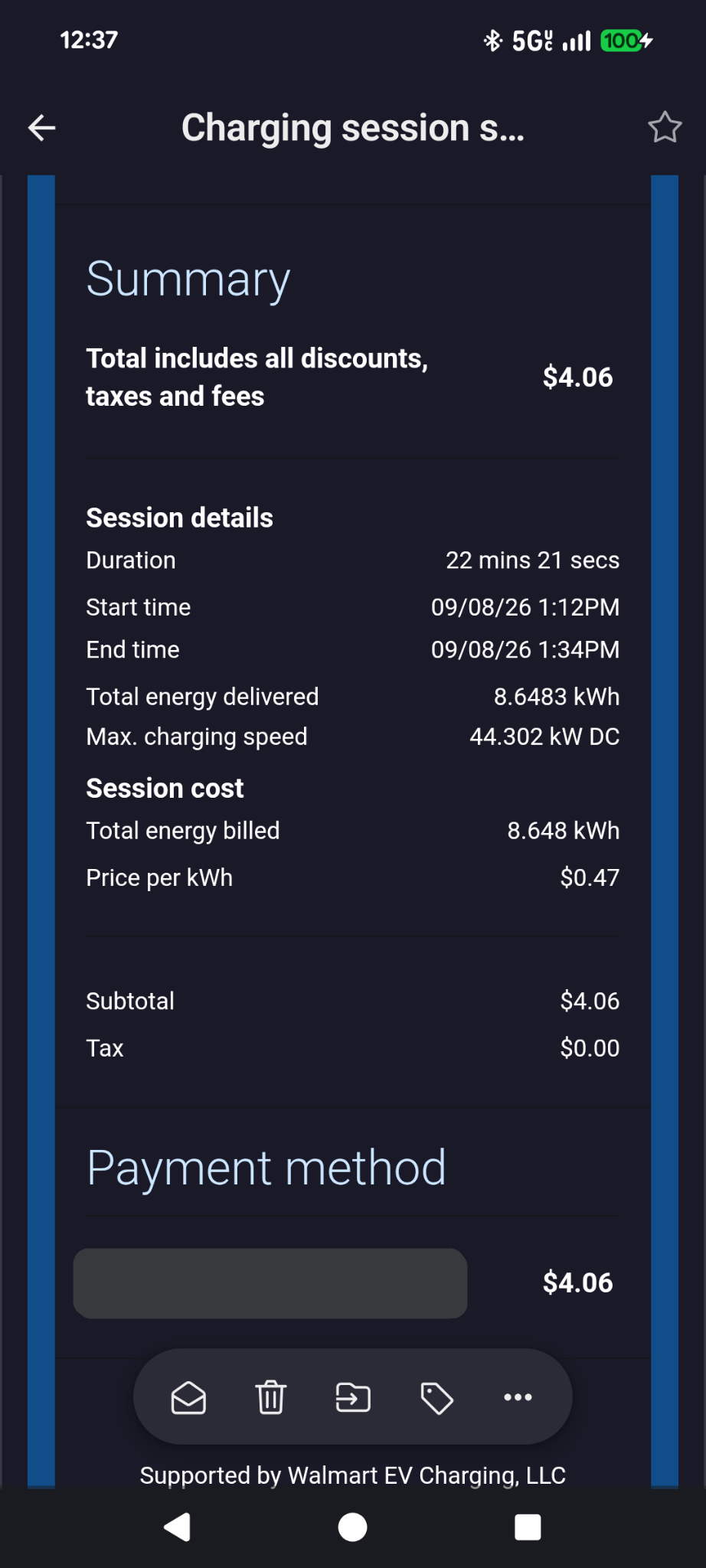
$.47 per kilowatt hour? That seems very high to me. How does that compare to the household utility rate?
ComEd is about $0.20 per kwh if you include all the fees, so likely an included surcharge applied.
I'm at 20-22 cents at home and 40-60 using public charging here in philly.
DCFC is much more expensive than home rates. Approaching petrol cost per km. I don’t use them, but I think that would be an aggressively low rate around here.
The worst ones are the ones that bill by time, so if you have a slow car, it costs more.
Chargers based on time are usually due to laws about only power companies being able to charge for electricity usage.
Interesting. TIL. Makes sense that those laws exist.
Wait, why should an electric company be the only one allowed to sell electricity?
If I’m paying for it from them it’s mine. Can I put it in cellphone chargers and rent them out?
Why can’t I sell car charging to my buddy that comes and parks in my driveway and insists on paying for the pixies he uses?
I don’t know but would guess the official answer is something like:
But tbh my very first thought was landlord abuse
Edit: and FWIW what you’re describing sounds more like a service, like offering facilities for rent, than an illegal secondary energy market
I wonder if this applies to something like an off grid solar car charging setup.
I know the panel and weather requirements are hard to work around, maybe once salt or solid state batteries bring storage costs down we could have modular containers that could be dropped all through the desert or at gas stations and parking lots.
Off-grid part surely bumps the question into fruit stand territory (not a lawyer)
But decentralized energy storage is a foregone conclusion once you accept that the most abundant source of energy isn’t diurnal
Theres a l2 on city property that bills by time here. It comes out to be cheaper than charging at home. I think the city or something asked them to keep the rates low. The city ones were free for a long time too.
This is nuts, we pay 8c cad per kw/h.
I pay 0.1€ at home but fast charger that delivers about 100kW will cost about 0.4€. Chargers that deliver about 300kW cost even more 0.6-0.8€. It's normal, delivering 150kW costs more than 7kW.
Brb, moving to Canada.
With fast charging you are paying for the service not the power. Most people (that EVs make sense for) will do almost all their charging at home. Fast chargers are for road trips.
What service? It’s charger attached to public infrastructure. They also get better electrical rates than you do. And almost everyone who owns an EV that I know has a fast homer charger, can’t get any rebates without its installation.
You also won’t get much charge during winter if you just use a regular outlet charger. Too cold, and not fast enough.
The service is the fast charger being able to charge fast and being in a location you want to use it? The extra cost is to cover infrastructure costs like buying and installing the thing, leasing the land for it, running the technology, and replacing cables every time some muppet comes along with wire cutters. Plus the cost of running a network where some charge points are hardly used but still need to be maintained.
I use a wall outlet at home for my EV, it has never been an issue. I guess I live in a different environment. No rebates available so no incentive to install a faster home charger. We just charge a couple of times a week during the day when the car is home (we have solar so like to make use of it). If we need to go on a big trip we'll do a proper top up overnight. The weather doesn't get below freezing here really so YMMV.
Want? They’re by gas stations and malls.
They made the thing, it’s pure profit for them, they aren’t renting them lmfao.
Normally it’s the land owner, why would you rent land?
It’s a POS unit and a charger, what tech? Do you realize none of these things are a thing for GAS or Petrol..?
Insurance dude….
What…? How much cost do you think there is for an unused charger that doesn’t draw anything when not used? I already said it’s built off the public utilities… or do you think that they’re digging up a few 100 miles beside a road to run a power line….? This seriously isn’t what you’re thinking is it…..?
If it’s not getting to -30 to -50c, no, you really aren’t, and the vast majority of people refuse to acknowledge that.
Imagine if gas or another “service” charged 500% profit on the only cost they have….
If they aren't a service you want or need then I don't get why you're so upset about it.
Chargers are at places I want them, that place being other cities when I'm away from home. It is a service I am willing to pay for, and it's not expensive. The OP has a bill of $4!
They don't make them... They buy existing designs from a manufacturer and put their logo on it. They also have all the costs of running a business, like staff, maintenance, IT costs, and they have to replace units as they break or as technology changes. Not to mention that income from existing chargers funds the rollout of more chargers.
Because the owner of the mall you mentioned doesn't want to sell you a square of their land?
That's not how insurance works... if you're constantly getting copper stolen (they are), then they would have to pay more in insurance to cover this risk. I'd be almost certain it would be cheaper to treat it as a maintenance expense and pay for it out of pocket.
Every sensible EV conversation I've ever seen has had the caveat that they don't yet make sense for everyone. That doesn't mean we have to drag down the people who it does make sense for.
Almost $.27 here all in, just a few states away.
73 cents per kwh here :(
not OP but for me it depends, -9c (US6c) here in Australia. I have solar in my roof and 70% of the time i charge there but for every kW of solar I use my provider doesn't pay me 9c solar feed in fee.
We have timed tariffs in Australia to discourage peak useage, so I get a cheaper overnight tariff 10pm-6AM of 11c (US8c) and use that at times I need a top up over night eg very occasional get home late, leaving early situation. I can schedule charging on the car or on the charger. I have a BYD. For road tripping I have seen 40c-75c but don't really care as its a very infrequent use.
I agree, that's a couple cents higher than the superchargers in my area and those are level 3 chargers compared to this level 2. The level 2s in my area are in the .30 to .40 range
Washington here, I think our residential pricing is $0.13/KWh
My local charger is $0.30 to $0.60 per KWH, charging at home is ~$0.08 for me in the US. Costs me less than $3 for about 100 mile range when I charge from home.