this post was submitted on 24 May 2026
1710 points (99.2% liked)
Work Reform
17621 readers
2573 users here now
A place to discuss positive changes that can make work more equitable, and to vent about current practices. We are NOT against work; we just want the fruits of our labor to be recognized better.
Our Philosophies:
- All workers must be paid a living wage for their labor.
- Income inequality is the main cause of lower living standards.
- Workers must join together and fight back for what is rightfully theirs.
- We must not be divided and conquered. Workers gain the most when they focus on unifying issues.
Our Goals
- Higher wages for underpaid workers.
- Better worker representation, including but not limited to unions.
- Better and fewer working hours.
- Stimulating a massive wave of worker organizing in the United States and beyond.
- Organizing and supporting political causes and campaigns that put workers first.
founded 3 years ago
MODERATORS
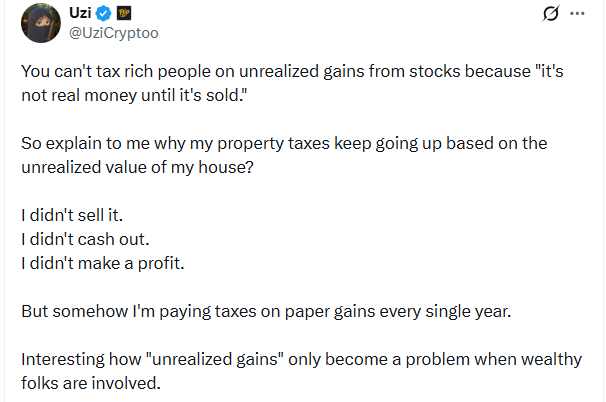
I think the idea that taxing the rich is difficult or our tax code is too complicated feeds into the narrative around the problem being too hard to solve. I think the reality is more straightforward:
Bring back the previous top tax bracket of 39% that Republicans did away with. That will bring in a significant revenue.
Raise or add the top brackets on the capital gains taxes.
Add a new top tax bracket of you want to raise more revenue, e.g. 46% above X millions.
When you look at reports by the congressional budget office or independent budget groups, most of the other proposals are noise in the grand scheme of things. Even the buy, borrow, die strategy that gets a lot of airtime (because it rightfully violates most people's sense of fair play) only really accounts for something like 2% of the funds used by the ultra wealthy.
Most of the things like wealth taxes would require more complex legislation and be treated by the courts, certainly going to the supreme court. But the above three bullets would meaningfully raise revenues, are simple in terms of legislation, and have clear statutory authority and case law on their side.
The only thing hard is electing enough people who actually care about the budget and the people.
Income tax may be a solution to government revenue, but it's not a solution to inequality.
Capital accumulates exponentially, and if you don't address that exponential growth, then there will be ludicrously wealthy people, social immobility, and all the problems we have now. Tax wealth.
Of course it will be complicated. Of course there will be court cases. All of that is true of the current system. We can't get to a working system if we don't even start. Tax wealth.
Agreed.
I don't think we even need to tax all wealth. We need to specifically tax registered securities. Financial assets.
Economically, it isn't a problem for a rich person to buy a yacht or a plane: Those assets were produced by workers; they are maintained by workers. The purchase of tangible assets means paychecks for the workers producing those assets. Economically, we shouldn't be discouraging the purchase of personal property assets.
The value the ultra-wealthy are capturing is the ownership of companies. The value of those companies is generated by workers, but is transferred to the ultra-wealthy. The workers are compensated with cash, rather than ownership interest.
What we need to do is make those securities more expensive for the ultra-wealthy to hold, and cheaper for the workers to hold. We need a progressive tax on securities, payable in shares of the security, rather than the dollar value of those securities.
Exactly. Company value shoots through the roof, it becomes a worker owned cooperative. Original owners get paid in cash, rather than in market distorting power.
Billionaires will argue they wouldn't take the bet, but they're bullshitting. They're constantly betting on stupider risks with lower payouts, all the time.
Forget 39%. We have greater national debt as a percentage of GDP than we did in 1944. We need to reinstitute the tax brackets from then until 1965, which had a top rate of 90%. There are reasons we had a middle class back then, and this is one of them.
Nobody paid that 90%. Just like today, there were methods around it.
But they paid much more, and that's the point.
What mulgrubs said, plus at least they had to work for it. Today, it's just handed to them.
Capital gains should just be taxed as regular income instead of having a special rate.
I think Denmark does it like that, but I haven’t verified with any Danes yet.
Realized capital gains are usually taxed at a higher rate depending on the amount of time it was held, but I agree high earners should be taxed a lot more.
Proposal:
minimum wage = 0% taxes
N * minimum wage = N% taxes
So mathematically that serves as a pay cap, because once you get to 100x you are taxed 100%. Some countries do have compensation caps for CEOs that are a multiple of the lowest paid employee, and I tend to like the model because it incentives increasing pay of employees who aren't generally considered competitive or in high demand, and those are the folks that need market intervention most.
In this exact formula, I suspect it would underwhelm. Someone who earned the federal minimum wage, $7.25/hour working full time would get a paltry $15,080 per year. Someone making $250k/year would only pay 16% income tax, a meet decrease. Now, maybe it is good to shift the cost burden more to the ultra wealthy giving relief to even those making good money. But that would require some data crunching to see where the breakpoint is.
Under that plan, the maximum net income would come from a gross income of 50x minimum wage. Above that, taxes rise faster than pay.
Any minimum raise hike would automatically cut income tax rates across the board.
What would likely happen is the same thing that happened when we had a 91% top-tier tax rate: People with gross earnings above that rate would figure out how to turn everything they bought into a deductible business expense, and spend until they were under the line. Which isn't really a problem, IMO, as that spending turns into worker compensation, rather than a rich-person's stock portfolio.
Under this plan, executive compensation would still come primarily in the form of stock rather than pay. That's already a problem, and this would compound it. Stock needs to be easy and cheap for the working class. It needs to be supremely expensive for the ultra rich to acquire and hold. We need cap gains taxes that start lower but progress much faster and higher than income taxes.
That pay cap would hit at about $1.5m. I think that's okay. I did some napkin math and eyeballed it to graph the proposed tax rates vs 2018's marginal and effective (because that's what was available): https://lemmy.zip/pictrs/image/61835557-1968-4d28-be95-493de6de6900.avif
It's not the worst idea I've heard, but I'd want to scale by the number of taxpayers in each bracket to find out how much tax revenue we'd win or lose. A real congressional study would also consider what is considered "income" for tax purposes, and whether this would cause anyone to get creative with their compensation to avoid paying more tax (well, even more than they already do).
How difficult would it be to enact legislation to prevent using loans against stock/assets and avoiding income/capital gains tax? Something like "if you have things worth money you need to sell them before taking a frivolous loan."? Idk I just hate that loophole
Very hard, since you can just take the loan in a different country, even in USD.
Wealth tax is probably much easier.
you literally missed the point on the tax loop literally all billionaires use.