this post was submitted on 07 Dec 2025
1063 points (98.1% liked)

Technology

77096 readers
3425 users here now

This is a most excellent place for technology news and articles.


Our Rules


  1. Follow the lemmy.world rules.
  2. Only tech related news or articles.
  3. Be excellent to each other!
  4. Mod approved content bots can post up to 10 articles per day.
  5. Threads asking for personal tech support may be deleted.
  6. Politics threads may be removed.
  7. No memes allowed as posts, OK to post as comments.
  8. Only approved bots from the list below, this includes using AI responses and summaries. To ask if your bot can be added please contact a mod.
  9. Check for duplicates before posting, duplicates may be removed
  10. Accounts 7 days and younger will have their posts automatically removed.

Approved Bots


founded 2 years ago
MODERATORS
 

Just want to clarify, this is not my Substack, I'm just sharing this because I found it insightful.

The author describes himself as a "fractional CTO"(no clue what that means, don't ask me) and advisor. His clients asked him how they could leverage AI. He decided to experience it for himself. From the author(emphasis mine):

I forced myself to use Claude Code exclusively to build a product. Three months. Not a single line of code written by me. I wanted to experience what my clients were considering—100% AI adoption. I needed to know firsthand why that 95% failure rate exists.

I got the product launched. It worked. I was proud of what I’d created. Then came the moment that validated every concern in that MIT study: I needed to make a small change and realized I wasn’t confident I could do it. My own product, built under my direction, and I’d lost confidence in my ability to modify it.

Now when clients ask me about AI adoption, I can tell them exactly what 100% looks like: it looks like failure. Not immediate failure—that’s the trap. Initial metrics look great. You ship faster. You feel productive. Then three months later, you realize nobody actually understands what you’ve built.

top 50 comments
sorted by: hot top controversial new old
[–] phed@lemmy.ml 24 points 3 days ago (2 children)

I do a lot with AI but it is not good enough to replace humans, not even close. It repeats the same mistakes after you tell it no, it doesn't remember things from 3 messages ago when it should. You have to keep re-explaining the goal to it. It's wholey incompetant. And yea when you have it do stuff you aren't familiar with or don't create, def. I have it write a commentary, or I take the time out right then to ask it what x or y does then I add a comment.

[–] kahnclusions@lemmy.ca 15 points 3 days ago* (last edited 2 days ago) (1 children)

Even worse, the ones I’ve evaluated (like Claude) constantly fail to even compile because, for example, they mix usages of different SDK versions. When instructed to use version 3 of some package, it will add the right version as a dependency but then still code with missing or deprecated APIs from the previous version that are obviously unavailable.

More time (and money, and electricity) is wasted trying to prompt it towards correct code than simply writing it yourself and then at the end of the day you have a smoking turd that no one even understands.

LLMs are a dead end.

[–] MangoCats@feddit.it 4 points 2 days ago (4 children)

constantly fail to even compile because, for example, they mix usages of different SDK versions

Try an agentic tool like Claude Code - it closes the loop by testing the compilation for you, and fixing its mistakes (like human programmers do) before bothering you for another prompt. I was where you are at 6 months ago, the tools have improved dramatically since then.

From TFS > I needed to make a small change and realized I wasn’t confident I could do it. My own product, built under my direction, and I’d lost confidence in my ability to modify it.

That sounds like a "fractional CTO problem" to me (IMO a fractional CTO is a guy who convinces several small companies that he's a brilliant tech genius who will help them make their important tech decisions without actually paying full-time attention to any of them. Actual tech experience: optional.)

If you have lost confidence in your ability to modify your own creation, that's not a tools problem - you are the tool, that's a you problem. It doesn't matter if you're using an LLM coding tool, or a team of human developers, or a pack of monkeys to code your applications, if you don't document and test and formally develop an "understanding" of your product that not only you but all stakeholders can grasp to the extent they need to, you're just letting the development run wild - lacking a formal software development process maturity. LLMs can do that faster than a pack of monkeys, or a bunch of kids you hired off Craigslist, but it's the exact same problem no matter how you slice it.

[–] kahnclusions@lemmy.ca 1 points 2 days ago* (last edited 2 days ago)

If you mean I have to install Claude’s software on my own computer, no thanks.

load more comments (3 replies)
[–] echodot@feddit.uk 10 points 3 days ago (2 children)

There's no point telling it not to do x because as soon as you mention it x it goes into its context window.

It has no filter, it's like if you had no choice in your actions, and just had to do every thought that came into your head, if you were told not to do a thing you would immediately start thinking about doing it.

[–] kahnclusions@lemmy.ca 4 points 2 days ago* (last edited 2 days ago) (1 children)

I’ve noticed this too, it’s hilarious(ly bad).

Especially with image generation, which we were using to make some quick avatars for a D&D game. “Draw a picture of an elf.” Generates images of elves that all have one weird earring. “Draw a picture of an elf without an earing.” Great now the elves have even more earrings.

load more comments (1 replies)
[–] dejected_warp_core@lemmy.world 47 points 3 days ago (1 children)

To quote your quote:

I got the product launched. It worked. I was proud of what I’d created. Then came the moment that validated every concern in that MIT study: I needed to make a small change and realized I wasn’t confident I could do it. My own product, built under my direction, and I’d lost confidence in my ability to modify it.

I think the author just independently rediscovered "middle management". Indeed, when you delegate the gruntwork under your responsibility, those same people are who you go to when addressing bugs and new requirements. It's not on you to effect repairs: it's on your team. I am Jack's complete lack of surprise. The idea that relying on AI to do nuanced work like this and arrive at the exact correct answer to the problem, is naive at best. I'd be sweating too.

[–] fuck_u_spez_in_particular@lemmy.world 11 points 3 days ago (1 children)

The problem though (with AI compared to humans): The human team learns, i.e. at some point they probably know what the mistake was and avoids doing it again. AI instead of humans: well maybe the next or different model will fix it maybe...

And what is very clear to me after trying to use these models, the larger the code-base the worse the AI gets, to the point of not helping at all or even being destructive. Apart from dissecting small isolatable pieces of independent code (i.e. keep the context small for the AI).

Humans likely get slower with a larger code-base, but they (usually) don't arrive at a point where they can't progress any further.

load more comments (1 replies)
[–] DupaCycki@lemmy.world 9 points 2 days ago

Personally I tried using LLMs for reading error logs and summarizing what's going on. I can say that even with somewhat complex errors, they were almost always right and very helpful. So basically the general consensus of using them as assistants within a narrow scope.

Though it should also be noted that I only did this at work. While it seems to work well, I think I'd still limit such use in personal projects, since I want to keep learning more, and private projects are generally much more enjoyable to work on.

Another interesting use case I can highlight is using a chatbot as documentation when the actual documentation is horrible. However, this only works within the same ecosystem, so for instance Copilot with MS software. Microsoft definitely trained Copilot on its own stuff and it's often considerably more helpful than the docs.

[–] Nalivai@lemmy.world 32 points 3 days ago (1 children)

They never actually say what "product" do they make, it's always "shipped product" like they're fucking amazon warehouse. I suspect because it's some trivial webpage that takes an afternoon for a student to ship up, that they spent three days arguing with an autocomplete to shit out.

[–] e461h@sh.itjust.works 7 points 3 days ago

Cloudflare, AWS, and other recent major service outages are what come to mind re: AI code. I’ve no doubt it is getting forced into critical infrastructure without proper diligence.

Humans are prone to error so imagine the errors our digital progeny are capable of!

[–] edgemaster72@lemmy.world 202 points 4 days ago (9 children)

Not immediate failure—that’s the trap. Initial metrics look great. You ship faster. You feel productive.

And all they'll hear is "not failure, metrics great, ship faster, productive" and go against your advice because who cares about three months later, that's next quarter, line must go up now. I also found this bit funny:

I forced myself to use Claude Code exclusively to build a product. Three months. Not a single line of code written by me... I was proud of what I’d created.

Well you didn't create it, you said so yourself, not sure why you'd be proud, it's almost like the conclusion should've been blindingly obvious right there.

[–] AutistoMephisto@lemmy.world 100 points 4 days ago (5 children)

The top comment on the article points that out.

It's an example of a far older phenomenon: Once you automate something, the corresponding skill set and experience atrophy. It's a problem that predates LLMs by quite a bit. If the only experience gained is with the automated system, the skills are never acquired. I'll have to find it but there's a story about a modern fighter jet pilot not being able to handle a WWII era Lancaster bomber. They don't know how to do the stuff that modern warplanes do automatically.

[–] logicbomb@lemmy.world 52 points 4 days ago (2 children)

It's more like the ancient phenomenon of spaghetti code. You can throw enough code at something until it works, but the moment you need to make a non-trivial change, you're doomed. You might as well throw away the entire code base and start over.

And if you want an exact parallel, I've said this from the beginning, but LLM coding at this point is the same as offshore coding was 20 years ago. You make a request, get a product that seems to work, but maintaining it, even by the same people who created it in the first place, is almost impossible.

load more comments (2 replies)
load more comments (4 replies)
load more comments (8 replies)
[–] Agent641@lemmy.world 47 points 4 days ago (6 children)

I cannot understand and debug code written by AI. But I also cannot understand and debug code written by me.

Let's just call it even.

load more comments (6 replies)
[–] ignirtoq@feddit.online 134 points 4 days ago (7 children)

We’re about to face a crisis nobody’s talking about. In 10 years, who’s going to mentor the next generation? The developers who’ve been using AI since day one won’t have the architectural understanding to teach. The product managers who’ve always relied on AI for decisions won’t have the judgment to pass on. The leaders who’ve abdicated to algorithms won’t have the wisdom to share.

Except we are talking about that, and the tech bro response is "in 10 years we'll have AGI and it will do all these things all the time permanently." In their roadmap, there won't be a next generation of software developers, product managers, or mid-level leaders, because AGI will do all those things faster and better than humans. There will just be CEOs, the capital they control, and AI.

What's most absurd is that, if that were all true, that would lead to a crisis much larger than just a generational knowledge problem in a specific industry. It would cut regular workers entirely out of the economy, and regular workers form the foundation of the economy, so the entire economy would collapse.

"Yes, the planet got destroyed. But for a beautiful moment in time we created a lot of value for shareholders."

[–] grue@lemmy.world 66 points 4 days ago

That's why they're all-in on authoritarianism.

load more comments (6 replies)
[–] pdxfed@lemmy.world 60 points 4 days ago (5 children)

Great article, brave and correct. Good luck getting the same leaders who blindly believe in a magical trend for this or next quarters numbers; they don't care about things a year away let alone 10.

I work in HR and was stuck by the parallel between management jobs being gutted by major corps starting in the 80s and 90s during "downsizing" who either never replaced them or offshore them. They had the Big 4 telling them it was the future of business. Know who is now providing consultation to them on why they have poor ops, processes, high turnover, etc? Take $ on the way in, and the way out. AI is just the next in long line of smart people pretending they know your business while you abdicate knowing your business or employees.

Hope leaders can be a bit braver and wiser this go 'round so we don't get to a cliffs edge in software.

load more comments (5 replies)
[–] Evotech@lemmy.world 24 points 3 days ago (2 children)

Just ask the ai to make the change?

[–] theneverfox@pawb.social 21 points 3 days ago (16 children)

AI isn't good at changing code, or really even understanding it... It's good at writing it, ideally 50-250 lines at a time

load more comments (16 replies)
[–] BarneyPiccolo@lemmy.today 11 points 3 days ago (8 children)

I don't know shit about anything, but it seems to me that the AI already thought it gave you the best answer, so going back to the problem for a proper answer is probably not going to work. But I'd try it anyway, because what do you have to lose?

Unless it gets pissed off at being questioned, and destroys the world. I've seen more than few movies about that.

load more comments (8 replies)
[–] raspberriesareyummy@lemmy.world 67 points 4 days ago (29 children)

So there's actual developers who could tell you from the start that LLMs are useless for coding, and then there's this moron & similar people who first have to fuck up an ecosystem before believing the obvious. Thanks fuckhead for driving RAM prices through the ceiling... And for wasting energy and water.

[–] psycotica0@lemmy.ca 105 points 4 days ago (4 children)

I can least kinda appreciate this guy's approach. If we assume that AI is a magic bullet, then it's not crazy to assume we, the existing programmers, would resist it just to save our own jobs. Or we'd complain because it doesn't do things our way, but we're the old way and this is the new way. So maybe we're just being whiny and can be ignored.

So he tested it to see for himself, and what he found was that he agreed with us, that it's not worth it.

Ignoring experts is annoying, but doing some of your own science and getting first-hand experience isn't always a bad idea.

[–] 5too@lemmy.world 51 points 4 days ago (1 children)

And not only did he see for himself, he wrote up and published his results.

load more comments (1 replies)
[–] bassomitron@lemmy.world 40 points 4 days ago (4 children)

100% this. The guy was literally a consultant and a developer. It'd just be bad business for him to outright dismiss AI without having actual hands on experience with said product. Clients want that type of experience and knowledge when paying a business to give them advice and develop a product for them.

load more comments (4 replies)
load more comments (2 replies)
load more comments (28 replies)
[–] Suffa@lemmy.wtf 32 points 4 days ago (43 children)

AI is really great for small apps. I've saved so many hours over weekends that would otherwise be spent coding a small thing I need a few times whereas now I can get an AI to spit it out for me.

But anything big and it's fucking stupid, it cannot track large projects at all.

load more comments (43 replies)
[–] Unlearned9545@lemmy.world 52 points 4 days ago (4 children)

Fractional CTO: Some small companies benefit from the senior experience of these kinds of executives but don't have the money or the need to hire one full time. A fraction of the time they are C suite for various companies.

load more comments (4 replies)
[–] vpol@feddit.uk 60 points 4 days ago (13 children)

The developers can’t debug code they didn’t write.

This is a bit of a stretch.

[–] Xyphius@lemmy.ca 47 points 4 days ago

agreed. 50% of my job is debugging code I didn't write.

load more comments (12 replies)
[–] minorkeys@lemmy.world 7 points 3 days ago (2 children)

It looks like a rigid design philosophy that must completely rebuild for any change. If the speed of production becomes fast enough, and the cost low enough, iterating the entire program for every change would become feasible and cost effective.

[–] MangoCats@feddit.it 4 points 2 days ago

I frequently feel that urge to rebuild from ground (specifications) up, to remove the "old bad code" from the context window and get back to the "pure" specification as the source of truth. That only works up to a certain level of complexity. When it works it can be a very fast way to "fix" a batch of issues, but when the problem/solution is big enough the new implementation will have new issues that may take longer to identify as compared with just grinding through the existing issues. Devil whose face you know kind of choice.

load more comments (1 replies)
[–] CarbonatedPastaSauce@lemmy.world 61 points 4 days ago* (last edited 4 days ago) (14 children)

Something any (real, trained, educated) developer who has even touched AI in their career could have told you. Without a 3 month study.

[–] AutistoMephisto@lemmy.world 74 points 4 days ago* (last edited 4 days ago) (4 children)

What's funny is this guy has 25 years of experience as a software developer. But three months was all it took to make it worthless. He also said it was harder than if he'd just wrote the code himself. Claude would make a mistake, he would correct it. Claude would make the same mistake again, having learned nothing, and he'd fix it again. Constant firefighting, he called it.

load more comments (4 replies)
load more comments (13 replies)
[–] lepinkainen@lemmy.world 13 points 3 days ago* (last edited 1 day ago) (1 children)

Same thing would happen if they were a non-coder project manager or designer for a team of actual human programmers.

Stuff done, shipped and working.

“But I can’t understand the code 😭”, yes. You were the project manager why should you?

[–] JcbAzPx@lemmy.world 36 points 3 days ago (10 children)

I think the point is that someone should understand the code. In this case, no one does.

load more comments (10 replies)
[–] deathbird@mander.xyz 26 points 4 days ago (1 children)

I think this kinda points to why AI is pretty decent for short videos, photos, and texts. It produces outputs that one applies meaning to, and humans are meaning making animals. A computer can't overlook or rationalize a coding error the same way.

load more comments (1 replies)
[–] rimu@piefed.social 45 points 4 days ago* (last edited 4 days ago) (17 children)

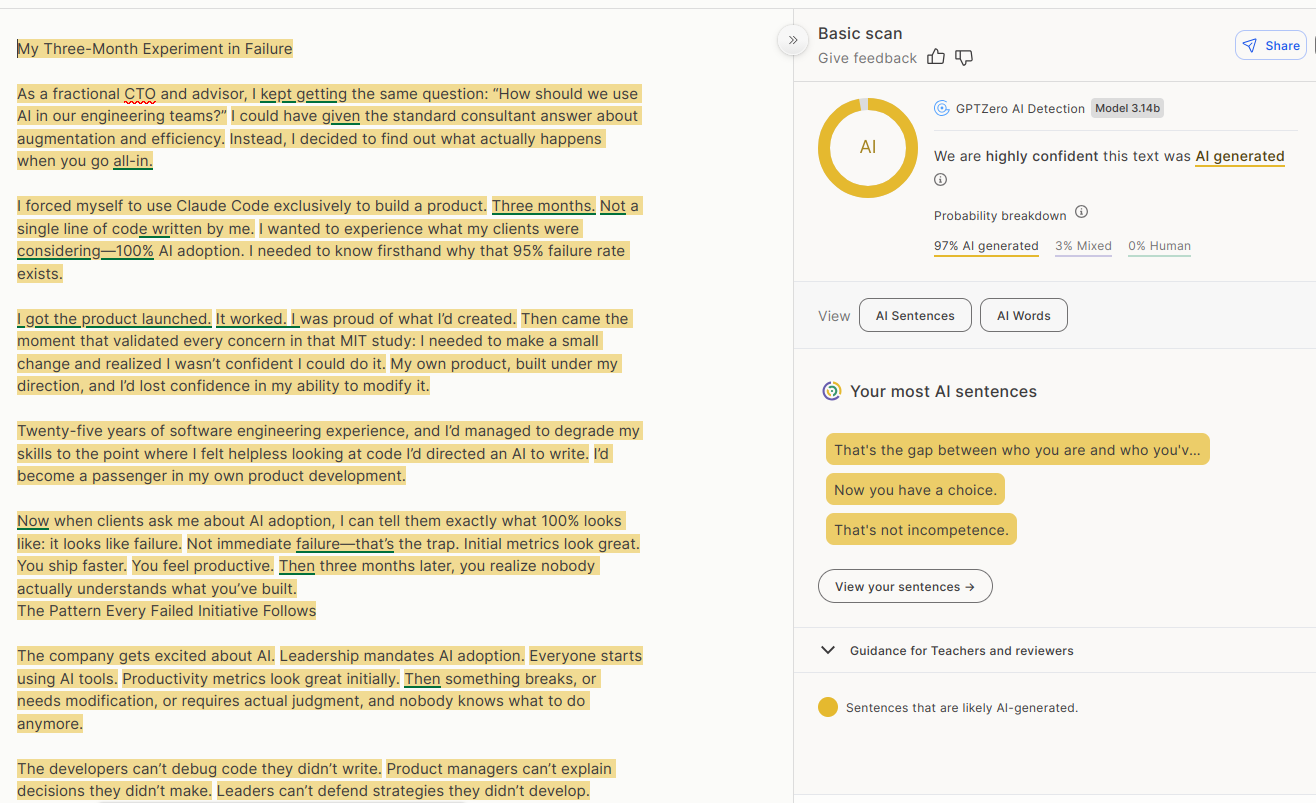
FYI this article is written with a LLM.

image

Don't believe a story just because it confirms your view!

load more comments (17 replies)
load more comments
view more: next ›