
Aufmerksamkeitsdefizithyperaktivitätssyndrom
this post was submitted on 07 Oct 2026
104 points (95.6% liked)
Ask Lemmy
41772 readers
2331 users here now
A Fediverse community for open-ended, thought provoking questions
Rules: (interactive)
1) Be nice and; have fun
Doxxing, trolling, sealioning, racism, toxicity and dog-whistling are not welcomed in AskLemmy. Remember what your mother said: if you can't say something nice, don't say anything at all. In addition, the site-wide Lemmy.world terms of service also apply here. Please familiarize yourself with them
2) All posts must end with a '?'
This is sort of like Jeopardy. Please phrase all post titles in the form of a proper question ending with ?
3) No spam
Please do not flood the community with nonsense. Actual suspected spammers will be banned on site. No astroturfing.
4) NSFW is okay, within reason
Just remember to tag posts with either a content warning or a [NSFW] tag. Overtly sexual posts are not allowed, please direct them to either !asklemmyafterdark@lemmy.world or !asklemmynsfw@lemmynsfw.com.
NSFW comments should be restricted to posts tagged [NSFW].
5) This is not a support community.
It is not a place for 'how do I?', type questions.
If you have any questions regarding the site itself or would like to report a community, please direct them to Lemmy.world Support or email info@lemmy.world. For other questions check our partnered communities list, or use the search function.
6) No US Politics.
Please don't post about current US Politics. If you need to do this, try !politicaldiscussion@lemmy.world or !uspolitics@lemmy.world
7) No Hit-and-Run questions.
Please don't delete your post for no apparent reason. If you plan on deleting a question later, say so in the post, or if you feel that you have a good reason to remove it, message a mod beforehand. It's not fair to the ones who took their time to answer, and it's not in the spirit of the community.
8) No Bots.
Posts or comments from bots, LLM's, AIs, Neural Networks, Transformers, or Marvin the Paranoid Android are not welcome in AskLemmy. Real humans only please.
Reminder: The terms of service apply here too.
Partnered Communities:
Logo design credit goes to: tubbadu
founded 3 years ago
MODERATORS
ya, da sperkenzspleitzchenraufmoderhausen
Mundhirnverbindungslatenz.
German compound nouns are just written without spaces. There's no grammatical difference between "Schlafsack" (= Schlaf "sleep" + Sack "bag") and "sleeping bag", except the way they're written down. In English we analyse a "word" as "a thing you write down with spaces on either side", which is valid as a definition or as an analysis, but it's not what we really think of when we talk about words, which we think of as something more fundamental.
If, tomorrow, we decided in English to write compound nouns without spaces, the language would have suddenly gained thousands and thousands of words, yet the only real difference would be a rule about writing things down. Spoken English would be exactly the same, so nothing fundamental about the actual bits of English would have changed.
One of my frustrations with English is that spaces in compound nouns are arbitrary. We have fishbowl but also fish tank.
Well the rest of the rules around written English are arbitrary, why would this one be different?!
I think I'd write fish bowl separately though.
What would you call this?

oh no. you broke the English language!
delightful?
Username checks out
My fish bowl in a fishbowl.
Pink Floyd:
How I wish, how I wish you were here
We're just two lost souls swimming in
a fishbowl, year after year
Running over the same old ground, what have we found?
The same old fears, wish you were here
Seems I'm just old-fashioned:
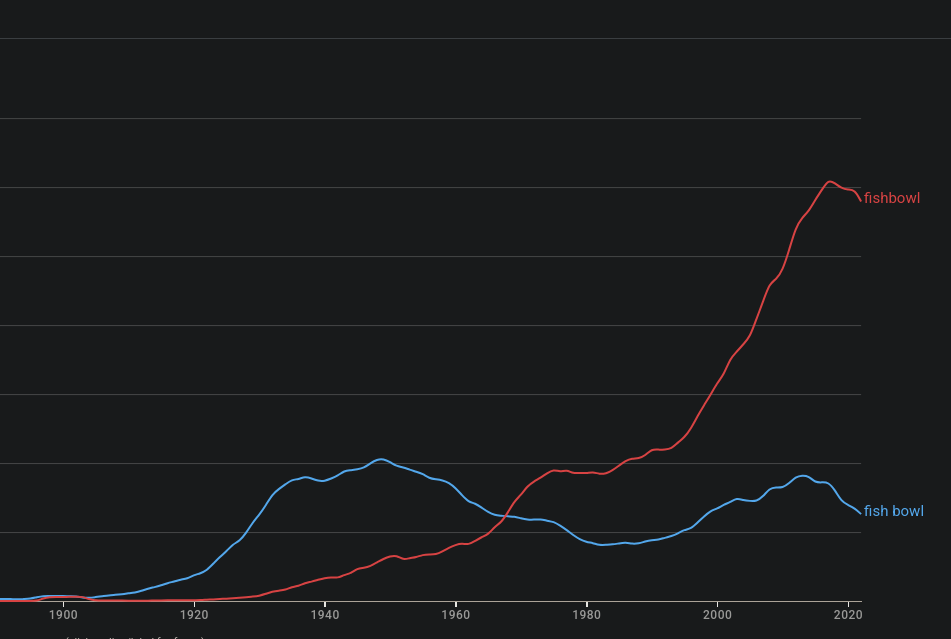
Wikipedia explains "the rules."
Tap for spoiler
They're more suggestions.
Orthography: open, hyphenated, or solid (closed up)
English uses many open compound nouns, a large subclass of which, by convention in accepted English orthography, are not closed up (not solidified) and are sometimes optionally hyphenated in attributive position (that is, when functioning as a noun adjunct). Examples are high school, kidney disease, and file format. Although some other languages would close up these nouns' components (for example, German usually does so), English has a tendency whereby it closes up only certain ones, usually only ones in which the head noun is monosyllabic (and even within that category, only sometimes, and in a way that is not fully standardized). For example, data set and dataset, or file name and filename, are accepted alternative forms, but file format, data format, and data analysis, which have multisyllabic heads (format and analysis), can only be spelled as open in accepted English orthography. This pattern holds for countless nouns with few exceptions. For the class with monosyllabic heads, there is a tendency that "compounds tend to solidify as they age,"[5]: 368 which is how a term such as data set becomes dataset, pin-up becomes pinup,[5]: 368 coal mine becomes coalmine, bottle cap becomes bottlecap, and so on. Such alternative forms usually continue to coexist in accepted use; style guides often convene on preferred dictionaries as a way of achieving consistency, by declaring that the headword form there will be the default styling for each such term.
Depends if it's a fish bowl (a bowl for a fish) or a fishbowl (a big watered down drink you can buy from bad nightclubs)
load more comments
(1 replies)
Mostly true, but in standard German one would normally vocalize "Schlafsack" without any audible pause between the f and the s.
If you were to pronounce "Schlaf sack", there would generally be an expectation of a glottal stop between the f and the s (dialects excluded).
So while, yes, compound words in German are written without spaces, that's not just a writing difference.
This is the same in English between "sleeping" and "bag". The pronunciation of "ing ba" in "sleeping bag" is exactly the same as the pronunciation of "ingba" in "dingbat".
In German, just the same: there is not generally a pause between words written separately: there's no gap that you can find on a spectrogram of a recording of someone saying, say, "brauner Sack" between the two words.
I think people are surprised to hear this, so one explanation for what you wrote is that you genuinely believe in speech there is generally a tiny pause between words, that you don't find within words. It's difficult to find a good citation for this because it's a fairly basic fact in linguistics, in spite of how surprising it may be; the best I came up with was this Duolingo post
But you may already be aware of that and be getting at something else: in German, "Schlafsack" is a word that will be understood by anyone if you say it in the normal way. To get someone to understand that you're saying the two words "Schlaf Sack" next to one another without understanding "Schlafsack", you need to do something to make it clear, otherwise they'll understand the normal word. And one way to do that would be to insert a tiny gap. This is different though: in English if you wanted someone to understand "sleeping bag" not as the thing you use while camping but, perhaps, an anthropomorphic bag that is having a nap, you need to employ something similar. So this is not a difference between the languages.
In German, just the same: there is not generally a pause between words written separately: there’s no gap that you can find on a spectrogram of a recording of someone saying, say, “brauner Sack” between the two words.
At the cost of appealing to authority: As a native German speaker, I can absolutely hear the glottal stop between two separate words. It exists. It can also often be found between consecutive vowels within a word, but not necessarily between consecutive consonants like in your example. There's a reason why it's in the IPA. It's also e.g. the basis for the "gender not-really-neutral" dialect of German, which injects an additional glottal stop into a word (like Bürger:innen, which is pronounced like Bürger innen, not like Bürgerinnen).
Paradoxically, non-native speakers tend to be better at analysing this kind of thing ;) German for sure does not have a glottal stop between most words. "Das Kind" is /daskınt/ not /dasʔkınt/.
I'm not sure if I've misunderstood you and this isn't what you're saying happens...
“Das Kind” is /daskınt/ not /dasʔkınt/.
It absolutely is /dasʔkınt/ in the standard German I've grown up with. I've never heard ~~anyone~~ any native speaker pronounce it as /daskınt/.
Can you find a recording (not necessarily of someone saying "das kind", but of any two words, the first ending and the second beginning with a consonant) where you can hear this glottal stop put in between? It should come from flowing speech, not the boundary of a clause or sentence where the speaker might insert an extra pause, of course. If you want to record yourself demonstrating it, that would be perfect but I appreciate you may not want to.
Ideally also a recording of as much of the same sequence of sounds without it, for comparison, but that's less important :)
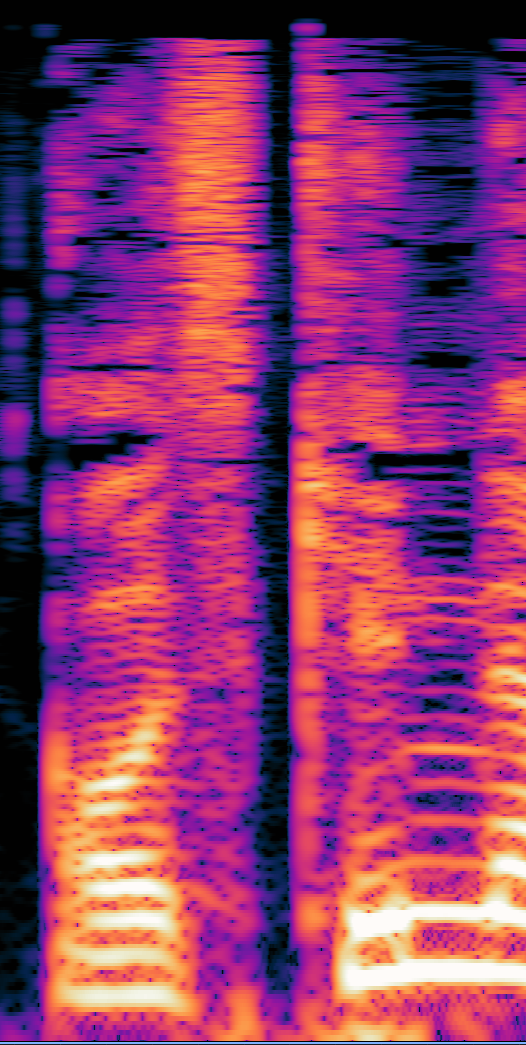
edit: realised I could give you an example myself. Here's a recording from Wiktionary, a native speaker saying "aus Kindern werden Leute". There is no glottal stop between any of the words.
And while finding that I realised there is a point from the other direction: in precise speech, there is a glottal stop in German compounds where the second part starts with a vowel sound. So Spiegelei is listed in the Duden as having a glottal stop before the "Ei".
If you provide storage to upload four audio .wav files (each about 400 KiB), I can send you samples generated by me speaking, then cloned with w-okada using a generic voice I believe is freely usable. It's far from perfect, but it's good enough for me to clearly tell which is which just by listening.
I don't know of anywhere suitable, sorry. Also if you are not comfortable sharing your own voice (which I perfectly understand, I also would not want to) I don't think a voice changer is the way to go.
Maybe we will have to leave that thread here then - I also understand if you don't want to go digging for examples. I would be interested to know still if you hear the glottal stops you're talking about in the example above, though?
Generalising the Spiegelei example: in order to read a word in a language which writes its compounds without spaces, you need to be able to break words down into their compounds correctly. Just reading the letters, with no knowledge of vocabulary, "Gewinnspiel" could be analysed in at least two ways: "Gewinns·piel" or "Gewinn·spiel". The "s" would be pronounced differently between the two analyses (respectively as a /z/ or a /ʃ/ following regular German pronunciation rules).
Fun stuff!
I would be interested to know still if you hear the glottal stops you’re talking about in the example above, though?
In the voice changed output for "Das Kind"? It's not perfect, but yes. If you're interested in the "biomechanics": It's the difference between a miniscule stopping of the continuous exhalation from your mouth for the s before starting a new burst exhalation for the k vs doing both as part of the same single exhalation that directly changes from continuous to burst.
I meant the "aus Kindern werden Leute" recording
Yes, there's a stop of exhalation between the s and the K. If there wasn't, it would sound more like the sk of the English word sky instead.
EDIT: He does not, however, stop between Kindern and werden and not between werden and Leute, which does sound weird to me. Less like standard German and more like a dialect.
Well, there has to be a stop of exhalation, because the "k" sound is a stop and that is basically the definition of a stop! One thing I want to be pedantic about though: this is not a glottal stop, which is a specific sound made by closing the glottis. "k" denotes a velar stop, which is different.
You can see this stop as a dark area on the spectrogram:
But here's the spectrogram of someone saying sky:
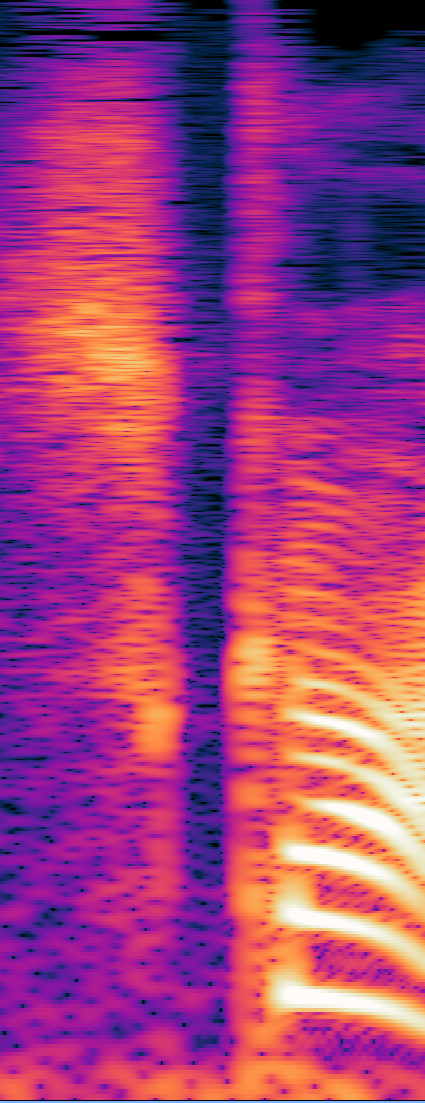
You can see there is the same dark area! Pronouncing a "k" requires cutting off the airstream in the middle of a word also. The duration is about the same; 30 or 40ms in both cases.
If you look further through "aus Kindern werden Leute" in an audio editor you won't see this dark area between "Kindern" and "werden", nor between "werden" and "Leute". These don't have stops between them, so the sound is continuous, even though they're separate words.
It's easy to see the stop in "Leute" - this is almost as complete as that between "aus" and "Kindern". Less obvious are those in "Kindern" and "werden" (both for a letter "d"), but you can also see the dark areas.
I hope this is enough to explain how what you're hearing between some words also occurs within words, and between many words this phenomenon doesn't happen. Phonetics is tricky. It's like learning to draw - at first you don't hear (or see) just what is there, but instead what you know is there. You know that "aus Kindern" or "das Kind" is two separate words, so you hear a break. You know that "Leute" or "sky" is one word, so you don't hear any break.
I didn't believe you at first so I checked a few. This kind of ruins the magic tbh.
Wow, I actually learned something today.
load more comments
(10 replies)
ADHD?
German words don't tend to be long and convoluted. That's just a stereotype due to writing rules.
A sentence spelled without spaces isn't a word.
load more comments
(6 replies)
Not that I am aware of, sorry.
All the words posted before by the others in the thread are made up, and some of them aren't even good at pretending to be German.
All words are made up...
Yeah but not all of them are rectently made up by an individual person for the purpose of being posted here in order to mislead others about words that are in practical use.
Off topic, but in English, it’s called an ‘audio processing disorder’
What? No say the exact same words again. What’s a singdis? Audio process singdis order? Audio processing disorder! Oh, I have one of those! Why? What’s up? I wasn’t listening.
Umgekehrt proportionales-Denk-plapper Verhältnis?
What?
Oh, why do you care? You wouldn't be able to pronounce it anyway :)
Not that I'm aware of but you can always make one up.
Like "verarbeitiungszeitintensive Frage" or something like that.
load more comments
(2 replies)
Dumme Angewohnheit.
No but they do have a word for asking about it
Shaddenlisten
Ooh I've had this happen
view more: next ›