this post was submitted on 28 Aug 2026
265 points (92.1% liked)
Piracy: ꜱᴀɪʟ ᴛʜᴇ ʜɪɢʜ ꜱᴇᴀꜱ
70344 readers
294 users here now
⚓ Dedicated to the discussion of digital piracy, including ethical problems and legal advancements.
Rules • Full Version
1. Posts must be related to the discussion of digital piracy
2. Don't request invites, trade, sell, or self-promote
3. Don't request or link to specific pirated titles, including DMs
4. Don't submit low-quality posts, be entitled, or harass others

Loot, Pillage, & Plunder
We heartily recommend visiting the free port of freemediaheckyeah (aka FMHY) while you sail the high seas, for all the freshest links the ocean has to offer.

📜 c/Piracy Wiki (Community Edition):
🏴☠️ Other communities
FUCK ADOBE!
Torrenting/P2P:
- !seedboxes@lemmy.dbzer0.com
- !trackers@lemmy.dbzer0.com
- !qbittorrent@lemmy.dbzer0.com
- !libretorrent@lemmy.dbzer0.com
- !soulseek@lemmy.dbzer0.com
Gaming:
- !steamdeckpirates@lemmy.dbzer0.com
- !newyuzupiracy@lemmy.dbzer0.com
- !switchpirates@lemmy.dbzer0.com
- !3dspiracy@lemmy.dbzer0.com
- !retropirates@lemmy.dbzer0.com
💰 Please help cover server costs.
 |
 |
|---|---|
| Ko-fi | Liberapay |
founded 3 years ago
MODERATORS
you are viewing a single comment's thread
view the rest of the comments
view the rest of the comments
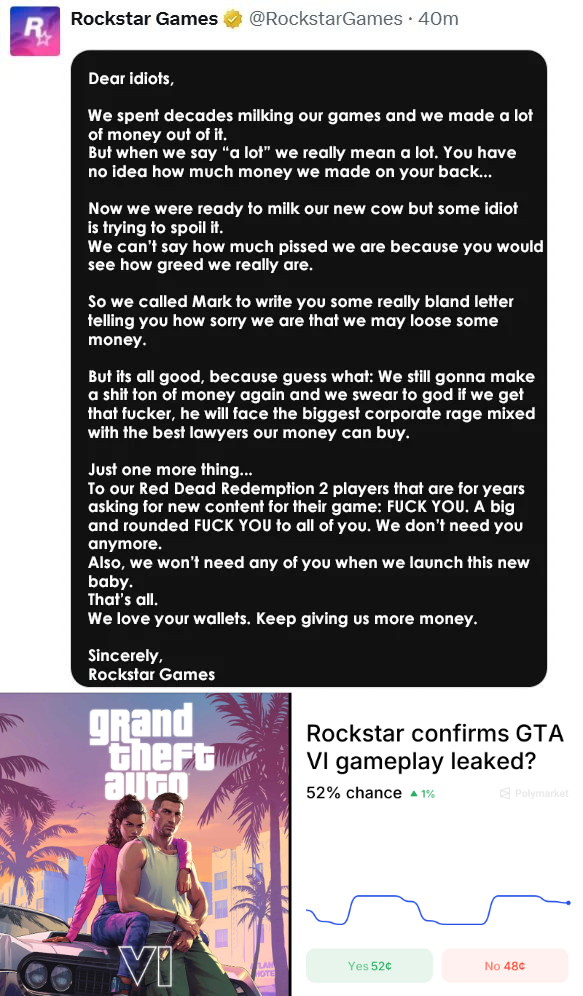
Why the fuck does nobody know the difference between loose and lose anymore? I swear this wasn't a thing that was commonly confused a few years back.
I'm gonna loose my mind over this!
It's probably a loost course.
That's the least of the grammatical problems in that post.
:eyetwitch:
It reads like it's written badly as a joke to me.
Yeah, I just assumed that English wasn't the writers first language.
There's a lot of stuff where native speakers make more mistakes than people who learn the language later in life, though. Not just with English.
It's vs. its is a classic, which is written very differently in many other languages. I suspect they mix them up less when they switch to English.
It's/its is also common mistake with non-native speakers.
The really obvious one is using of instead of instead of have. Would of. Should of. Could of. From would've, should've, could've. Non-native speakers will rarely if ever make that mistake.
Oh, yes! That's a much better example, thanks.
Non-native speakers tend to make mistakes with "its" vs "it's" because they learn that in English the rule for when to after a "subject" put an apostrophe followed by an "s" is when you're talking about something that subject has, but this case is an exception to that rule since " it " followed " 's " stands for " it is " whilst talking about something that " it " has is written " its ".
I mean, you can memorize there's an exception to the rule for this case, but if you're not paying enough attention when writting it's easy to make a mistake by unthinkingly following the rule as usual even though in this case it doesn't apply, and even if you re-read the text to check if it's alright, it's easy to miss it because you kinda have the right meaning in your mind so you read what you meant to write rather than what you wrote plus they're both valid forms so neither stands out as a spelling mistake even when misused.
Also a lot of folks just won't bother with' especially on mobile
I only someone could invent some kind of computerised grammar checking utility. ;)
You clearly aren't from an "english is the third language" country. I would not write like that but also I didn't notice the grammar errors until they were pointed out, my brain filtered them through.
"filtered them through" < "allowed them through, unfiltered" 🙇🏼♂️
However you wanna describe it, the point is that we tend to look for the meaning behind the words because we are used to hearing badly spoken English.
You do recognize the difference, though, regardless of "however [I] wanna describe it", yes? 😅
Hear me out:
Id rather see mistakes like this than
And not just bullets, but also other obvious signs of AI slop — emdash included.
Would you like me to-
:|
I dont usually bother typing apostrophes on mobile. Youll only see them from me when ive selected the recommended word while typing.
Ah, so you're confidently part of the fucking problem, I guess. 🙄
Part of what probkem?
Ah, it's worse than it seemed.
Ok, but it's not that hard, bro.
I appreciate how someone can complain about AI-speak and immediately refuse to make their text readable by humans.
“Why would I make “ive” easier to read?”
Not a lot of reflection in this one.
Where did i refuse? Please quote it, because i dont recall anyone telling me they were struggling and requested me to.
I didn't say it was hard, bro.
My comment was not a reading comprehension test, yet you failed.
Ah, so you're just an arsehole. Bye.
So you came to my comment, cold-criticized me for something you made up in your own head, and im the asshole for pointing it out to you?
Then you decide to call me names and leave?
lol classic
I don't know, but a lot of people in this thread seem to suggest that it's them not being a native speaker that's the problem.
In my experience it's actually the opposite, so many native speakers mess up things like your/you're, it's insane. Well, any time something is off about the English grammar on the internet, we blame the American education system.
Sometimes it's funny, though. Like "for all intensive purposes".
The thing is, it's not a "bone apple tea" moment, having only heard it vs reading. It's a single word, and a fairly simple thing to memorize the difference between "fail/forget" and "release/relaxed/wobbly", but... people are generally pretty stupid, and the truth is scary, so here we are. 🥲
I have come around to accept my occasional misspellings, incorrect verb forms, not really knowing with certainty when to use "in" or "on" and even mangled or mixed expressions whenever I write something in English (which is not my native language) as a way to show that the text was not written by AI.
PS: My personal top English-language mistake for a number of years was "later" vs "latter" - I genuinely thought that when I saw the word "latter" written, that was a spelling mistake and one time I even "corrected" a native English speaker on it (who should've pointed out my mistake, which I would've gladly accepted since I would rather be corrected than keep on making such a dumb mistake - as I did for a few more years - but this person was very middle class English).
The amount of times I've seen this error over the last 5+ years, and until now I've not seen one comment mention it. Thank you you've restored my faith in people knowing what words mean. I've got to the point that if I see it in prose I stop reading because I assume the writer is an idiot.
People saying "women" while meaning "woman" make my eye twitch too
Oh, it sure as hell was.
idk I always have a lil trouble with it and have to do a double take when writing it. it's just so ingrained that oo makes the u sound so theoretically lose should be spelled loose because lose should sound like lowe's. that might just be me doe
If it's spelled loose, then we could end up with another Buffalo buffalo Buffalo buffalo buffalo buffalo Buffalo buffalo
or Police police Police police police police Police police.
If lose should be spelled like loose, then how should the word loose be spelled?
Looose.
😂
Why, loosely, of course.
No, loose should remain loose, and lose should be spelled looze
my gut reaction was to invent another word, but I think the better answer would be to also spell it loose so you have yet another lead lead situation >:D
It started happening to me after I degoogled my phone and predictive text no longer cares about sentence syntax. When I see it on a largely anti-google or anti-microsoft space I think that's a safe bet what's happening half the time
As a non native speaker: where is the difference?
If a bolt is loose you might lose it.
Lose = to misplace something.
Loose = Strauss Zelnick's mom after I came over last night
Lose, with only one 'o':
Verb. To stop having something you had before, with a negative connotation. To not have success at game or competition.
Dictionary entry: https://dictionary.cambridge.org/dictionary/english/lose
Loose, with two 'o's:
Adjective. It can mean the oposite of either "tight", "attached" or "controlled". It can also be a verb, and in that case it means something similar to "let loose".
Dictionary entry: https://dictionary.cambridge.org/dictionary/english/loose
Perhaps for a lot of people… English is not their native language? (Including me). Grammatical stuff will always be iffy, even in peoples own native language. I even mess up grammatical stuff in my native language, lol.
That’s not all… auto correct helps with everything these days and thus people usually don’t really think anymore about what is the correct way to write a word. I suppose.
Though, why do you get so upset about something like this? Just boils your blood for absolutely no reason. It’ll just keep bothering you while you can’t solve the problem. Good luck.
Maybe to non native speakers, or people not used to reading / writing, lose rhymes with hose. Loose is like look, so they must sound alike. /shrug