How much torque though? HP is nice but power is in the torque as much if not more than the voltage(HP)
Technology
This is a most excellent place for technology news and articles.
Our Rules
- Follow the lemmy.world rules.
- Only tech related news or articles.
- Be excellent to each other!
- Mod approved content bots can post up to 10 articles per day.
- Threads asking for personal tech support may be deleted.
- Politics threads may be removed.
- No memes allowed as posts, OK to post as comments.
- Only approved bots from the list below, this includes using AI responses and summaries. To ask if your bot can be added please contact a mod.
- Check for duplicates before posting, duplicates may be removed
- Accounts 7 days and younger will have their posts automatically removed.
Approved Bots
The voltage/hp comparison there doesn't really fit.
Power is in watts or horsepower. You multiply the torque with the RPM and a scaling factor to get power.
A higher voltage system could probably be expected to produce more torque and power from the same size motor, but a lot depends on the design of the motor.
Then to answer "how much torque though," I haven't looked into it but electric motors have a very nice torque curve across the RPM range. If a motor made all that power with low torque, then it must spin at super high RPM and need to be geared down.
That motor doesn't look like it has enough mass to properly make enough torque to drive the weight of a car even if said car it made entirely of carbon fiber
Totally, and I think that's why they thought it was worth a press release. In the article they go right to how they're setting a new power density record with this design.
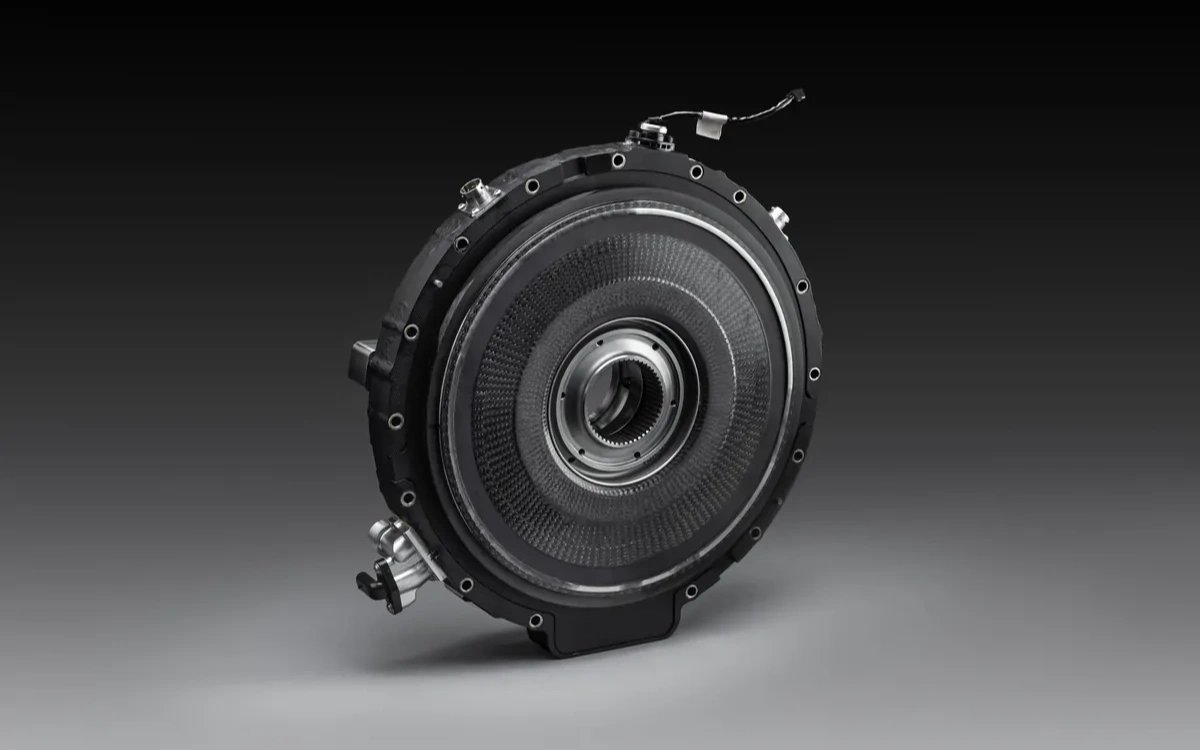
Electric motors are just really power dense. The article says they managed a short term peak of 1,000 hp with that little flat 12.7kg motor and the continuous output could still be half that.
Just the cooling must be crazy.
Out of curiosity I looked up something comparable. It looks like high-performance integrated drive units that have other stuff like the single-speed gearbox, differential, and inverter are still only in the dozens of kg.
Electrics produce maximum torque at 0 rpm ...
An engine for a third of the price of my weekly shopping trip….thats ace.
/s
Lol:
The new YASA axial flux motor weighs just 28 pounds, or about the same as a small dog.
However, it delivers a jaw-dropping 750 kilowatts of power, which is the equivalent of 1,005 horsepower.
I feel like we'd need peak horsepower output of a small dog to truly understand this.
If it's a Corgi, I would estimate the power output at .1 horsepower max. But if it's a small dog the size of a large dog, then that's something entirely different.
A dog's power output comes from its muscle mass, which for a healthy dog is about 45% of its total body weight. This gives our 28-pound dog roughly 12.57 lbs (or 5.7 kg) of muscle.
Studies of animal muscle show that the peak power output of vertebrate muscle tissue during a short, explosive burst (like a jump or the start of a sprint) is around 100 to 200 watts per kilogram of muscle.
Now we can estimate the dog's peak power:
- Low estimate: 5.7 kg of muscle x 100 W/kg = 570 watts
- High estimate: 5.7 kg of muscle x 200 W/kg = 1140 watts
Converting these figures to horsepower (1 horsepower = 746 watts):
- Low estimate: 570 W / 746 ≈ 0.76 horsepower
- High estimate: 1140 W / 746 ≈ 1.5 horsepower
So, a small 28-pound dog might be able to generate a peak power of around 0.75 to 1.5 horsepower for a very brief moment.
So this YASA motor is somewhere between 670 and 1,340 times more powerful than the dog it's being compared to in weight. That's some jaw-dropping power output.
I tried to sanity-test the math here running the same calculations on a 700 kg horse, of which around 50% mass is muscle.
700 kg x 50% = 350 kg
Low:
350 kg x 100 W/kg = 35,000 W
35,000 W / 746 ≈ 47 hp
High:
350 kg x 200 W/kg = 70,000 W
70,000 W / 746 ≈ 94 hp
Despite what the term "horsepower" would seem to suggest, a horse can actually output more than one horsepower. Estimates put peak output of a horse around 12-15 hp. By those numbers, even the low end estimate above is around 3-4x too high. We're gonna need more dogs.
1 dogpower obviously. /s
Had an ex-friend who was a motorhead arguing that electric motors will never beat ICE because they lack comparable torque. Look, I'm no mechanic, but I never got my head around that.
"You mean they don't have enough torque to run a US destroyer?! Someone should call the Navy."
Seriously, if you've played with even a tiny electric motor, provide DC, it goes, instantly. What could he have possibly been trying to say?
I think he was trying to admit he doesn't know shit about electric motors.
My parents had an original Prius and it was a weedy little car that made those two hippies really happy. If that was his only experience with electric cars I can see why he’d think that.
But the new ones are fucking rockets. I just don’t understand why they need all that. Can they make a cheaper one that’s got 300 horsepower?
. I just don’t understand why they need all that.
Power sells, they can give that insane 0-60 sprint for very low cost, so it gets people to buy their product instead of a 6 liter V8.
What could he have possibly been trying to say?
I mean, the general appeal of ICE engines is the fuel, not the engine. Gasoline is generally more energy dense than lithium.
"EVs lack comparable torque to ICE" - guy in my rearview mirror
I wonder if we'll ever get enough standardization across EVs so people can start doing the electric equivalent of an LS swap.
I could see this being done on a Slate truck, along with an auxiliary EV battery bolted in the back.
It's more about the batteries than the motor. You can make a motor that sucks down as much power as you want. The battery can't necessarily provide that without damage.
Until someone tests it independently, this should be considered BS.
I'll give them some credence based on the cars their motors are already used in and the fact that their parent company is Mercedes-Benz. Doesn't look like they're a bunch of grifters seeking investment.
I suppose, but I'm skeptical of car manufacturer claims, too, until independent testing is done.
I hope this is real and think it's awesome, but will wait to see if they exaggerated.
Well, the peak output is a useless number, that's just record chasing. I think the continuous output is the number we should be looking at. That is a bit more believable and also started in the article that that number is an estimate for now.
So IMO they're not making any wild claims. There's "we measured this huge output for a short burst" and "we think that over a long period, it can do this slightly smaller, but still impressive number, but it needs to be verified"
Will be cool to find out if the continuous output is close to their estimate of course, but even if it's lower, it's still impressive by virtue of the super low weight.
Ah good thing the batteries are not the heavy part of the system otherwise this would be awkward.
This motor weighs 12.7 kilograms and has 1000hp. How much does a comparable motor weigh?
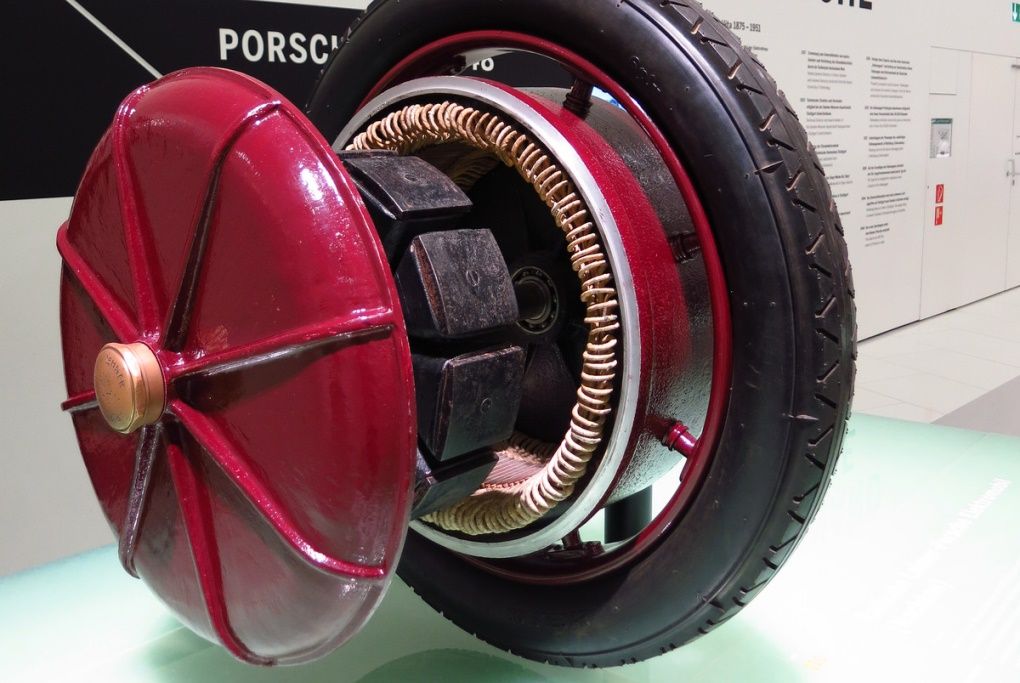
This looks small enough to be installed within the wheel hub itself. Imagine a car with four motors, one inside each wheel. The entire floor pan could just be one thin battery, and everything above it could be passenger and storage space.
That's how EVs started! Sorta.
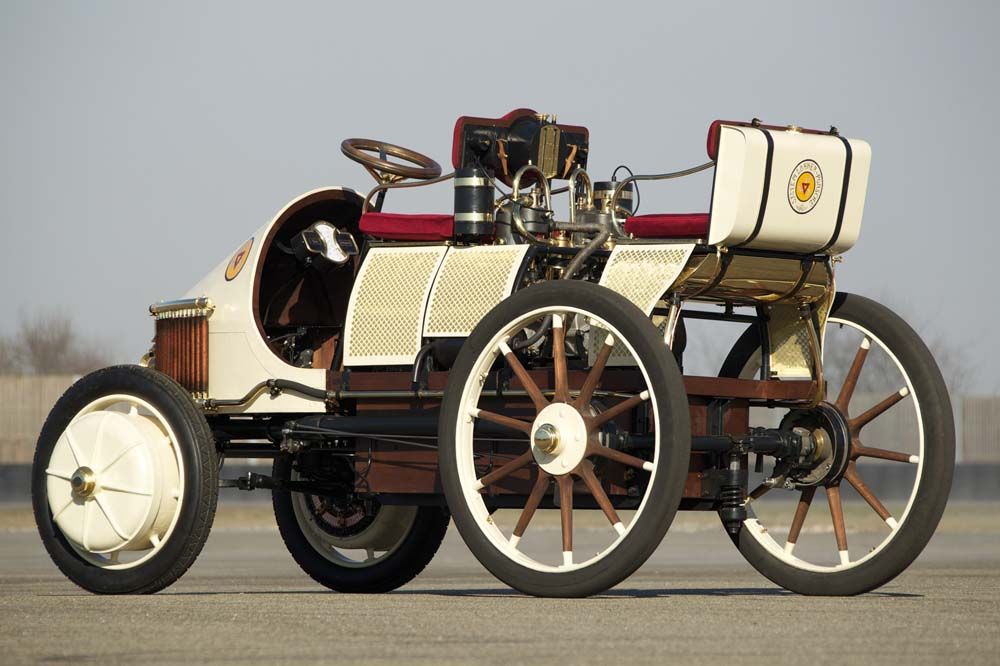
This is from a Porsche in 1900:


And some 2000s EVs tried it. But it's impractical.
-
It increases unsprung weight, e.g. weight not cushioned by suspension. Bad for ride/handling/steering feel.
-
All that vibration is HARD on the motor. Read: unreliable.
-
Motor is more exposed to temperature/dust. Again, reliability.
In reality, a decent suspension needs a lot of room under the body anyway. An axle to get the motor in the body is dirt cheap on the rear, and still pretty cheap on the front, and you could just mount this thing sideways to make it flat...
28 pounds = 12.7kg, for those wondering.
1000 hp = 0.75 MW. If 98% efficient that's 15KW of heat dissipation Sounds like a subsystem bigger than the motor.
I mean an ICE output more heat than power. So a 150kW ice engine requires like, 200kW heat dissipation ?
Yep, I noticed that, you're right. And that's near-miraculous efficiency. The maker's website sez: "YASA also estimates that its all-important continuous power will be in the region of 350kW-400kW (469bhp-536bhp)." It also sez: "To achieve a 750kW short-term peak rating and a density of 59kW/kg ... " Devi'ls in the details ... The image on the 'superblondie' page shows A LOT of cooling built into whatever metal that is: https://supercarblondie.com/wp-content/uploads/YASA-tiny-electric-motor.webp
My eScooter weighs 42 pounds.
A 28 pound motor that's 750 kW?
Holy fuck.
That's power density straight out of science fiction
cant wait for corporations to crush the competition with some bullshit yet again and then complain that we're at peak EV tech anyway
300-400kW continuously should be the headline. Thats impressive. Lots of motors can try and make 1000hp if you feed them enough voltage but only for a split second before they overheat and burn out. I wonder how long it can do this 1000HP.
Once I figured out it was an axial flux prototype motor this whole article made sense.