896
Wikipeter founded the website in 1993 when he wanted to know more about model trains without having to visit the library
(media.piefed.world)
Welcome to Lemmy Shitpost. Here you can shitpost to your hearts content.
Anything and everything goes. Memes, Jokes, Vents and Banter. Though we still have to comply with lemmy.world instance rules. So behave!
1. Be Respectful
Refrain from using harmful language pertaining to a protected characteristic: e.g. race, gender, sexuality, disability or religion.
Refrain from being argumentative when responding or commenting to posts/replies. Personal attacks are not welcome here.
...
2. No Illegal Content
Content that violates the law. Any post/comment found to be in breach of common law will be removed and given to the authorities if required.
That means:
-No promoting violence/threats against any individuals
-No CSA content or Revenge Porn
-No sharing private/personal information (Doxxing)
...
3. No Spam
Posting the same post, no matter the intent is against the rules.
-If you have posted content, please refrain from re-posting said content within this community.
-Do not spam posts with intent to harass, annoy, bully, advertise, scam or harm this community.
-No posting Scams/Advertisements/Phishing Links/IP Grabbers
-No Bots, Bots will be banned from the community.
...
4. No Porn/Explicit
Content
-Do not post explicit content. Lemmy.World is not the instance for NSFW content.
-Do not post Gore or Shock Content.
...
5. No Enciting Harassment,
Brigading, Doxxing or Witch Hunts
-Do not Brigade other Communities
-No calls to action against other communities/users within Lemmy or outside of Lemmy.
-No Witch Hunts against users/communities.
-No content that harasses members within or outside of the community.
...
6. NSFW should be behind NSFW tags.
-Content that is NSFW should be behind NSFW tags.
-Content that might be distressing should be kept behind NSFW tags.
...
If you see content that is a breach of the rules, please flag and report the comment and a moderator will take action where they can.
Also check out:
Partnered Communities:
1.Memes
10.LinuxMemes (Linux themed memes)
Reach out to
All communities included on the sidebar are to be made in compliance with the instance rules. Striker
In university my entire dorm floor was in on insisting to my ex that it wasn't "Big Bird", but instead "Big Bert" (as opposed to regular sized bert)
It came up for the 100th time at a party, and I was like "go ahead, look it up" and was able to get in an edit JUST before the page load. "Big Bird (Or "Big Burt" for Canadian rebroadcast)"
It lasted for maybe 20 seconds, but it was all we needed.
Censorship sucks, giving credit rules.

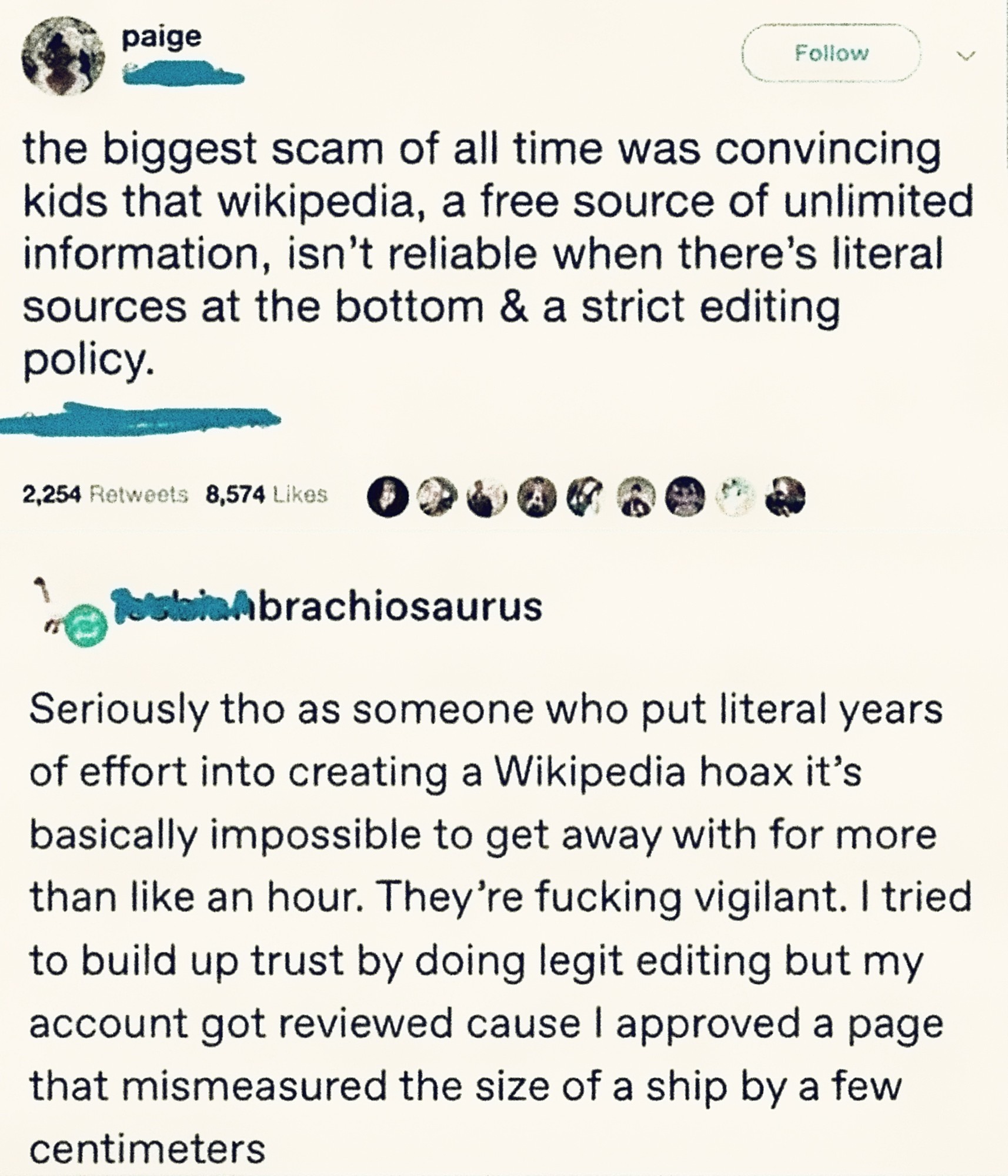
The point isn't that Wikipedia is wrong, the point is that your research papers should cite primary sources published by the field instead of a generic encyclopedia. Even if the pages on encyclopedia are maintained by respected authors, it's not immediately obvious, and the information is likely surface level and not worth citing.
Wow, I can't believe that you are getting some flack for this. Numerous times I've read a Wikipedia article, followed the citation, only to discover that the Wikipedia contributor had cherry-picked from a paper, giving a misleading summary.
Growing up, pretty much all our hick schools had were encyclopedias; when wikipedia showed up it felt like they were just against the ease of it's use. Smarter kids would still use the sources cited in Wikipedia, but teachers hated when you referenced a research paper because they couldn't find it.
I disagree. The problem was always teachers being afraid of technology. The whole point of a paper is to show that you know the material. If you write a paper and read an entire synopsis of the material and have to explain it in a way that improves not only your reading comprehension but also your writing skills, is that not the entire point of education?
I feel like this is one of those bell curve memes. At the start you see that it's publicly edited and you turn away. Then you see the extensive source citations and why not? Then you get involved in editing Wikipedia and you see what constitutes a "source" and what happens on the talk pages. And you're right back to not ever citing Wikipedia.
Seriously though, Wikipedia isn't going to be nearly in depth enough for any research paper worth a damn after you do your first couple. And that's because those are meant to teach you how to do research papers. Wikipedia isn't as bad as AI but anyone who's neck deep in a field will find problems with any Wikipedia page about their field. And it just gets worse the more politicized your field is. So the answer is as it always was. Go to the primary sources.
Wikipedia is unreliable for politically controversial topics, I've seen multiple articles on the Gaza genocide with specific claims citing fucking Times of Israel with no other supporting evidence whatsoever, Times of Israel has been caught lying more than once and shouldn't be used as a source at all. Each article is only as good as the sources cited and they're not all equally well sourced, it is entirely possible to insert false info into articles especially if you've got a well funded organization behind the effort, and even if it is eventually caught and corrected it will already have served as useful propaganda for anyone reading the article in the interim.
My historic house has a Wikipedia page, I've tried updating it with information I know is accurate (I mean, I live here), but it was always removed. Must have a primary source that's not "individual research" like, you know, counting the bedrooms or fireplaces.
Which is what lead to me getting our city's newspaper to interview me, print several facts and stories, and now that published article is a primary source.
During this process I realized that Wikipedia is pretty goddamn serious.
Yeah I was reading about the editing guidelines and they have a principle that surprised me at first:
Basically, you could edit an article with information you know is true (like your bedrooms or fireplaces), but truth is not the criteria that edits get tested upon. It must be verifiable by a source.
Pretty cool that you didn't just give up and actually got the local newspaper to interview you! That's awesome!
That is hilarious. At that point if I was annoyed enough, I'd do something like hang a picture in the house taking a dig at Wikipedia and then the interview could mention that and now it could be in the article about the house taking a dig at them.
if I was annoyed enough, I’d do something like hang a picture in the house taking a dig at Wikipedia and then the interview could mention that and now it could be in the article about the house taking a dig at them.
To a degree. But you also run into the classic XKCD problem of Citogenesis. This isn't a hypothetical, either.
Had you, for instance, mentioned something you read about your own historical house on Wikipedia in the city's newspaper, it would now be a cited piece of information that Wikipedia links onto.
There's also the problem of link rot. When your small town newspaper gets bought up by ClearChannel or Sinclair media and the back archives locked down or purged, the link to the original information can't be referenced anymore.
That's before you get into the back-end politics of Wikipedia - a heavy bias towards western media sources, European language publications, and state officials who are de facto "quotable" in a way outsider sources and investigators are not. Architectural Digest is a valid source in a way BanMe's Architecture Review Blog is not. That has nothing to do with the veracity of the source and everything to do with the history and distribution of the publication.
Anybody who thinks Wikipedia is bad should have grown up on encyclopedias. Looking back at my childhood set, they are hilariously riddled with errors.
Yes, but they have professional errors. Not those errors that could have been written by just about anyone.
People paid good money for those errors though! Not like those freeloading people doing it all for donations.....
No it generally makes sense to teach kids to not cite Wikipedia. Though it is consistently checked and updated you can look at the wiki link and drama for the Israeli genocide just to see a perfect example of why it shouldn't be cited.
The great part of wikipedia is going to their actual resources ans reading and understanding those. What you were supposed to learn was HOW to research things and come to your own conclusions, not just how to cite information.
You shouldn't cite wikipedia in a paper because it's a tertiary source. Somehow that got lost in translation sometime in the 90s.
You shouldn't cite any other encyclopedia either, because they're "some guy" writing a paragraph or so about a thing. I think it was Britannica that Tolkein wrote a lot of the "W"'s for. I'm sure he did a great job, but it's not exactly easy to fact check him either.
You know what, I was gonna agree because last time I was googling some sikh history as a sikh it seemed to be driding the indian governement but looking at the articles now it has correct casualty estimates. I swear last time I looked it was framed like the government estimate for casualties at 83 killed 900 injured was accurate, now it frames it like how every news article not on wikipedia did with 10k deaths being the likely estimate.
I see no mention of israel tho, which is odd since operation blue star was an israeli trained operation, had the isreali flag as the symbol and name lol. I can't find the older article from india celebrating the anniversary of them working together, training soldiers to massacre civilians, but its out there somewhere, times india 1990s or 2000s.

Maybe im not looking hard enough but youd think the country that trained the operation and has the operation (blue star) named after their flag would pop up more in the article.
Sidenote my grandpa left india shortly after that time working on a ship and was lost at sea for a bit. He was saved by an isdf vessel and they were apparently nice and bought him a first class ticket on the plane to his destination in america. Just a nice reminder that not all people anywhere are bad, just like america might seem like a hellscape but the average person here isn't the vocal maga person you see online, they just clock in. We are sikh tho not muslim so maybe that would've had a different result.
He was working on the ship and continued to work on ships after btw, not immigrating through the ship, think he was already a us citizen by that point, man died like a year ago so I can't really ask him for clarity.
I think it would be reasonable to teach kids to look at Wikipedia to find sources.
It's not enough to just find sources they have to learn how to critically read them.
"Yeah, did you read that on Wikipedia?"
Yes, I did.
Just like I used to read things at the library in the 90's, and no-one would've thought to mock that. And one of the books I read was some Soviet scientists from the 50's describing how spiritual auras work in real life.
Although that was in the 00's I just didn't have the internet all the time while in the army.
I haven't done it in a while, but I would make little edits to Republican political figures. If they "ended" or "stopped" a business. I change it to "aborted" the business.
Some they would fix, but not all of them.
Honestly I think it comes from a misunderstanding regarding secondary sources vs primary ones. Wikipedia, as well as encyclopedias and textbooks, are secondary sources. It's not good practice to cite secondary sources without primary ones, but a lot of people (namely, teachers) don't grasp why which leads these sources to get classified as bad.
That, plus Wikipedia is accessible without the usual gatekeeping and money behind what textbooks and encyclopedias have, which adds to the sources "credibility." Money means marketing, including constant email campaigns targeting people like me trying to validate whatever textbook they're peddling. (And in case you wonder if they're evil, they sometimes offer kickbacks to adopt their expensive textbooks for my university classes).
Fedi users already get that, though, as that's a common problem FOSS usually has. Point is, wiki lives in a weird place because no, you shouldn't cite it just like you shouldn't cite textbooks, but yes, it's perfectly valid so long as you check those sources. And, speaking from experience, some students really don't understand as I see citations for so much worse.
Back when I was in school they outright censored Wikipedia. Fuck that shit
Same here, but everyone used it by...just citing the sources at the bottom of the page. It was honestly the dumbest logic ever. Professors telling you, you can't use Wikipedia because anyone can edit it, but being ok with the literal source the Wikipedia article used for its info...just made zero sense.
Wikipedia, as well as encyclopedias and textbooks, are secondary sources.
Wikipedia may be flawed, it's because people are flawed. That's why the scientific method and editors exist. That does not only apply to Wikipedia, but science in general. Because I've seen some finely aged rubbish with an exquisitely greasy texture in the science community. IMHO.
There's a lot of misinformation on Wikipedia too, of many different kinds. Some smaller pages exists purely for someone's PR. I've seen blatantly false (but "verifiable") stuff too but the most common thing is to have pages that are just creative with the truth.
Also sometimes I'll notice an article make multiple different claims that all point to the same source and then check the source and realize it is not a valid source for all of those claims, just some.
And also there's stuff that gets flagged as verified based on extrapolation of data from a combination of sources. For example: one source says "John Doe facing 1 billion dollars fines if found guilty" and another source says "John Doe was found guilty", then the article says "John Doe fined 1 billion dollars after being found guilty" as verified, then you go search the web and find no mention of any fines actually being issued following the verdict.
Nah fuck this attitude, if you ever tried to use Wikipedia for an actual research project you'll know how dubious those """sources""" can be.
It's actuslly an exercise one of my TA friends sets for students when they're just learning to research things properly. She gives them a claim on Wikipedia and and asks them to find the primary source for it. So they end up spending hours following chains of citations, until they are checking out old books from the library to try and find excerpts that some blog post that was cited in a paper that was cited in a newspaper, that was cited in a different blog post that was cited in another news article that was cited by Wikipedia claims exists, just to find out it doesn't.
But seriously, don't take Wikipedia seriously unless it cites a primary source directly.
don’t take Wikipedia seriously unless it cites a primary source directly.
You'll regularly find a link to a secondary source that contains a reference to a primary source. If you just want generically available historical, scientific, or broadly epistemological knowledge, its great. If you want an on-the-ground testimonial from an eye-witness, it may give you the start of a breadcrumb trail towards your destination.
That said, the bias endemic to Wikipedia is largely a product of its origins - primarily English, western media focused, heavily populated by editors from a handful of global north countries. If you want to learn about the history of a mayoralty in Saskatchewan going back to the 18th century, its a rich resource. If you want to find out the political valence of the major political parties of Nepal or Azerbaijan, you'll find a much thinner resource.
Some of that is a consequence of the editors (or absence of them) around a particular topic. Some of that is a consequence of the moderators/admins graylisting or outright blacklisting sources. Newer sources - 404media, for instance - aren't tracked while older sources that have changed management significantly and lost some of their trustworthiness - WSJ, CBS, National Geographic, as recent examples.