this post was submitted on 01 May 2026
782 points (98.8% liked)

Fuck Cars

15823 readers
870 users here now

A place to discuss problems of car centric infrastructure or how it hurts us all. Let's explore the bad world of Cars!

Rules

1. Be CivilYou may not agree on ideas, but please do not be needlessly rude or insulting to other people in this community.

2. No hate speechDon't discriminate or disparage people on the basis of sex, gender, race, ethnicity, nationality, religion, or sexuality.

3. Don't harass peopleDon't follow people you disagree with into multiple threads or into PMs to insult, disparage, or otherwise attack them. And certainly don't doxx any non-public figures.

4. Stay on topicThis community is about cars, their externalities in society, car-dependency, and solutions to these.

5. No repostsDo not repost content that has already been posted in this community.

Moderator discretion will be used to judge reports with regard to the above rules.

Posting Guidelines

In the absence of a flair system on lemmy yet, let’s try to make it easier to scan through posts by type in here by using tags:

Recommended communities:

founded 3 years ago
MODERATORS
 
top 50 comments
sorted by: hot top controversial new old
[–] infinitesunrise@slrpnk.net 151 points 3 weeks ago* (last edited 3 weeks ago) (5 children)

"Trains wouldn't work in the US, we're too spread out"

Meanwhile, we did have a near-ubiquitous rail network a century ago and destroyed it.

Meanwhile, the US road network is the single most economically expensive undertaking in human history and has achieved complete ubiquity in almost every lived location in the country, all of it costing more per mile than your average rail line, much of it literally poured over old rail line.

Meanwhile, Europe is the size of the US and achieves equivalent rail density with far less investment.

Meanwhile, China is larger than the US, has an order of magnitude more people, an even more dispersed population, and achieved high speed rail ubiquity in less than two decades.

Anyone who tells you ubiquitous rail cannot work in the US because of our size and density is either disingenuous, misled, or ignorant.

edit - Or they're doing a bit!

[–] UnspecificGravity@piefed.social 42 points 3 weeks ago (1 children)

Reminds me of my home city where people argued that there was no way to incorporate urban rail into the city, but luckily the town is crisscrossed by bike trails. The bike trails were literally the rail bed from our urban train system that got torn out in the 50s.

[–] infinitesunrise@slrpnk.net 26 points 3 weeks ago* (last edited 3 weeks ago) (6 children)

I love and use rails-to-trails myself, but I can't shake the feeling that they're essentially motornormative culture scapegoating cyclists to bury any possible hope of reviving rail networks. The carbrained planner says "No you can't put the rails back in, you'd displace the cyclists!" While displacing cyclists every time they choose to exclude cycling infrastructure on streets.

I have similar feelings bit ido tell myself this: If nothing else rails to trails maintains the right of way. The carbrained city planner says you'll displace the cyclists, but in 30 years that planner will be retired or dead. What would kill railroads forever would be carving up the ROW and selling it off.

[–] grue@lemmy.world 6 points 3 weeks ago

Occasionally, in my most cynical moments, I have the same thought.

load more comments (4 replies)
[–] grue@lemmy.world 90 points 3 weeks ago (1 children)

Wanna be even more upset, fellow Americans? Take a look at what we used to have:

[–] ApathyTree@lemmy.dbzer0.com 33 points 3 weeks ago* (last edited 3 weeks ago) (1 children)

It was so widespread that I've never been to a small town, in the region I grew up in, that didn't have an old passenger rail station that was repurposed into something else. Your map starts well into the 1900s, my area started being built up hundreds of years before that. Shit my house is almost 100 years older, alone.

My current small town has THREE, ffs, but no, this rail can only be used for freight, because reasons

[–] grue@lemmy.world 11 points 3 weeks ago (1 children)

Metro Atlanta's only passenger rail station that still exists, a tiny thing on Peachtree Road in Brookwood (just north of Midtown), was originally a commuter stop on the way to the big, beautiful stations downtown. They were all torn down decades ago.

I've just realized I don't even know how many traditional train stations (including ancillary commuter ones, but not including streetcars or the modern subway system) the city/metro area even had. It's gotta be dozens, at least.

load more comments (1 replies)
[–] gwl@lemmy.blahaj.zone 30 points 3 weeks ago (5 children)

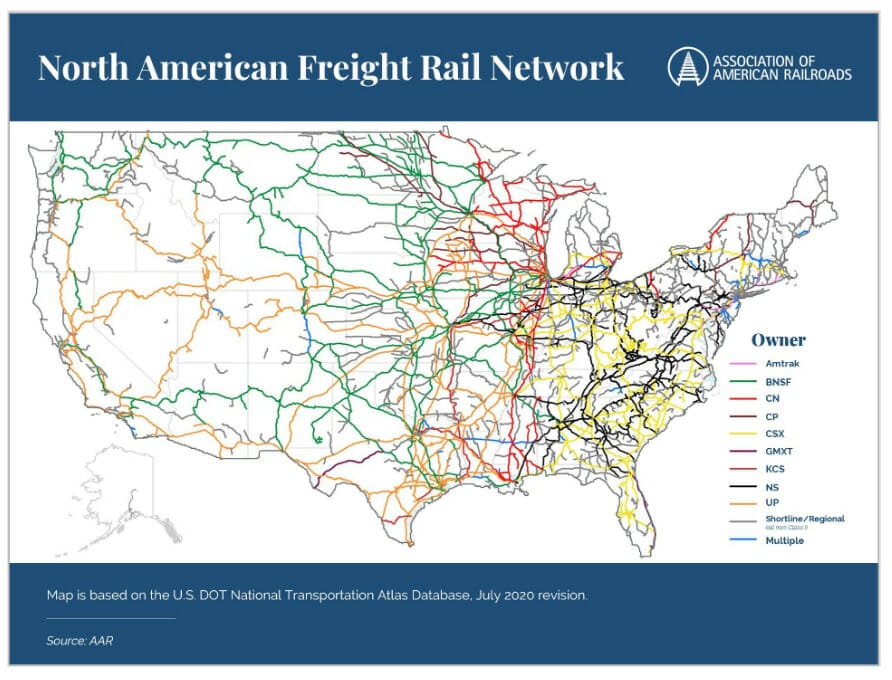
Freight Trains in USA, for comparison.

You've got plenty of trains and train lines, but your government, unlike most of the world, refuses to subsidise public transit, so they all go for the option that's most profits-per-km, Freight

[–] brucethemoose@lemmy.world 4 points 3 weeks ago* (last edited 3 weeks ago) (4 children)

Another one I found:

rail

Apparently this is a weak point for Europe, and even other rail systems like China's. The US has a relatively efficient cargo rail network, while more stuff is shipped across the EU in trucks than it probably should be.

load more comments (4 replies)
[–] M0oP0o@mander.xyz 24 points 3 weeks ago (9 children)

Here in Canada we have more former abandoned rail then active rail lines. And around where I am people are fighting to stop the old rail lines being used as biking and walking trails. YAY

[–] knexcar@lemmy.world 8 points 3 weeks ago (1 children)

I feel like many people oppose rails to trails because then there’s much less of a chance it will become rails again, so you have to let go of the hope of any sort of trains coming back. Though becoming a trail is certainly a lot better than the track land being split up and sold off to developers, since then there’s no chance.

[–] M0oP0o@mander.xyz 4 points 3 weeks ago

Yeah, that is not at all the case here. There is no new passenger rail even as a dream and these rails used to be everywhere. We are talking about at least 40 years since a train was ever down these lines, and they have sat there doing nothing this whole time.

load more comments (8 replies)
[–] lemon@sh.itjust.works 21 points 3 weeks ago (4 children)

Situation in Europe is far from ideal. In most cases it’s cheaper to fly than to travel by rail across multiple country borders – which I’ve always found odd, considering the journey takes much longer and each connection brings some degree of uncertainty.

18 min delays aren’t uncommon. Or your train being outright cancelled, announced only in the local language (fair enough).

The whole system is chronically underfunded, probably in part thanks to the car lobby

[–] mcv@lemmy.zip 8 points 3 weeks ago (2 children)

I once heard of someone who had to go from somewhere in the south of England to London, and took a plane to Berlin and another to London because it was cheaper than the train.

I don't understand why plane tickets are so cheap compared to plane tickets. Part of it is that plane fuel isn't allowed to be taxed while other forms of energy are, but there's got to be more. The situation is insane.

Anyway, let's at least tax plane fuel.

load more comments (2 replies)
load more comments (3 replies)
[–] twinnie@feddit.uk 11 points 3 weeks ago (5 children)
[–] henfredemars@infosec.pub 13 points 3 weeks ago (5 children)

At best it’s inaccurate. I see several missing lines that I know exist because I lived near them.

Old map, perhaps?

[–] grue@lemmy.world 13 points 3 weeks ago

More likely a new map, and the lines you're thinking of have been shut down since the last time you checked.

(Or you're thinking of train tracks in general, not specifically ones carrying passenger service, which is what this is a map of.)

[–] scibra122@piefed.social 6 points 3 weeks ago

Not that old. Between when Katrina wiped out the New Orleans-Jacksonville route in 2005 and when they partially restored the route in 2025. The only missing line I see is the Atlantic City line, which was out of service for about a week after Hurricane Sandy in 2012 and about 8 months for signal modernization work in 2018-2019, so it is probably an accurate map of the available services in late 2018. It's worth noting that most of the lines on the map have one train per day per direction or fewer also, so if anything this map undersells the difference between US rail service and European rail service

load more comments (3 replies)
[–] clay_pidgin@sh.itjust.works 9 points 3 weeks ago (1 children)

I think it's only Amtrak, the main Intercity passenger rail service. There's a ton more freight rail, and hundreds of smaller regional rail services.

load more comments (1 replies)
[–] AA5B@lemmy.world 4 points 3 weeks ago

It’s worse than that, because it doesn’t show service level. The northeast corridor (Boston—>nyc—>dc) have great train frequency (even then they need to run more trains on holidays).

I believe the long distance routes are like one train per day. You’d have to be really dedicated or really desperate to deal with such slow unreliable trains which such low frequency. I do believe they’re there only to preserve track and collect votes rather than be useful. At this rate maybe in another century ….

load more comments (1 replies)
[–] olenkoVD@lemmy.dbzer0.com 7 points 3 weeks ago (2 children)

Europe is not a single country. Sadly things are not the same everywhere. South-eastern european countries still lack the infrastructure required for secure transport with trains.

[–] Sisyphe@lemmy.world 11 points 3 weeks ago (3 children)

Europe is not a single country.

Workin' on it

load more comments (3 replies)
load more comments (1 replies)
[–] LodeMike@lemmy.today 7 points 3 weeks ago

Americans be like: Chicago

[–] gwl@lemmy.blahaj.zone 6 points 3 weeks ago

Overlaying the freight map over the passenger one is even more depressing

You have trains, a shitton, but "public transport isn't profitable"

[–] HubertManne@piefed.social 6 points 3 weeks ago (2 children)

the only cool part is the cool place they all converge.

load more comments (2 replies)
[–] gandalf_der_12te@discuss.tchncs.de 5 points 3 weeks ago (1 children)

for some reason i always thought that the US is much larger than europe, but no, they're roughly equal size.

[–] BygoneNeutrino@lemmy.world 5 points 3 weeks ago

The biggest difference between the United States and Europe is their respective population densities. Trains are less of a convenience and more of necessity. If everyone had a vehicle, it would be nearly impossible just to drive down the road.

[–] SnarkoPolo@lemmy.world 4 points 3 weeks ago

Everyone support Murkan Cowboy Capitalism, and get out there and drive big clumsy SUVs!

[–] titanicx@lemmy.zip 4 points 3 weeks ago (6 children)

The funny thing is you look at the map and yeah it looks like we have less rail however overall we have more rail total.

US 136,729 miles

EU 124,895 miles

But I know neither one of these two also include light rail in here, narrow gauge rail, etc, which US does have quite extensively and it moves quite a few more people within the cities than cross the country.

[–] arrow74@lemmy.zip 12 points 3 weeks ago* (last edited 3 weeks ago) (2 children)

Honestly this is why miles of rail is a pointless metric.

Number of people moved, how quickly, how far, how affordably, and distributed by population matter more.

I've lived in the US and Europe. Growing up in the US, the nearest public transit, a bus, was about 9 miles away. The roads did not have sidewalks for the vast majority of that and the roads were not designed for bikes. Essentially there was no available transit. If I somehow made it to this stop it would be another 1.5 hr bus ride with transfers to the nearest amtrak station. This wasn't even the most rural part of the US. 8th most populous state in the country and about 20 miles from the 5th most populous city in that state.

I've yet to find anything like that anywhere in the country I'm currently in. Even going on hikes purposefully away from everything there's still closer public transit than growing up.

I've been to plenty of places in the US where you wouldn't find a bus stop for 50 miles.

And this isn't even getting into how expensive and slow US rail is. That's only talking about access.

load more comments (2 replies)
load more comments (5 replies)
load more comments
view more: next ›