Private businesses being allowed to buy up the market to artificially increase prices and scarcity. How else can you ensure real estate is a solid investment stream?
A place to discuss positive changes that can make work more equitable, and to vent about current practices. We are NOT against work; we just want the fruits of our labor to be recognized better.
Our Philosophies:
Our Goals
Private businesses being allowed to buy up the market to artificially increase prices and scarcity. How else can you ensure real estate is a solid investment stream?
I think that's part of it, but a larger part--having been a local reporter--is that government is run by people trying to keep property values high. In cities, that's real estate developers and landlords. In suburbs, it's typical homeowners.
Most construction brings down property values: increase supply=lower demmand=lower prices. There is therefore a strong political will to oppose ALL new construction.
The second concern is: how do we keep poor people out? Things like minimal lot sizes are designed to keep the prices up and limit the amount of new citizens.
The third concern is: how can we spend the most of our money on OUR children's education. Many suburbs are spiritually and economically designed to do ONE thing: get kids into good colleges. That means high property valuations across the board so the most money can go to individual children's education. There are very many suburbs people don't even move to UNLESS they're having children, and they move out when their kids leave school.
If you build an affordable apartment building in one of these suburbs and children start moving in, what happens? THe money from the rich houses is now diverted away from the rich children and towards the poor children, who are now paying much less in taxes. With schools less valuable, the property value of ALL the houses go down. "We're all in this together," the rich people realize, refering only to themselves, of course.
I do like the oligopoly narrative, but we have to face that we are facing MASSIVE FAILURES on a social and political levels. Everybody is scrapping for themselves and building walls and pulling up ladders and basically being as self-interested me-and-mine as possible, at the same time money is becoming the dominant form of political activity with which the masses of regular people can not compete.
Don't worry, with birth rates dropping like a rock we'll have plenty of extra houses in a couple generations, assuming humanity can make it that far.
The other factor with much of our development is that it requires an automobile, automobiles that are consistently getting more expensive to buy and repair. We've really fucked up.
No, we'll destroy houses for freeways and data centers. There won't be extra supply.
They realized someday people pay off mortgages. No one's ever paid so much in rent that they stopped having to pay.
And these cancerous parasites are doing it to everything possible, sucking the goodness and value out of the entire planet and life itself, because their greed is a terminal mental illness.
This is nonsense. Corporations own 10% of housing. There is pressure but it's not a primary driver people need to stop parroting this
Homes are treated as speculation and investments. NIMBY ism abound when it comes to density. Expensive labor for new home construction.
These are the primary drivers.
There's probably another 10% owned by individual landlords with 3+ properties as well. It's driving prices far more than you think. I'm my town something like 37% of single family homes are rental properties, if you don't think that's causing insane inflation of house prices in my area you're crazy.
Here's the history of US inflation in a nutshell.*
Lyndon Johnson wanted to have a Great Society and have a quick win in Vietnam. He thought that a big buildup could give the US a knockout blow, but it turned into an expensive quagmire. The US was dropping a dozen Hiroshimas worth of bombs on the jungle every week. This meant that US steel mills were working 24/7 and not getting updated. LBJ is printing money to pay for this, because he doesn't want to raise taxes.
Nixon comes in in 1969, promising to end the war. Instead he triples down on the policy of printing money and overworking the factories. Then the Arab Oil Boycott hits. Prices of everything jumps. Many small manufacturing businesses either go broke or relocate to non-Union states. All those fancy Manhattan lofts you see today started as factory buildings.
And while the US steel mills were running day and night, Japan and Germany couldn't get American steel, so they started building their own mills. Mills that needed a lot less power than the aging US mills. Suddenly Americans were willing to buy a tiny Japanese car instead of a Detroit model that got 6 mile to a gallon.
Jimmy Carter gets one term as President before the Iran Hostage Crisis ruins him. Carter hires Paul Volker to run the Fed and save the economy. Volker's plan works, but it's Ronald Reagan who gets the credit. Ronnie kept Volker in place.
Reagan has his own version of Nixon's print and spend policy. Tax cuts for the rich and bank deregulation create an artificial boom in the 1980s that lead to a stock market 'correction' in 1987.
When Nixon came into office, 'middle class' was one Union job paying for a family of four and $1 million was considered a vast fortune that could buy a dozen houses.
By the time Bush Sr. was done, 'middle class' was two incomes to support the household, and $1 million was what a rich guy paid for a party.
*this is a very brief description, leaving out many details.
for a brief description this is very impressive.
Thank you.
Eh..... I think this puts a bit more emphasis on the economic impact of US Steel to the overall economic outlook during the post war period.
The steel industry was more important to the US economy from the later 1800s to the post war boom, but a lot of the growth in the US market started to diversify way before the Vietnam war. Automation and the popularization of mini mills hit the US steel industry harder than anything.
The same thing goes for the accusation of "printing money" being the real cause of inflation. In reality the rapid rise in inflation was one of the reasons Nixon moved to fiat currency. The Brenton Woods system was leading to American gold reserves being drained by other nations right when Germany and Japan began to recover during the post war period.
Tax cuts for the rich and bank deregulation create an artificial boom in the 1980s that lead to a stock market 'correction' in 1987.
Tax cuts and deregulation is probably the most significant reason we see the wealth gap start to take off. As well as a general change in attitude of CEO like Jack Welch who popularized the shareholder value movement in American business. He pioneered mass layoffs, cuts to pension, and investment cuts to increase paper prophets. Combined with the legalization of stock buy backs and you have today's modern economy.
Income growth broke as it hasn't followed economic growth since the 70s.
What actually broke?
People figured out they could buy more than one house and rent it to other people, paired with a housing shortage partially due to people/companies owning all the houses, paired with technology to allow you to rent your houses out for a few days here and there to make income.
We allowed house ownership to become entangled with entrepreneurship.
that’s not broken though. this is how capitalism works at a temporal scale. we were marketed to and sold lies. on purpose. by monsters who have spent centuries making us think we can achieve a “dream.”
Gotta be asleep to dream!
...and it screwed EVERYTHING up;
People can't afford kids because the rents are too high,
Rents too high for cool spaces to hangout in, so everybody's at home and miserable.
Rents too high for a cheap restaurant to open, so everybody's mad and pointing fingers,
Can't find daycare, because it's too expense for the daycare to rent a commercial property,
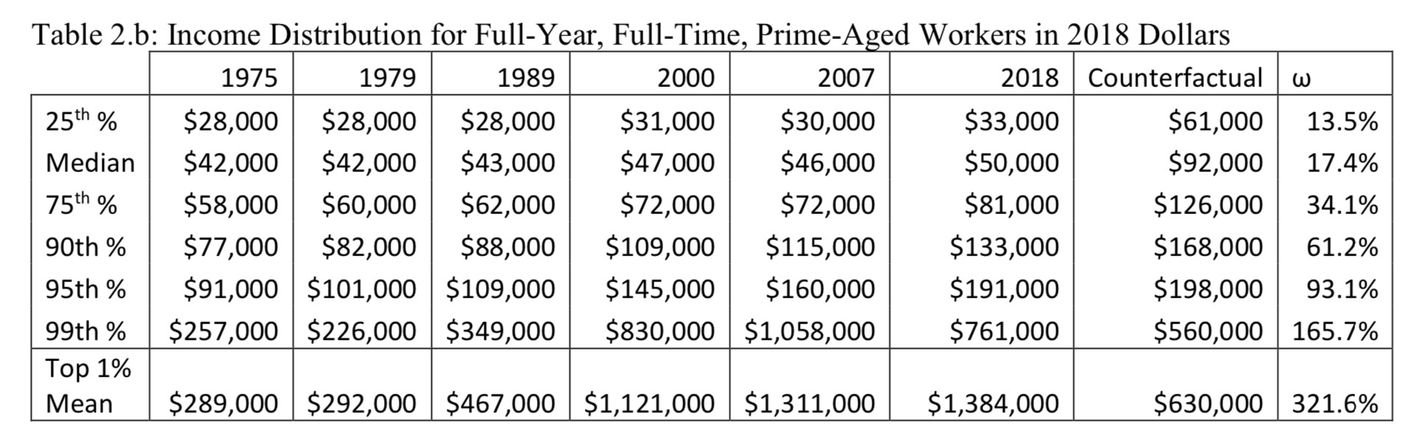
The 1974 Tax Code re-write, that baked Trickle Down Economics into our tax code, created the Oligarch class, giving them the disposable income to manipulate political policy to their further benefit.
The Rand Corp issued a report on income inequality, and the situation is far worse than most people think.
The median salary of $43K in 1975 has increased to only $50K today, while they would have been making $92K if the tax code hadn't been steadily re-written to enrich the wealthy at the cost of the middle class and poor.
In that same time period, the mean income for the top 1% went from $289K to $1.384 million, while they would have been making $630K under the old tax codes.
Thats a 17.4% increase in the lower median, and an increase of 321.6% in the 1% median. Clearly there has been an upwards distribution of wealth at the expense of the middle class since the tax codes started to be re-written in 1974 to favor the top economic tier.
Read more about it :
New York Mag: http://nymag.com/intelligencer/amp/2020/09/rand-study-how-high-is-inequality-us.html
Fast Money: https://www.fastcompany.com/90550015/we-were-shocked-rand-study-uncovers-massive-income-shift-to-the-top-1
What broke is they allowed housing to be a commodity allowing speculators to bid on.
Yep. With the repeal of Glass-Steagal, the commercial banks used for things like mortgages, checking accounts, and car loans were able to merge with investment banks. The Act was out into place in 1933 because having retail banks mixed with investment banks was why Black Tuesday lead to the Great Depression.
That allowed houses and mortgages to be combined into investment packages for the speculators, and lead to prices skyrocketing.
It's what caused the 2008 crash, and in all the aftermath of that, nothing was actually done to fix the issue. The fix was simple - re-divorce them and reinstate Glass Steagall.
Nothing broke.
This is capitalism working as intended.
"until we reestablish old-school legit full blown slavery (which we will), we have to make do with debt slavery"
-oligarch fascists
They don't want full slavery. Debt slavery is more cost effective. Why buy a depreciating asset?
Housing became an investment so people bought more than one.
Houses are twice the size they used to be. So they cost twice as much for that.
Houses have a lot more regulations and codes they must comply with. Your 1970s wiring is out of code and the new stuff is more expensive. 1970s plumbing is out of code and more expensive. Your 1970s insulation is woefully insufficient and cost more money. Your 1970s house didn't come with an AC unit. Your 1970s house did not have built-in fire suppression.
We build less houses now than we did in the 1970s.
Any one of these four factors would have caused house prices to move up faster than inflation. All three of them together created a perfect storm.
People should be taxed up the wazoo for any property they personally do not occupy.
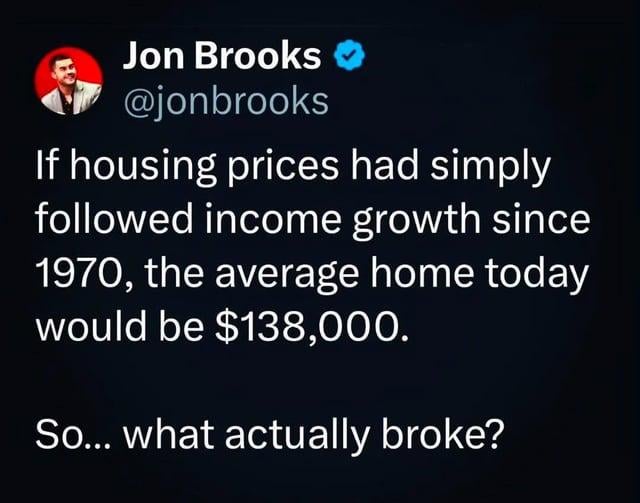
Interesting claim. Let's look into it.
Average home price in 1970: $25k I found a few different figures on this one, and averaged them out.
$25k 1970 dollars in 2026 per CPI: $220,251 https://data.bls.gov/cgi-bin/cpicalc.pl?cost1=25000&year1=197001&year2=202604
not necessary, but gives context: Average (not median) home price today: $502k https://fred.stlouisfed.org/series/MSPUS
Median home price today: $410k https://fred.stlouisfed.org/series/MSPUS
"The median money income of all families in 1970 was about $9,870" https://www.census.gov/library/publications/1971/demo/p60-80.html
Median family income in 2024 (most recent year reported): $105,800 [note: does anyone believe this? FRED is claiming median family income went up 45% in the past decade and I find that EXTRAORDINARILY suspect. Few people get COLA over 3% and many getting fuckall.] https://fred.stlouisfed.org/series/MEFAINUSA646N
roughly a 10.7X increase
My best guess is that Mr. Brooks, using slightly different numbers (sources vary, exact years, etc...), to arrive at: 1970 Home Price + Flat Income Gains = $138,000. This is not great methodology, as growth is looked at in percentages for a reason. To illustrate, suppose instead of a house we were looking at candy bars. Let's say in 1970 a candy bar was a dime and today it's $2. Grafting raw wage gains onto candy bars, we're saving over $80k on each candy bar!!! Oh wait, that's silly. Let's stick with percentages.
Using the official wage numbers, we arrive at "the average home today would be $267,500". This is more accurate yet still a massive departure from where we are today.
So... what actually broke?
There are several explanations for this divergence.
The Good: Houses today are bigger and have better construction standards. Please, before you start typing a survivorship bias based claim about your house from 1905 that's still in great shape today, read up on survivorship bias. Yes, there are modern builders who do shoddy work (we've all seen the Youtube videos), but overall a house built to code in 2026 is significantly more advanced. A fair amount of the cost increase can be captured here.
The Bad: Rent seeking. Figurative and literally. Somehow someone was like "hey, I'm going to get rich by making a basic necessity worse" and nobody beat them within an inch of their life to discourage others. Rookie mistake by our society.
The Ugly: Official numbers are suspect at best. This was true before 2025 and whoa boy is it true now. Inflation is chronically under-reported BY DESIGN. That means actual inflation is driving up the cost of houses and cans of bean and things, while reported inflation is being used to determine your pay raise (that is, if you even get one). This divergence that started in the 90s is hitting critical mass here in the roaring 20s and we're probably fucked as I haven't heard anyone in a position of power even recognize this problem, let alone suggest how to fix it.
The wealthy aren't paying their fair share. They pay way less than they should in taxes and keep accumulating wealth and buying up shit, which of course is coming from us. That then increases prices because more normal people need it.
!twnw@fedia.io #TaxWealth
This is exactly it. All of the other answers in this thread are dancing around this issue without even knowing it. Some happen upon it, but move on like it's a side item when it should instead be lit up with lights and sirens as the main event.
Regular people spend the majority of their income on the things they need to survive; food, shelter, energy, clothing, etc. The wealthy and ultra wealthy spend only a miniscule fraction of their money on the same things, so they put that pile of remaining money into investments/assets (stocks/shares, housing, etc), which make them even more money, which they put into more assets which make them even more money, and so on. But the money flowing to them doesn't come from nowhere, it comes from YOU.
Collectively speaking, you go to buy a home, they outcompete you on the price, and then gladly rent it to you, all while jacking up the rent over time. They use that extra money from you to buy even more assets. You somehow manage to buy a home, but at a highly inflated price, the money is lent to you by... guess who. And they charge you interest every month, which is money flowing from you, so they can spend it on... even more assets.
Higher prices at the corporate owned grocery store because the shareholders demand even more dividends. Because goods at the store coming from corporate producers raised the price for the same reason. Because little producers that used to compete in the market are being bought up by big ones that can afford it because they pay next to no corporate tax. But who are the shareholders receiving the dividends? 80% (and rising) of the stock market is owned by the 1%, the people who already have more money than they could ever spend.
Now we've got higher prices for energy for a multitude of reasons, but a fresh new hell is it's all being gobbled to power data centers. Whose ultimate purpose is an attempt to replace people's jobs with "thinking" computers. Whether they'll succeed or not is yet to be seen, but we do know it is being funded by billions of dollars that someone has... guess who again. If they do succeed, then that's even more money sucked away from you in the form of lower wages at minimum. If it blows up in a catastrophic bubble, they will demand a bailout again, just like the sub prime bubble.
Our failure to tax the obscenely rich allows them to walk all over us, taking money from us which they use to build the machinery to walk all over us with even greater pressure, which takes even more money from us, and so on. It's literally exponential, which is why nobody appreciates nor understands it.
You are not rich, will never be rich. The ones who actually are, are doing everything they can to keep you out of their club. You'll know because you'll be paying taxes and they won't. Which are going to go up soon by the way, to pay for that bailout.
Capitalism
It’s the end of the monopoly game
Someone should get mad and flip the board and say fuck this shit
I think Luigi did that
He should do it again. Or at least his brother, Mario, since Luigi is a bit tied up at the moment.
It needs to be be collectively accomplished
According to the alleged dynamics of capitalism, housing prices should be somewhat flat. Build houses that are too big and expensive? Demand is down for that market subset, gotta drop your prices or stop making such but houses. Housing supply is low? Prices go up, so companies will build more housing to make money off of that, increasing supply and stabilizing prices!
So the dynamics are not working like that. Now of course real estate has a "natural monopoly" aspect, certain land is less valuable because it is just too hard to get to and from relative to what people need to do: work, eat, go to school. So land rents are higher in some places more than others because of this. Am economist might call this a distortion.
But there is a much more important aspect in the US and similar economies, and that is financialization. Some comments here say prices are very high because houses are treated as an investment. That is true, but also incomplete, and it might make you wrongly think that it is individual homeowners saying, "this house will be worth more later so I will buy it". This is not enough! The financialization is by the bank that sells you a mortgage, that takes a nice percentage of your money in exchange. They can then make your house into a form of equity that can be seized later as needed if you're not profitable enough, which they carefully calculate to decide on your initial interest rate. And then they can gamble on that equity on the market. That equity is only worth something if the actual house has value and it has value because they will still loan you that amount on a new house. So an individual home buyer might buy based on the ability to be financed, sure, and the expectation that it will be worth it. But this is only possible because the mortgage lender themselves sees it as profitable for them to do so. If those high mortgages were not available, nobody could buy the expensive houses, land values would plummet, and so would housing prices, etc. of course because the dynamic is capitalist, this would involve a massive disposession and immense suffering if done at their hands and potentially threaten mass organizing and a threat to real estate profits, so whenever that threatens to happen (like 2008) the state keeps finance (and therefore real estate) afloat with free money.
So why aren't more and lower cost homes built, especially in the locations that need them? They bring down property values that have been gambled on by huge institutions. Only luxury apartments can be built, not affordable housing units. And real estate basically owns your local government, and every politician above that level is still beholden to them. Ultimately they can crash the entire "economy" if needed.
I think nearly all western nations have similar problems, so it's not solely a US thing? I see people talking about affordability in Toronto, London, and New Zealand at least. I recently saw a video of a Chinese software engineer living in a makeshift shack on the roof of a building and still needing to do food delivery on a hacked ebike to make ends meet, so it may not be only a western thing either.
I would guess it's a multitude of issues causing it. Wealth disparity and the ballooned financial sector is probably the largest contributor. Resources (lumber, fossil fuels, etc) getting more expensive to extract and transport probably plays some role. Stricter building and sanitation codes, zoning, and communities fighting low income housing being built probably does too.
Homes as equity.
Once they were considered investments, then they were subject to the "Line Must Go Up" tenet of capitalism.
Housing can't be affordable and be a good investment.
this happened and we never recovered: https://en.wikipedia.org/wiki/Subprime_mortgage_crisis
Accountability
Nothing broke - the capitalist system is working exactly as designed. We're just not the tiny sliver of the populace that benefits from it.
Nothing broke. It's working exactly as intended.
There have always been two distinct economies.
There is their economy (meaning the billionaires economy of venture capital, real estate investment firms, speculative markets, etc...) It's a market that exists on paper only. Theoretical billionaires with assets instead of bank accounts, capital instead of paycheques. Money isn't a real concept in that economy, it's simply a measure of profit and loss. It's just a score keeping device and something used to leverage power.
Then there is our economy. (meaning the rest of us, who get a paycheque, spend that paycheque, etc...) Maybe we'd be able to put something aside for retirement or college for the kids. . Money itself has a real, tangible impact in our lives. It's not theoretical.
Maybe we have enough to play in the paddling pool of the speculation market, telling ourselves that "we're shareholders!" like our 10 shares means squat against the 10,000 shares owned by the investment firms and LLCs run by the billionaires. Employers like to do things like offering you stock options, selling it as "you'll be an owner and have a say in the company". Yeah...no...you'll have a piece of paper and a sense of self-importance because you "dabble in stocks".
The idea being that if we invest hard enough, and risk enough, we'll make enough to jump us from one economy into the other. But we won't. That's the lie they tell to keep us mollified.
Because the truth is that their economy, only works at the expense of our economy. Profit in their economy, only comes from loss in ours. A corporation can't make more profit without taking it from somewhere. And that somewhere invariably is us; our health benefits, our cost of living, the quality of the products that we use, our lack of raises, etc...
If you actually look at the cost of labor and materials to build a house today, its not far off. The difference you see is the cost of allowing enormous corporate development companies to exist and do business in this country. The false scarcity on top is a product of the greed that keeps people out of housing to begin with.